
#On the Streets and the Cellars
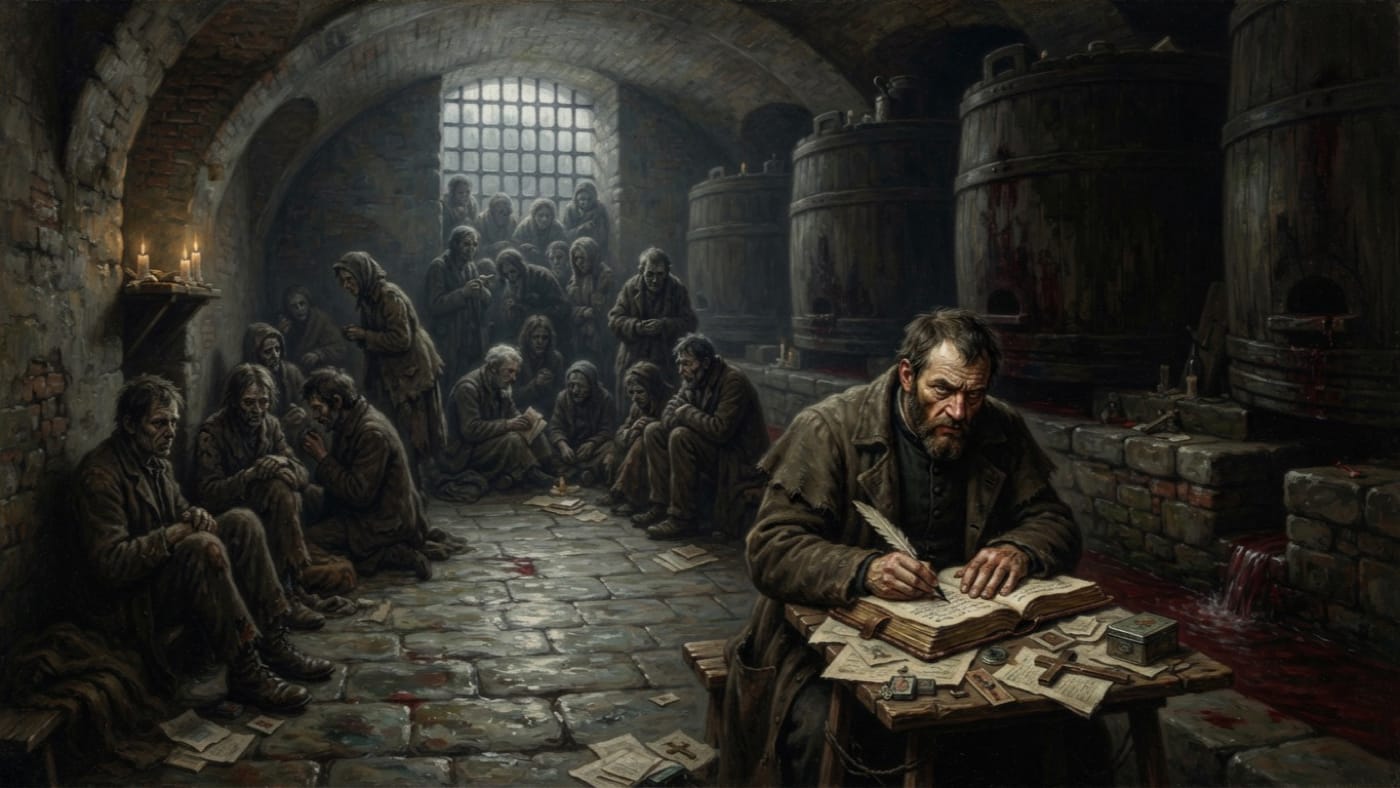
The Brewers' Quarter of Cologne is known to the Codex chiefly by what lay beneath it. Above were the breweries, with their vats, malt floors, barley carts and the warm sour breath of fermentation that hangs over any brewing street and stays in wool for a week. Below were stone cellars, cut to keep beer cold and the excise man ignorant. Below those ran the drains. In A.S. 34 the drains ran red.
That is the entry. The rest is commentary, and the commentary is mine.
The Codex holds no surveyed plan of the quarter. No street names have reached us in any source I trust. We have no boundary stones, no roll of brewery owners and no charter of foundation. A Records clerk once proposed to draw a plan "from atmosphere." He now counts hymnals. What survives is the inside of a single cellar, described by the man who lived in it. It had stone underfoot and one grating that let in air and street noise together. Tallow burned by ration. At night water moved through the foundations, a second congregation that would not stop muttering.
#On the Sixty Souls
Father Wernher was a defrocked canon. Between the Treaty of Regensburg in A.S. 30 and the Sundering in A.S. 45, he kept the largest confirmed congregation of the Cellar Saints under brewery stone in this quarter. At peak count it held sixty souls in one cellar. That figure belongs to the congregation alone. I have personally confiscated three Bureau pamphlets that stretch it to cover the whole quarter, and one that stretches it across all of Cologne.
Sixty bodies in one stone room produce heat, coughing, stench and arithmetic. The cellar had a single latrine trench. It breathed through a single grating, which made the grating both the most coveted seat in the room and the most dangerous. It was nearest the air and nearest the street, and so nearest any patrol that might hear a cough rising from a brewery wall where nobody ought to be coughing. Wernher kept a list of those forbidden to sit by it. He kept lists of everything: rations, watches, confessions, and candles by the inch. Another list named those permitted to know the entrance. It was shorter than the list of those who wished to know it.
Communion came weekly. The sacramental drink was brewed from stolen grain. In a brewing district that is less a miracle than an opportunity, and later examination judged the recipe to be strong beer. I shall return to the beer. The Bureau certainly did.
The first winter killed three of them. It was lung fever, which is what a damp stone room does to sixty sets of lungs while the Rationalist Republic patrols overhead with lamps and a philosophy. Wernher buried the three beneath the floor and entered the burials in his record. The congregation went on kneeling over its dead because there was nowhere else to kneel.
"Not one soul perished in Father Wernher's cellar." Schoolroom lives of Father Wernher, repeated in devotional primers.
Retracted. By Wernher's own entry, three died of lung fever in the first winter alone, and they lie under the cellar floor. The primers preferred a cellar where faith kept out the damp. The damp was not consulted.
#On the Crimson Water
The Red Flood of the Danube came in A.S. 34, two years after the Year Without Dawn, and ran for three weeks on its own river. Passau, Linz and Vienna had the boiling, the dead fish and the burned hands. Cologne sits on the Rhine, and none of that is recorded there. According to the accounts the Codex keeps, Cologne had crimson runoff moving through the sewer channels beneath the Brewers' Quarter. Those who lived against the foundations could hear it.
The congregation heard the water before anyone saw its colour. When they saw it, they whispered that the martyrs of Saint-Malo, slaughtered twenty-four years earlier, had found the river road back.
That is what they believed. I set it down as belief because it was belief, and because the sources give me nothing harder. No sample from the Cologne drains survives. The Republic's hydrologists were busy elsewhere cracking jars. None of them recorded how Danube water came to a Rhine sewer, or whether it did. None recorded what else might have turned a Cologne drain red in the same weeks that a river beyond the watershed was turning red in earnest. Nor does the record say how long the Cologne runoff lasted. The Danube cleared on its twenty-second morning. The Brewers' Quarter kept no such calendar, or none that has reached us.
The Saint-Malo reading deserves its due. By then those people had spent four years under the Treaty's prohibitions, cut off from every public bell, feast and office of the Church. They had no martyrology on the shelf. They carried one in memory, and when water ran red under their feet, memory supplied the name. Doctrine has declined to say whether the Creator sent the blood of Saint-Malo by way of a Cologne drain, and I am forbidden to. The documented fact is that the faithful in that cellar heard it so, and that is a better fact than most.
#On Carriers and Census Paper
The quarter's cellars were not sealed boxes. As the Thread accounts describe Wernher's practice, each link had two contacts and no more: a feeder and a receiver, never the whole route. A captured member could give up a door. He could not give up a network, because he had never been shown one. Messages travelled in the ordinary commerce of a brewing district. Beer invoices left the quarter carrying quantities that were either bad bookkeeping or liturgical code, depending on who held the key.
The best evidence of that contact is two lines in Wernher's journal. In A.S. 33 he records "Ig. B., arrived from the south, thin, carrying communion wafers in a tobacco tin." In A.S. 41 the same man has become "the Carrier, who brings what we need and asks for nothing." This is Ignatius Brenner, who supplied the underground and commanded none of it. He came through the quarter. He did not keep it.
A warning to the pilgrim trade. The apostolic bones that Brenner carried across the river in A.S. 31 went to Aldric Hartmann's crypt beneath a different brewery, in Deutz on the eastern bank. They were never in the Brewers' Quarter. There were two breweries and two cellars, with the Rhine between them. I have seen devotional map-sellers merge them, and I have yet to see one corrected.
Wernher wrote the journal itself on the backs of Rationalist census forms: forty-seven pages of a priest's register laid over the Republic's own columns. The Republic counted Cologne on one side of the paper. Wernher counted it on the other, and got a different result.
#On Emergence and What Was Filed
On 1 November A.S. 45 the Sundering broke the world. In Cologne, according to the surviving record, the smaller bells that the Rationalists had failed to melt rang without hands. Wernher's final entry reads: "The bells. At last."
The faithful climbed out of the cellars into a Republic that was failing unevenly, street by street, with no one yet certain who governed any given street. In that interval the hidden Church became a public one by walking out of the ground and refusing to go back. The formal Synod was forty-five years off. The Brewers' Quarter did not know that. It knew the bells.
Then came the filing. The Bureau of Records holds the journal in Strasbourg and permits one supervised viewing a year, on the feast of Saint Ignatius. Brenner thus outranks his chronicler in death, as he never did in the cellar. The Cellar Saints received provisional recognition in A.S. 92 and collective canonisation in A.S. 104. Wernher's own cause went forward alone and stalled in A.S. 187, when the Bureau of Relics reviewed the sacramental recipe and pronounced it very strong beer. Doctrine thought the beer theologically neutral. Relics reserved judgement. Common speech calls him the Blessed Wernher, and the folios call him suspended. Nobody calls him Saint Wernher in my hearing twice.
Of the cellar itself the Codex knows nothing current. The Bureau holds the journal. It holds no survey of the stone the journal was written under, no report that the cellar still stands, none that it was filled in, and none that anyone has gone down to look. Pilgrims are directed to the glass case in Strasbourg, which is dry, well lit and has an excellent grating.