
#On the Name and the Years
The Breach Plagues are filed in the plural, and the plural is the first honest thing about them. Between roughly A.S. 110 and A.S. 115, 1820 to 1825 by the reckoning the Rationalists would have preferred, the towns of the forward territories suffered a series of communal violent outbreaks. The Bureau of Oaths refused to file them as ordinary riots. Its indices pin the matter to A.S. 112. The Registry put its card on that year because it had to put the card somewhere. Anyone who tells you the Plagues ended in 112 has mistaken a filing date for a funeral.
I keep two facts in separate drawers. In the first: neighbours turned on neighbours, in streets the surviving records seldom trouble to name, often enough and close enough together that clerks began to speak of contagion. In the second: the Bureau's explanation that the violence was spiritual rot, bred by broken oaths left lying unburied in one district. The first drawer holds the dead. The second holds a theory, and the theory happens to favour the institution that proposed it. I hold the keys to both drawers. I do not mix their contents.
#On the Bonds That Broke
A Synodal town of the period was a heap of promises stacked in a cold climate. Every marriage lay in the Ledgers under scarlet wax. Every guild bond tied a journeyman to a master and a master to a workshop's claims. Every debt covenant carried its conditions in a Witnesser's hand, along with the penalties and the name of the bailiff to be notified. Every recruit had sworn the Oath of the Line before a cord-sash in a barracks doorway. Under these lay the street truces, the sworn arrangements between quarters and trades and families that kept a district from settling its quarrels with iron.
The Witnessers recorded each of these bonds as Bureau practice required: the wording, the conditions and the cadence. That is the trouble with a well-kept record. A breach can be proved, and the injured party knows where the proof is kept. A widow can read the clause that should have protected her. A creditor can quote the term the debtor failed. Both know which chapel holds the entry. When a marriage dissolved in contempt, the house stood in trespass. When a guild bond was forsworn, a workshop's labour stood in dispute. When a truce failed, the street had men on both sides of it who remembered the exact words.
The Forgery Years had already taught the Bureau that a district full of contested vows was a district full of knives. The Widow-Bond Scandal had taught it that its own instruments could be turned to predation. Custom already buried broken promises in various ways, depending on the chapel and the Witnesser's patience. The Plagues found that custom inadequate.
#On the Diagnosis
The Bureau's position, which it maintains to this day and at considerable expense, is that an unburied oath festers. A broken promise that has not been named, closed and struck through is held to poison the ground on which it was first spoken. When too many such breaches accumulate in one district, Bureau doctrine says the result will be violence, disease or, in the worst cases, manifestation. The Breach Plagues were read as the first proof at scale.
The argument has an elegance I admire as a professional. It explains the dead and names the cure, and the cure is the Bureau's own ink. A theologian could not ask for more efficient reasoning. An auditor might ask for less.
I note what the record establishes. It shows violence clustered in places dense with sworn obligation, and it shows the Bureau attributing the clustering to rot. It does not establish a mechanism. It names no demon working the streets of 112, and it describes no confirmed manifestation sitting among the rioters. The Bureau of Records counted bodies where it could and declined to classify their cause. The Bureau of Doctrine read "rot" as a figure of speech, while the Bureau of Oaths' enforcement clerks read it as a description. That division survives in every catechism since. The rot might have been a substance, a metaphor or something hungry with good penmanship. The sources I am permitted to cite do not say which, and I will not supply a monster to fill the gap.
#On the Funeral of a Promise
Out of the Plagues came procedure. The Bureau formalized the Breach Rites and created a specialist rank to conduct them, the Breach-Rite Witnesser. Breach-Rite Witnessers stand at the top of the profession, beside the High-Bond Witnessers, and they are the only officers of the Bureau about whom other Witnessers make no jokes.
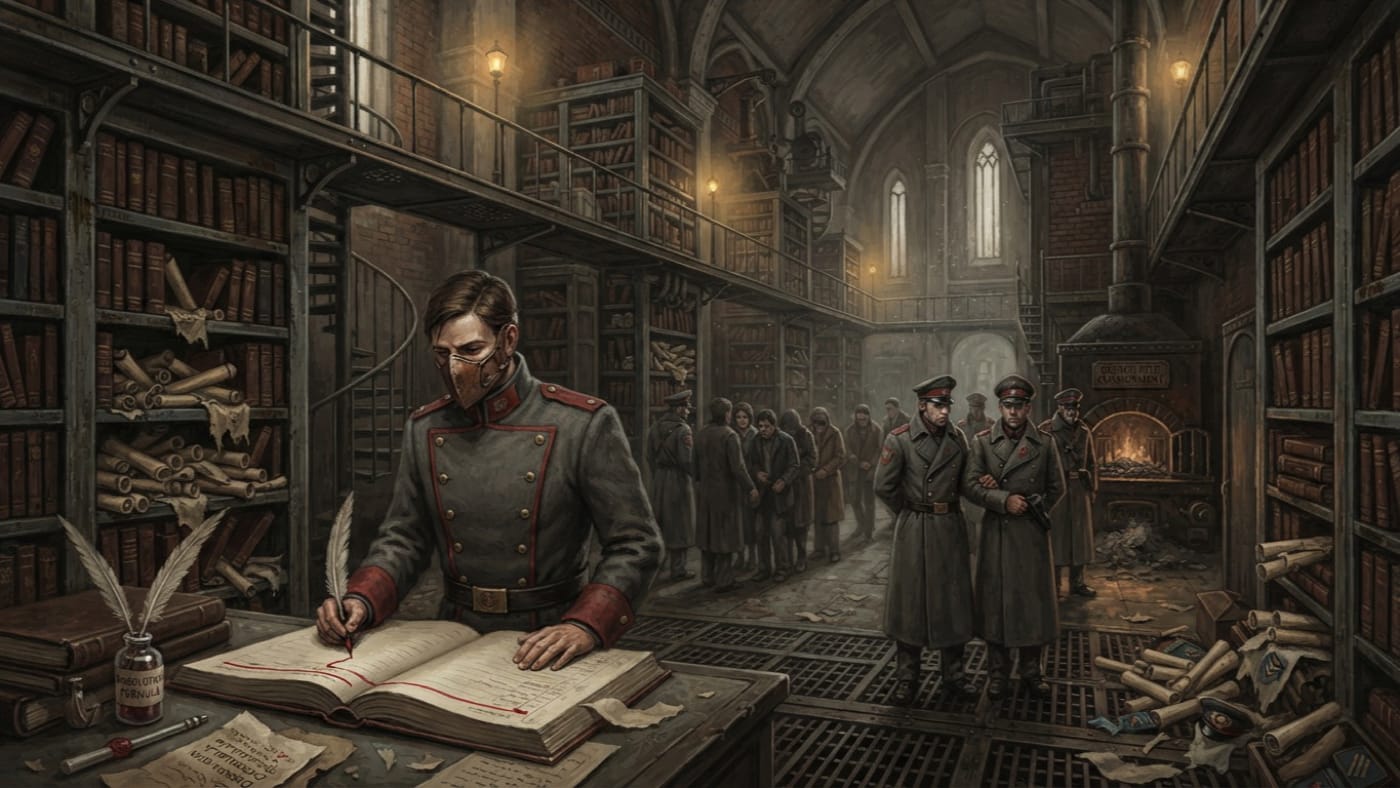
Their own definition of the rite is "the funeral of a promise." The structure is fixed. The broken oath is named aloud and its parties are identified. The Witnesser speaks the Dissolution Formula. Then, while the parties watch, because they must watch, the Witnesser draws a single horizontal line of red ink through the entry in the Ledger. The original remains entirely legible beneath it. The Bureau voids an oath and keeps the corpse on file.
The materials vary with the kind of vow. Military oaths are buried with iron and ash, marriages with water and torn cloth. A guild betrayal requires the original token to be destroyed in a sanctified brazier, and the wax spits as it goes. The trade adds smaller furniture of its own: a half-mask worn by some officers during the rite, a tiny wax seal held under the tongue, salt sachets in the inner pocket and grave soil under the nails afterward. These are recorded habits of the profession. I cannot certify that each of them was born in A.S. 112. The Bureau's histories present the whole rite as a product of the crisis. Its older folios suggest some of the furniture came earlier. I report both accounts and endorse the more flattering one, as my office requires.
Formalization brought uniformity. A breach in a coastal parish and a breach in a Heartlands guildhall could now be closed by the same words, with the same line and the same filing. Formalization also gave the Bureau a standing reason to stand at every bad ending, as it already stood at every beginning.
The outbreaks did not stop on the day the first red line was drawn. The indices close the cluster around A.S. 115. The Bureau credits its ink. The Bureau of Records credits nothing, which is its habit.
#On the Soldiers Who Stay Sworn
The Plagues left their longest shadow in the army. In their aftermath the Bureau formalized the Trench Last-Oath Doctrine, under which a soldier's oath of service binds beyond death. The record gives no exact year of approval beyond "following the Plagues", and I decline to invent one.
The logic follows from the diagnosis. If an unburied breach rots a street, a regiment of half-closed vows would rot a trench. The Bureau therefore keeps the dead under contract. A ghost that lingers remains sworn. At several bastions, according to Bureau report, a name has reappeared on a roster, and that name remains under Bureau jurisdiction. The doctrine does not say that every dead soldier returns, and the Bureau has never claimed the dead caused the Plagues. It simply refuses to recognize death as grounds for terminating a contract, which the Bureau of War considers a sound principle of recruitment.
The military Breach Rite and military punishment must be kept apart, because the Bureau's critics merge them for effect and the Bureau merges them for convenience. The rite buries the oath. Iron and ash, the Formula and the red line close the record. The Martial Code deals with the man. A soldier who breaks his oath is gagged and buried alive, and his silence is notarized as his final testimony. That penalty belongs to soldiers alone. It does not extend to failed marriages or defaulted debts, and no record I have found counts how many soldiers it claimed during the Plagues. The Bureau calls the penalty "rarely applied in the present era." I have read that sentence many times, and it has not grown more reassuring.
#On What Remains Filed
The Plagues are the Bureau's founding argument for compulsory closure. "Breaks must be buried" was a Witnesser's proverb before them. After them, the Bureau could treat a breach left unritualized as a public hazard rather than a private failure. That is my one "not this, but that" for the page, and I spend it there deliberately. Every Breach-Rite Witnesser fasting on Saint Liora's day, every volume of the Ledger of Dissolved Compacts and every red line drawn under the vaults of the Basilica of the Ledgered Saints descends from those years. They are also why the Bureau can demand a funeral for promises that no one else would have mourned.
Older indices group two other catastrophes of A.S. 112 with the crisis: the Brine Fever Winter at Saffron Bastion on the Adriatic coast and the Dust Fire at Grain-Gray Wexel in the Heartlands. Each turned disaster into administration. The fever left Saffron its Quarantine Prefecture, and the silo explosion left Wexel a Prefecture of its own. Neither town's history calls its catastrophe a Breach Plague. I cite them as contemporaries and nothing more. Grouping them with the outbreaks would turn coincidence into evidence, and grouping is how both prefectures got their charters in the first place.
Earlier indices recorded Quarantine Prefectures established at both Saffron Bastion and Grain-Gray Wexel in A.S. 112.
Wexel's authority is a Ration Prefecture, installed after the Dust Fire. Only Saffron's is a Quarantine Prefecture. The Bureau of Records regrets that two prefectures were filed under one title. It does not regret the prefectures.
No founder ever stood over these ledgers. Both had been dead for a generation before the first line of red ink was drawn. The rites belong to the Synod that the Concordat of Strasbourg built, and they are administered within earshot of the bells of Strasbourg Cathedral. The Bureau of Bells once offered an opinion on whether a district's peals could carry rot. That memorandum has been struck through. It is still legible.