
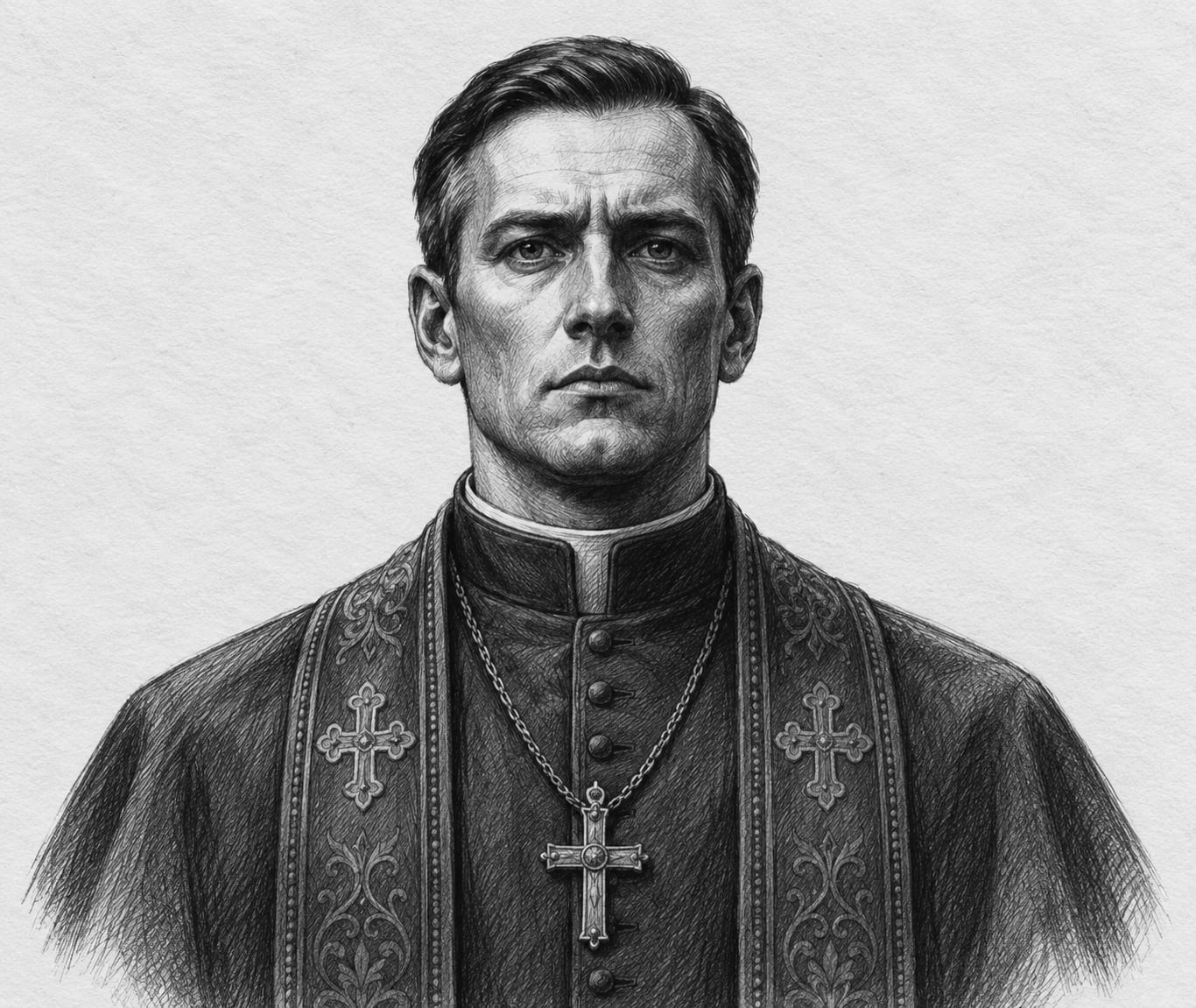
#On the Name and Station
Bishop Marek of Vyšehrad survives in the Ledger as a name, a title and a place, written in the seventh line of a roster that cannot agree with itself. Some copies of the roster for the Night of Crowns put him there. Others put Auxiliary Ilen of the Lesser Quarter in the same line, in ink just as firm. The Bureau of Records holds Marek's name because a list wrote it down, and it holds nothing else of him that a list did not write.
Readers want more, and they always do. They want a see and a consecration day, a cathedral stall with his initials worn into the oak, a mother weeping at the vesting. The copies give a title, Bishop, and do not say who conferred it or in what year. They give a designation, of Vyšehrad, the old rock above the Vltava, and do not say whether it marks a chapter, a household or a scribe's convenience. I have arranged this dossier around what the vellum asserts and I stop where the vellum stops. If I furnished a man out of plausible episcopal furniture, the result would be a forgery. Records already holds two forged recantations from that evening, which is enough.
#On the Seventh Place
The evening itself is settled. In A.S. 8, before the old university hall in Prague, seven bishops took off their mitres in public while a crowd cheered, and the minutes record the reason as "the demands of reason." Prague was then under Rationalist administration. The formal Republic would not be proclaimed for another twenty-two years, until Regensburg, but the clerks of that administration already knew how to stage a crowd. The Bureau of Doctrine teaches that seven mitres fell, and the primers say seven.
The seventh place has never been settled. From that night Records inherited three incompatible lists, two forged recantations, one Rationalist commemorative programme and a cathedral death-roll amended in a hand later found to belong to no known scribe. Marek stands seventh in some of these documents and Ilen in others. No copy calls either name an alias of the other. No copy makes the two men rivals or puts both of them on the steps. They are competing readings of a single line. Every warden who has held the drawer since has wanted that line to choose, and none of us has been able to make it.
The Bureau of Silence offers a third reading and names nobody at all. Its sealed appendix calls the seventh the one who kept the crown. The phrase is assigned to no one. I will not hang it on Marek because it would suit him, since an epithet is not a cope to be draped over whichever bishop happens to be nearest the vestry.
Witnesses split over the gesture. Some say the seventh took off his mitre with the other six. Others say he lifted it, paused and set it back on his own head, and that the crowd's roar swallowed the moment before anyone thought to write it down. The Rationalist programme declares that all seven complied. The later death accounts declare that all seven were punished. Both documents are unanimous, and neither so much as glances at the question of who stood seventh.
#On the Crown and Its Copies
One witness tradition gives the seventh a voice. It is recorded here exactly as it was filed, under the warrant of the Bureau of Silence.
PRAGUE WITNESS FRAGMENT, FILED A.S. 92 The seventh looked toward the cathedral roof and laughed: low, dry, wholly misplaced. He said, "You will need these when the mouths open." Then ███████████████████████████████████. The pamphlet copy omits the line. The cathedral copy preserves a burn mark in the shape of a ring.
The fragment is dated by its filing in A.S. 92, and that date belongs to the filing alone. It speaks of "the seventh" and never names him. If Marek stood seventh, the laugh may be his. If Ilen stood there, it is Ilen's. If the Silence appendix describes someone else again, the line belongs to a man the Ledger has never met. I record the warning, the redaction and the ring-shaped burn as attributed testimony. I do not explain any of the three. The roof is not explained either, and readers who write to ask which roof it was may write to the roof.
The mitres themselves passed into Rationalist custody. They were catalogued, and each was given a tag and a lecturer's note before being packed for the travelling exhibition The Voluntary Abdication of Superstition, which visited Vienna, Amsterdam and Regensburg and then three provincial halls that the record leaves unnamed. Whatever the tags said, no mitre in the Ledger has been sorted to Marek's name. The Rationalists displayed bishops' crowns as a group, and a group needs no owners.
The mitres vanished during the A.S. 30 consolidation inventories. After the Treaty of Regensburg, the Bureau of Relics claimed three fragments recovered from a Viennese storage crate. Their status is unratified and contested. None is ascribed to Marek. None is ascribed to anyone.
#On the Received Disposition
The Bureau's primers are firm about the end. When the Sundering broke on 1 November A.S. 45 and the Rationalist certainties began to fail in the cellars and the bread lines, Prague's congregations turned on their fallen shepherds. All seven bishops of the Night were devoured by their own congregations during the Sundering Panic of A.S. 45–48, which is thirty-seven to forty years after the evening at the university hall.
Marek's share in that sentence depends entirely on the roster. If his is the true seventh name, the disposition covers him. If Ilen's is, then Marek leaves the account of the Night altogether and takes the account of his death with him, and the Ledger is left with a bishop's name and no event to attach it to. Records holds no death day, parish of death, burial or authenticated remains for him. A collective fate can be applied to a man only when he is first proved to belong to the collective. Until then the sentence stays in the plural, where it was written.
An earlier instructional broadside held that the seven bishops were eaten on the Night of Crowns itself, so that one evening's roster would have served as one evening's death-list.
Withdrawn. The congregations did their work across the Sundering Panic, A.S. 45–48, parish by parish and cellar by cellar. Nor does a forty-year interval let Records copy a contested name from the first list onto the second as though the matter were settled.
A reader who presses for a scene, with Marek's last words and the parish and the hands that did it, will find nothing written. I add none of my own. A Warden who writes in a dying man's words to fill a gap in the record ought to be fed to a congregation himself.
#On the Ledger's Use
Doctrine and Records keep the same evening for different purposes, and the difference is the whole of Marek's dossier.
Doctrine needs a lesson that can be repeated. It teaches the Night beside the Desecrations as apostasy performed through authorised mouths: seven mitres, one basket and a crowd taught to applaud. That lesson holds for every child in every primer, whoever stood seventh. A school card needs seven heads and a basket. It has never needed a signed register, and Doctrine has never asked Records for one.
Records has to hold names, and in the seventh line it holds two names and an unnamed phrase. It ranks none of them. It keeps the lists, the recantations, the programme, the amended death-roll and the filed fragment. It labels the drawer disputed and seals it sound. This is the Bureau's oldest economy. A contradiction filed costs a little wax, while reopening Prague would cost a Warden his ease and probably a Bureau its pride.
Prague itself has since been taught other spectacles. Condemned heretics are now walked across Charles Bridge under the Order of Saint Ephrath, and the city watches them in silence. Marek did not found those processions. He did not sponsor them or provoke them, and no record joins him to them. They are mentioned here because the crowd that watches in silence descends from the crowd that cheered, and the Ledger keeps both.