
#On the Warrant and the Standard
"The bell does not ask what time it is. The inspector tells it."
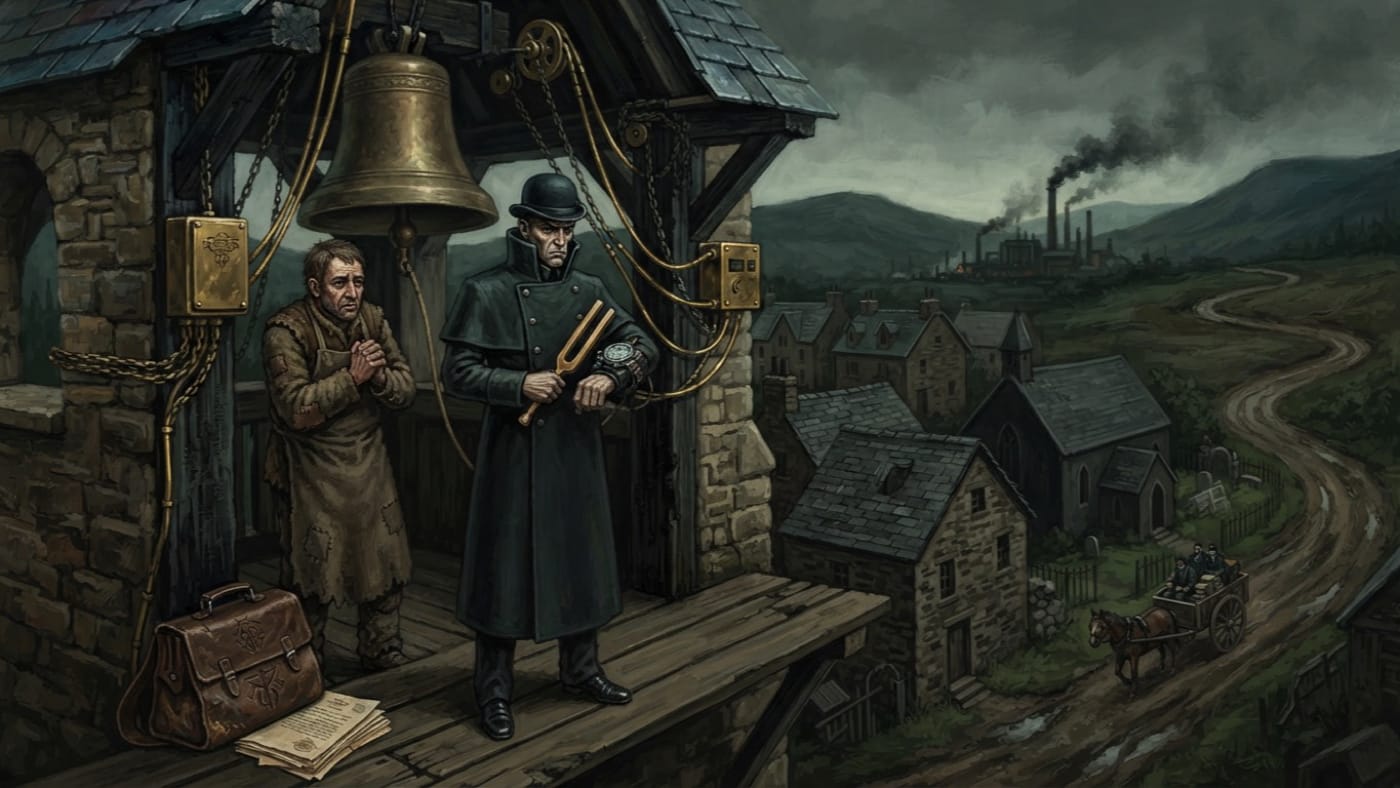
The Bell Inspector is an agent of the Bureau of Bells who goes from parish to parish with two instruments and a grievance. The instruments are a calibrated tuning fork and a sanctified chronometer. The grievance is everyone else in Europa, who would still be ringing by local appetite if the Bureau left them alone: a sexton who rings when the soup is ready, a curate who rings when his sermon runs out, a foundry foreman who rings because his men have hands and the rope is there.
The standard is simple enough to be cruel. In Strasbourg the Grand Carillon of the Cathedral divides the day into eight canonical hours. Every tower in the Theocracy must sound within seven seconds of Strasbourg's toll. Noon struck at 12:00:08 is a bell that has acted on its own, and the parish will have to explain it to the Bureau. The Bell Codex keeps this tolerance "unless dispensed," and dispensations do exist: authorised local addenda, seasonal corrections and emergency supplements, each filed and each sealed. The inspector honours every one of them, after reading it twice.
He carries two instruments because he asks two questions. The fork settles pitch, meaning whether this bronze is the bell its licence describes or some other bell wearing its name. The chronometer settles time, meaning whether it spoke when it was permitted to. Neither instrument reads a soul. Doctrine has never pretended they do, and the inspector who claims his fork can hear heresy is reassigned to counting cattle-bells in the uplands, where his imagination can do no harm.
The Office of Bells was constituted in A.S. 52, three years after the Miracle of Cologne taught the Church that bronze could break a Host. The present Codex, which the inspector enforces, was ratified in A.S. 115. No ledger I have been permitted to open records the year the first inspector set out on the road. The road came before the entry. Most roads do.
Certain Bureau circulars and one training almanac gave A.S. 115 as the founding year of the Bureau of Bells, and computed its institutional age from that date.
Corrected. The Office of Bells was constituted in A.S. 52. A.S. 115 is the ratification of the current Bell Codex, which drew on older peal orders and folios. The almanac's arithmetic has been withdrawn. Its author has been given a chronometer and time to reflect.
#On the Parish Inspection
The inspector arrives before the hour and asks for paper before he asks for sound.
First he wants the schedule: the parish's copy of the Grand Schedule, whose master is kept with the fork-ledgers by Aldo Venn at Strasbourg and whose copies drift as copies always do. Then he wants the licence. A Bell Peal Licence names the permitted strokes, hours, tonal range and occasions, along with every exception the parish has managed to purchase or deserve. After the licence he wants the amendments, meaning every local addendum, mourning allowance and feast correction filed since his predecessor last stood in this belfry. Last he wants the compliance record kept by the Bellwarden, the parish's own account of when it rang, how often and why.
Only then does he climb.
He opens the chronometer on the bench. He strikes the fork against his knee, or against the beam if he is the type who enjoys hearing oak complain. He waits. The Bellwarden waits too, with his hands near the rope and away from it, because touching a rope early in front of an inspector is a way of confessing. The hour arrives at Strasbourg. Some seconds later it arrives here. The inspector counts strokes, notes when the first one began and listens for the bronze to settle against the fork's pitch.
After that the work is comparison, which is the only work he does. He sets the sound against the timetable, the timetable against the licence, the licence against the amendments and all of them against the parish record. Where they agree, he writes nothing remarkable. Where they disagree, he writes the disagreement down.
Take a parish whose name the form leaves blank until it is needed. Its High Angelus strikes the three ascending commands, stop, recite, resume, eight seconds late. If a seasonal correction allows for that, the eighth second is lawful and the inspector moves on to the curfew bell. If no correction exists, the discrepancy goes into his book, and from his book into other books. What happens next depends on the licence class, on the parish's earlier entries, on Doctrine's reading of the matter and on whether Tithes has met its quarter. The inspector does not decide the penalty. He decides that the eighth second happened.
The bakers, washerwomen and carters of the parish understand the stakes better than any theologian. The market opens on a bell. The curfew closes on a bell. Iron Vespers locks the gates. If the curfew rings late, the baker walking home is innocent by his own ears and in breach by Strasbourg's, and the watchman has to choose which of the two he believes. If the alarm bell cannot be trusted, the parish will one day ring for fire and find nobody in the square, because they have all learned that this bell lies. That is why the inspector climbs. The rest of his work is temperament.
#On Liège, and the Signals That Are Not Bells
The Bureau teaches by example, and its favourite example is soot-black.
In A.S. 108 the miners of Liège's Sainte-Barbe lower galleries rang their own shift sequence during a pump crisis, without waiting for the diocesan Bell-master's dispensation. The crisis was real. Gallery Seven was taking water and twenty-eight men were below. The bell struck eleven times, and eleven was not a permitted emergency number under the Cologne schedule then in force. These were the earlier bell orders, seven years before the present Codex was ratified, and nobody may cite the A.S. 115 recension against men who drowned before it was written. Men came. The pumps started. Twenty-one survived.
The Bureau prosecuted the bell first and then the men. Bell-masters sealed the tower and took out the clapper. The scourging lasted three days. On the fourth day the mines reopened under sanctioned horns, sounded to a schedule the miners may not read. The official reading is that the water was real and the jurisdiction was also real, and that a government which yields its jurisdiction to every real flood will soon find that floods are the only thing it governs. I hold to that reading. I also hold to the number twenty-one, which Records has never tried to revise.
Liège now has a permanent Bell Inspectorate above a former guild counting room, which was chosen for convenience and carries an insult nobody needed to state. It has three locked cabinets: horn schedules, offence slips, and confiscated table-tap primers printed to look like arithmetic cards. The third is the fullest. Children make better archivists of forbidden things than clerks do.
The Liège inspectors work in pairs. One listens and one watches mouths. The listener carries a fork, wax plugs, licence tabs and a small red book of prohibited intervals. The watcher writes down coughs, whistles, hammer rhythms, boot scrapes, and any pause in a drinking song that runs a breath too long. This is a Liège arrangement, made for a Liège problem. A quiet parish in the Vosges is not watched for the way it coughs, and an inspector who tries it there gets laughed out of the tavern and, eventually, written up.
From the confiscated bell-metal the Bureau cast shackles, and some of these were issued to travelling inspectors as teaching objects. Not every inspector carries one. The ones who do seldom have to take it out of the bag.
#On Jurisdiction, and the Present Hour
The inspector's office is narrow, and the narrowness makes it formidable. The Bellwarden rings. The Bell-master holds ordained authority and may countermand a parish priest. The Bureau of Doctrine declares what a peal means and what a missed peal implies. The Bureau of Records keeps the proof. Tithes sends the bill. In a city that has earned it, as Liège has, the Bureau of Purity lends the hands that make findings into custody. The inspector measures and writes the measurement down. Every other office in this list depends on that page.
Now and then the instruments return a reading no rope accounts for: a peal on an empty schedule, or a stroke the chronometer places before the Bellwarden's hand moved. The inspector makes no diagnosis. He records the reading, seals the page, and sends it to the offices whose business is causes. The Bureau of the Hourglass is one of them, and it receives these pages without enthusiasm. His business is the number. He leaves the cause to them, and nobody has ever accused him of cowardice for it.
In A.S. 201 the inspectors are still on the roads, from the Rhine parishes to the foundry towns, with their forks wrapped in felt and their chronometers wound at Strasbourg's hour. The washerwoman hears the noon bell and stops. The baker hears the curfew bell and hurries. The Bellwarden hears a cart on the road on inspection day and checks his rope for the third time. Seven seconds is not long. On an inspection day in a small parish it is long enough for the entire village to wait and listen.