
#On the Commentary and Its Occasion
The Bell-Hold Commentary of A.S. 132 survives in the Codex mainly as one sentence. A Bureau rarely needs more than one sentence to remember something wrongly. The sentence reads: "no Bureau suffered diminution of dignity under the Route-Timing Concordat." Its author is not recorded here, and neither is its issuing office. If it ever had further clauses, they sit in no folio I am presently permitted to open. What survives is the assurance, and the assurance is the instructive part.
The Commentary came three years after the Night of Two Bells. In A.S. 129 two bells sounded together over the cathedral quarter of Strasbourg: the funeral bell of Saint Erasmus, and Vespera, the vespers bell of the Cathedral of the Perpetual Writ. Eight hundred mourners heard two lawful commands and obeyed both, which means they divided into three streams. Nineteen died at a canal embankment whose rail, lamps and watchman had each been removed by a separate repair order. No demon was required. Two schedules, each correct in its own office, were enough.
The Route-Timing Concordat answered in the same year. It stood on older ground. Under the Concordat of Civic Cadence of A.S. 113, a Marshal could already override a parish bell during crowd danger, through powers styled temporary, local and emergency-bound. A.S. 129 turned the emergency into a standing clearance. The Commentary arrived afterward to tell every offended chapter how it ought to feel.
#On the Authority Retained and the Bell Held
The settlement between the Bureau of Bells and the Cadence Corps is the Bell-Hold Writ. It divides the goods exactly, and I admire it the way one admires a well-cut seal.
Bells kept liturgical authority over tone, over sequence and over sanctioned silence. The meaning of a peal stays in the bell-house, together with the order of the offices and the right to declare a lawful quiet for the dead of the Church's own calendar. The Writ left the bell's theology where it found it.
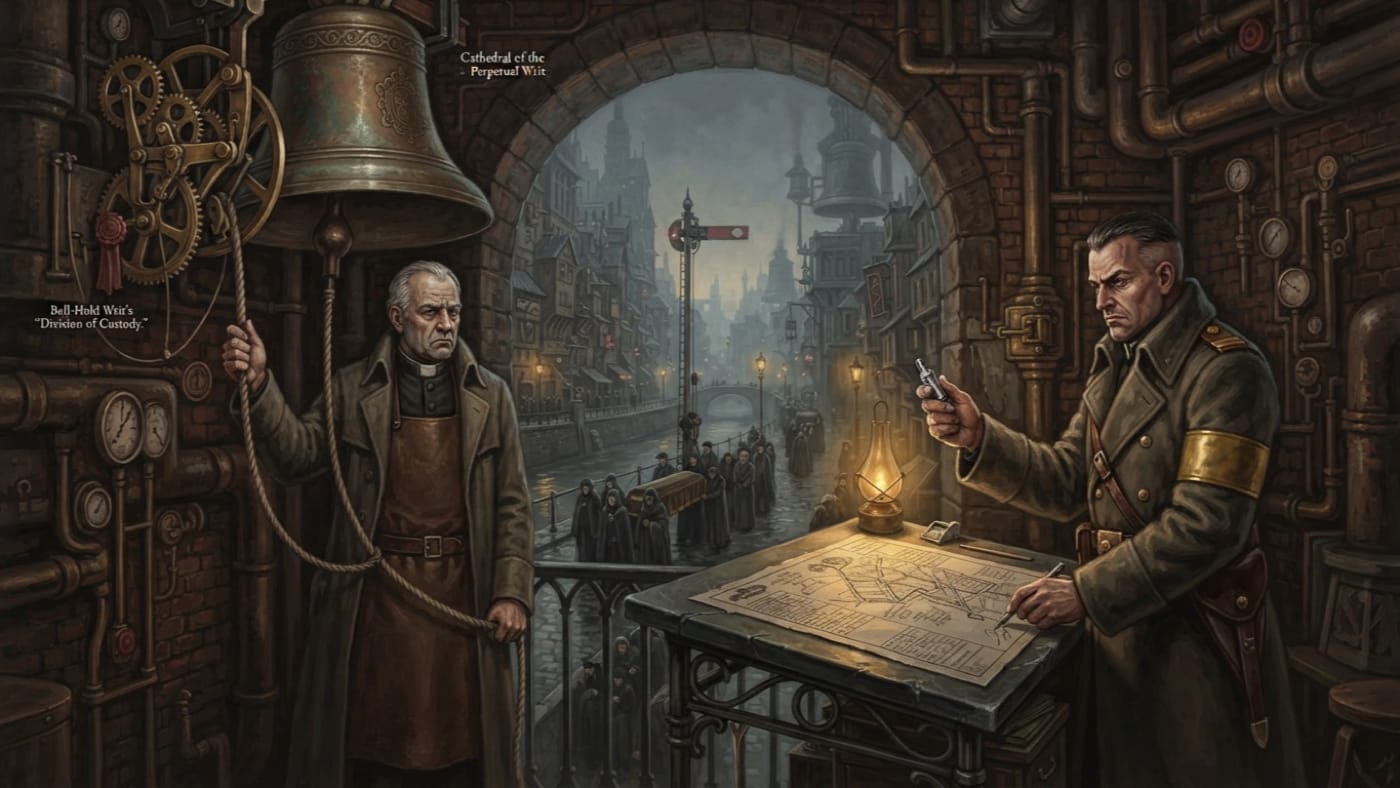
The Corps received interruption. During crowd movement, inside a cleared route zone, the whistle of a Procession Marshal may suspend a parish bell. The sequence has no ornament. First a route is designated under one of the Concordat's classes: funeral passage, levy transfer, relic procession, ration release, penitent march or evacuation. Every bell within harmonic range of that route is then held. If a bell is to sound at all, the lead Marshal must certify its compatibility by whistle, by baton and by written mark. If any one of the three is missing, the bell stays held. For a funeral, clearance runs three turns ahead of the coffin and lasts until the last mourner passes the final chalk mark. Then the bell is given back.
Observe what Bells kept: the right to say what the rope means. Observe what it lost: inside the cleared zone, the right to say when the rope may speak. A Bellwarden still keeps the tone. The Marshal now keeps the hour.
The chapters called this an insult to consecrated bronze. The Corps called it Tuesday. Both descriptions are on file, and both are accurate.
#On the Table and the Living Name
The Night of Two Bells was a paperwork death before it was a canal death. The route sheet lived in one office and the bell-table in another. Each kept its own column honest while the street between them filled with water and mourners. The Concordat's remedy was the Integrated Route and Bellway Table, Form RT-1. It was amended to RT-1b once bridges received the attention they had long been demanding.
The table puts sound and movement on one sheet. It records the route class, head count, lead auditory authority, harmonic exclusions, choke points, emergency cut lanes and the chain of responsibility. It ends with the legible signature of a living officer. Bells, the Bureau of Rites and the Corps each receive a copy. The Bureau of Records keeps the master and resents every amendment.
A single sheet defeats the obedience-split. The Cadence Architects, created by the same settlement, study how citizens divide when two lawful authorities speak at once. The table's purpose is that only one authority speaks. The Architects' purpose is to know what happens when the table fails anyway.
At Saint Erasmus the doctrine is attached to a rope. Before major processions the rope is sealed, and the ringer signs the living-name line before it is released. The parish's independent priority, its old right to toll by its own reckoning, is revoked inside cleared zones. The Marshal answers for the route and signs the table. The ringer answers for the rope and signs the line. The two signatures are separate, and each can be read aloud at an inquiry. The canal inquiry lacked exactly that.
#On Dignity Under Suspension
Now the sentence itself: "No Bureau suffered diminution of dignity under the Route-Timing Concordat."
Give the Commentary its due. Dignity is precisely what survived. Bells kept its vestments, its consecrations and its theology of tone. Vespera still hangs in its cage. Erasmus is now patron of restrained mourning. No one was ordered to repaint a tower. If dignity means the right to be addressed correctly, Bells lost nothing at all.
What Bells lost was independence. The Commentary was written so that no one would notice that independence and dignity are kept in separate files. A parish bell that must wait for a whistle is a dignified bell that does not command its own hour. Inside a cleared zone the oldest toll in Strasbourg and the loudest cathedral peal are in the same position: held until a Marshal makes the mark.
The sentence was useful to everyone. Bells could quote it to its chapters. The Bureau of War could quote it back to Bells whenever Bells began to petition. Rites could quote it to itself at night. The Bureau of Doctrine had approved both sides of the original quarrel and edited the preface. It could now file the matter as settled. A falsehood shared among four offices becomes a treaty.
The Bell-Hold Commentary, A.S. 132: "no Bureau suffered diminution of dignity under the Route-Timing Concordat."
Corrected: Bells retained its dignity and surrendered command of its own hour inside every cleared zone. The Commentary described the first and filed the second under courtesy.
I do not despise the Writ. I despise the need to dress it up. The Writ is a fine instrument. It names who holds the tone, who holds the hour, which marks release a bell and whose signature answers for a drowning. It is precise enough to hang a man by, which is the highest compliment I pay to paper. The Commentary took that precision and packed it in wadding, so that no chapter would have to feel the edge.
The quarrel did not end on the Commentary's schedule. By my own count Bells sulked for seven years, and the Architects are still received in bell-houses the way a granary receives a tax assessor. A bell does not feel undiminished because a gloss says it is.
#On the Continuing Application
As of A.S. 201, the Concordat and the Bell-Hold Writ govern every serious procession in Synod territory. Strasbourg publishes its daily clearance sheets before Prime. In the Bell-Table Loft above the Perpetual Writ's west porch, clerks copy route holds and releases onto slate beside bell columns that once lived in separate offices. Bastion-Brest runs its ration queues under grain-yard bell locks. The whistle still interrupts, and the bronze still waits.
None of this depends on the Commentary. No Marshal carries it, no table demands it, and RT-1b has no field for it. In the Codex it survives as one quotation and one erratum, which is the proper allowance for a sentence of that kind.