
#On the Basilica in the Market
"A church in a market square hears two liturgies. One of them is haggling."
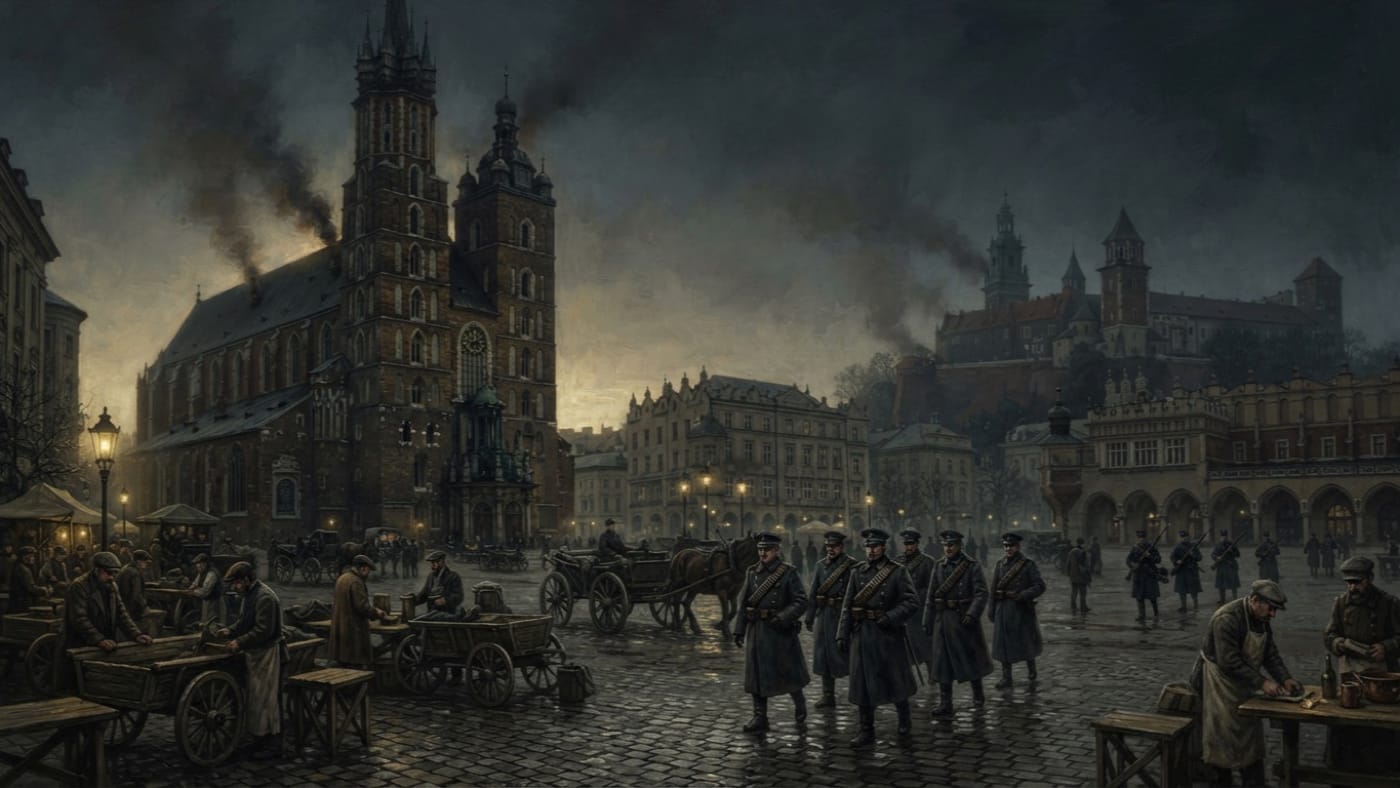
The Basilica of Our Lady stood in the market square of Kraków. The Codex can certify that sentence and almost nothing beyond it. Few buildings receive so honest a foundation. The account of the Night of Knives names the Basilica once, in its inventory of the city's sacred stone: the Cathedral on Wawel Hill, the Basilica of Our Lady in the market square, and no fewer than forty-three parish churches. The Cathedral held the hill and the Basilica held the square. A reader who confuses them will be corrected by the first verger he meets and then by me in print, which hurts longer.
This entry is filed under A.S. 18, 1728 CE. That year belongs to the city's catastrophe. The building's stones have no claim to it. No founding year, architect, patron, consecration or later condition appears in the record available to this office. The dateline marks the historical setting in which the Basilica is documented: Kraków under Rationalist administration, through the years of suppression and on the night the knives came out.
#On the Market and the Old Hours
Before its ruin, Kraków was a city of bells and spires, with an obstinate attachment to the calendar of saints. The account sets its population at some two hundred thousand souls. The figure is an approximation, and I preserve it as one. It counts a city. It does not count a congregation.
The city had three dominions, and they did not share well. The Church held Wawel, where the Cathedral kept the feast days in order. The University held its own quarter with observatories and lecture halls, along with astronomers whom the Bureau of Doctrine would one day find professionally rewarding. Trade held the square. The Wawel record describes clergy moving between the hill and the market square before the Atheist Wars, calm in the way men are calm after centuries of being obeyed. That traffic places priests in the market. It does not hand the Basilica a procession, a parish boundary or a guild chaplaincy, and I will not slip any of them in by the side door.
What the record allows is enough. A merchant in that square weighed goods within sight of a church. A buyer counted coins within sight of a church. Every bargain in Kraków's chief market was struck in front of a consecrated wall, and on saints' days the city's bells rang over the whole transaction. Commerce and devotion shared one paved floor. Neither is recorded as having complained about the arrangement. Each, I suspect, considered the other a tenant.
#On the Suppression of Worship
"Brechtold could confiscate iron. He kept discovering that prayer is made of other material."
Colonel-Prefect Ignaz Brechtold governed Kraków for the Rationalists with the diligence of a provincial functionary who knew his superiors were reading. In A.S. 14, 1724 CE, he dissolved the monastic houses by decree. In A.S. 15 he seized the Cathedral's endowment and put it toward a public anatomical theatre. That was the Cathedral's endowment, on the hill. No document in this office connects the seizure to the Basilica's purse, and the Basilica's purse appears in no document at all.
Next came the bells. Brechtold forbade church bells between six in the morning and ten at night, which covered every hour in which a waking Christian might hear one. The faithful rang them at three in the morning. Brechtold then confiscated the clappers.
The order applied across the city. The surviving record does not name the towers that lost clappers or the hands that gave them up, and the Basilica's bell is absent from it entirely. I could write a scene of a Rationalist corporal on the Basilica's stair with a clapper under each arm. It would be vivid, and it would be forged.
Worship went below ground and into lofts. The clergy said Mass in cellars and attics, and in the back rooms of butcher shops, where the smell of blood covered the smell of incense. The informers reported it, the militia raided, and fines followed. The faithful gathered again the following week. The record names cellars, attics and butchers' rooms. It does not name the Basilica or any crypt beneath it, and I decline to move a hidden service into its nave because the nave would look well in a woodcut.
By the winter of A.S. 17, Brechtold's correspondence had grown longer and shriller. He asked for reinforcements and received advice on fiscal discipline. His reports grew longer and his patience ran out. The pages from that winter show a man who had confiscated everything he was able to lift and found that the city went on praying.
#On the Night Beyond the Square
On 17 Martius, A.S. 18, between the second and third hours after midnight, sixty-three men of the Kraków Secular Guard and fourteen of the Rationalist Philosophical Police struck eleven locations across the city. They seized forty-seven clergymen. Each man's mouth was wired shut with iron wire. They were driven to the Dębnicki Bridge and thrown into the Vistula while the river was still carrying ice.
The record does not list the Basilica of Our Lady among the eleven locations. It is not given as an assembly point, as the place where the wire was applied, or as the place of murder. None of the forty-seven is recorded as its priest, its sacristan or its servant. The killings had a geography, and it is worth stating plainly, because sermons have been blurring it for a century and a half.
The square was the landmark, and it is the Basilica's only recorded station. The witness's window looked over the street approach below Wawel at Grodzka Gate. From her convent window there, Sister Agata Wiśniewska, a Poor Clare, watched the procession of wired men pass. She saw the approach and not the whole bridge span. She timed the march by the bells of Saint Andrew's. Those clappers had been spared because the Philosophical Police kept their headquarters in that church, and Brechtold enjoyed the joke. The bells that timed the atrocity were Saint Andrew's and not the Basilica's. The bridge was where they did the killing. The river took the bodies downstream.
The fishermen recovered the dead at Sandomierz over the following nine days. The Rationalist tribunal found that the deaths were ritual suicide. Agata's testimony and the bargemen's songs both called them murder. The Codex agrees with the nun and the bargemen. The tribunal had the better stationery.
None of this happened inside the Basilica. I have written that sentence three times in draft and deleted it twice, because a building that saw nothing makes for poor drama. It remains in the third draft because the record supports it. That night the Basilica stood in its square while the Guard went about the city, and its stones are not described as having done anything else.
Earlier Bureau publications listed the Night of Knives as occurring "c. A.S. 13."
Corrected to 17 Martius, A.S. 18. The earlier figure came from Rationalist fiscal-year records kept on a non-standard reckoning. Cross-reference with Sister Agata's testimony and the Sandomierz fishermen's log of the first recovery establishes the true year. This entry's dateline follows the correction. The Basilica was not five years older in its suffering than the rest of Kraków.
#On the Record That Remains
What the record holds for the Basilica of Our Lady fits on one line: a church in the market square, listed separately from the Cathedral on the hill, in a pious city about to be punished for its piety. The Codex adds nothing to that line. It records no founding, dimensions, relics, clergy or later fate, whether ruin, survival, restoration or reconsecration. Elsewhere the Codex records that Kraków's spires were restored. A city's spires are not this spire, and a sentence about the whole city does not certify one of its churches.
The later ceremony has its own date. In A.S. 148, the Fifteenth Doctrinal Congress ratified Agata's testimony as the canonical narrative of the Night of Knives and established the Vigil of the Drowned Priests, which the Bureau of Bells keeps with one hour of silence. That came one hundred and thirty years after the murders. Kraków's private mourning began on the riverbank in A.S. 18. The mandated rite began at Strasbourg in A.S. 148. The two should not be filed together, and the Basilica appears in neither ordinance.
The Basilica's entry closes here with nothing more certified than its place in the square.