
#On the Seven Stones
"Everything in Vienna is broken except the columns, and the columns are the only thing in Vienna anyone wants to touch." — Drax, marginal annotation
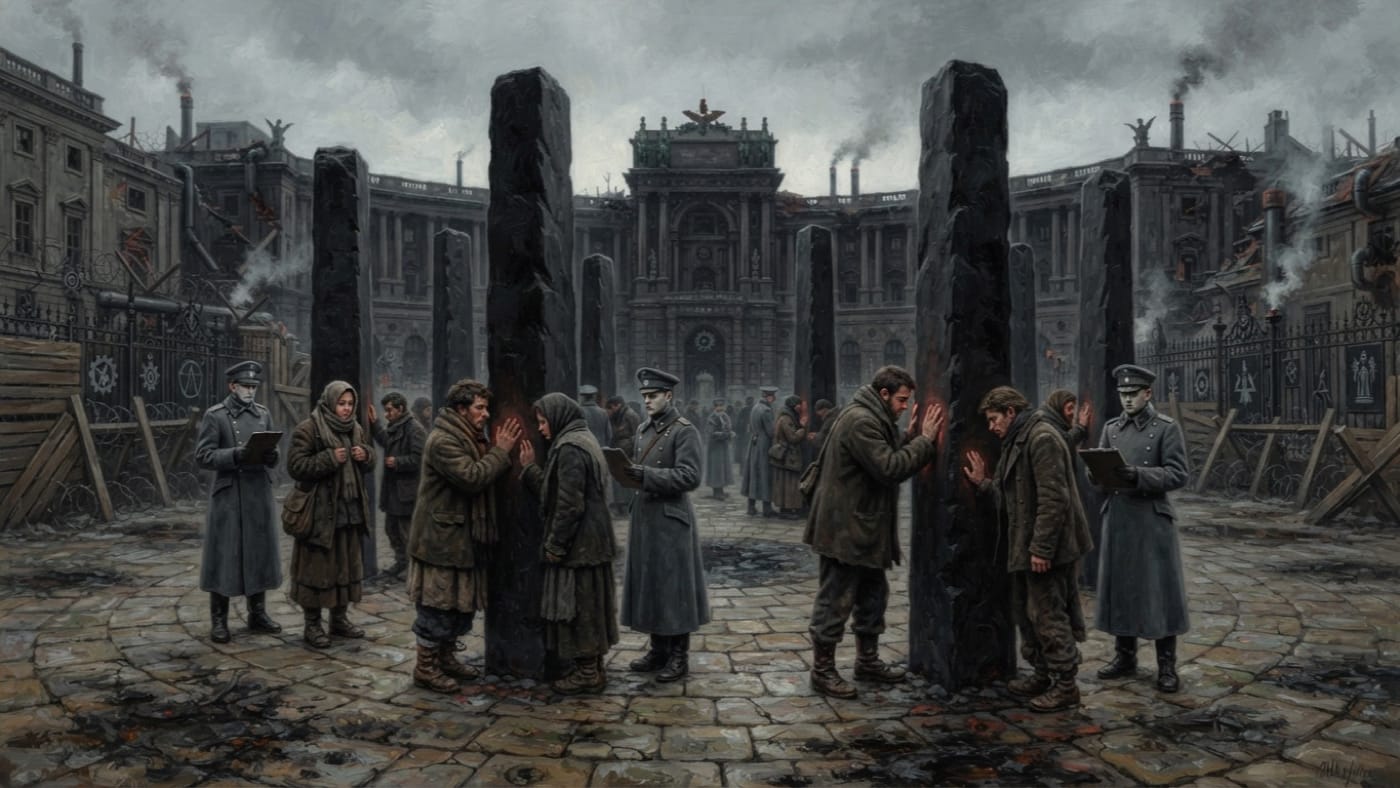
Seven columns of black basalt stand in the Heldenplatz of Vienna. They face the blind frontage of the Hofburg, on paving that the Siege cracked and the Synod has declined to mend. The columns are warm. They hold thirty-seven degrees, the heat of a living body, and they have held it since the square was reconsecrated in A.S. 95. In this present year of A.S. 201 that makes one hundred and six years with no fuel, no flue and no stoker on any Bureau payroll. They also glow, faintly, like a coal that has decided to be polite about it.
Pilgrims lay their palms against them. That is the whole rite, and no Bureau has improved on it. A pilgrim who has come down the Central Corridor in winter boots takes off a glove, puts a bare hand to the stone and finds under the skin the temperature of another hand. Some weep. Some pray. Some lean their foreheads almost to the basalt, as a penitent leans toward the confessional screen, and do not move until a licensed guide coughs.
I am Hieromnemon Valerius Drax, Warden of the Sacred Ledger, and my office is to tell you what the columns mean. I will. First I will admit that the stone does not need my permission to be warm. I make that admission once, here, and will not repeat it in front of the Bureau of Doctrine.
#On the Cold Fires
The columns stand where the pyres stood.
A.S. 30 / 1740 CE was the year of the Treaty of Regensburg. The Holy See of Vienna was dissolved at swordpoint, and the Rationalist Republic received its formal constitution. That same year the Rationalist elite of the city staged what the Church remembers as the Black Procession. They draped saint-effigies in mourning cloth, paraded them through the boulevards and burned them on pyres in the public squares, with the Heldenplatz foremost among them. Reason had rented the costume of liturgy so that it could set the costume alight.
The fires burned cold.
Eyewitnesses reported flames that gave no warmth, only frostbite, as if fire itself had refused the commission. The surviving account kept in Vienna's shrine literature puts the effigies at forty-seven. It records three citizens dead of exposure within six feet of a pitch-fed pyre. I give those figures as that account gives them. Forty-seven effigies do not make forty-seven pyres. No document tells me how many pyres the Heldenplatz held, which saint burned on which, or whether a particular figure was consumed on any of the seven sites. Pilgrims who assign a saint to each column are writing hymns. I am keeping a Ledger.
The Rationalists called the phenomenon "a chemical marvel" and published an explanation to match. Sixty-two years later, in A.S. 92, the Bureau of Doctrine filed its classification from Strasbourg: First-Order Portent, Providential Warning, Category: Elemental Rebuke. One is a chemist's shrug. The other is a verdict handed down after the defendants were dead. The witnesses themselves said only that they were cold.
The inherited chronology of the Sacred Ledger dates the Black Procession to A.S. 124.
The Black Procession took place in A.S. 30, the year of Regensburg. The same older table also misdates the Siege of Vienna, which is fixed at A.S. 95. The Bureau of Records regrets that for some time its tables had the Rationalists burning saints in a Vienna they no longer held.
#On the Reconsecration
The Church lost Vienna before it could take it back. The Sundering of 1 November A.S. 45 tore open the east. Then came the Great Retreat, and the city became what the refugees called dead ground. The Synod received its formal constitution at Strasbourg in A.S. 90. Five years later it turned to the ruin.
In A.S. 95 Bishop-Warden Clemens Stahlhand reclaimed the city. He struck down Althazar of Pest with the reliquary of Saint Aldebrand. The testimonies about that blow belong to other entries, with their bells, their glass and the marrow of the earth. For this entry one fact is enough. The square was reconsecrated the same year, and seven basalt columns were raised on the sites of the old cold-fire pyres, sixty-five years after the effigies burned.
There the documents stop. I cannot tell you why there are seven. Who quarried the stone, who dressed it, who paid for the carting, whether anything is sealed inside: the Ledger has no answer, and I will not manufacture one. Popular devotion traces the warmth to Clemens's blow. No record does. The record says three things. The blow came first. The columns were erected afterward. The warmth is attested in the columns. The pilgrims fill the gap between those statements with faith, and the Bureau of Tithes fills it with pamphlets.
#On the Measurement and the Explanation
The Bureau of Engineering has measured the warmth. The Bureau of Doctrine has explained it. The two explanations differ, and both carry a stamp.
The Engineering file gives one figure: thirty-seven degrees, constant. It gives no rise in summer and no fall in the Viennese winter, which reaches the square in November on the anniversary of the other great wound. I cannot tell you what instruments were used or how often the readings were taken. The file is not mine to open for you. It is enough to know that the Bureau of Engineering, which trusts nothing, wrote the number down and put its seal beside it.
The Doctrine file explains what the number means. I will not reproduce it. I will not reproduce the Engineering account of the cause either. A Hieromnemon who quotes one stamped explanation against another has called a hearing, and I have been to hearings. Both documents stand in the archive, each sealed and each certain, on facing shelves like two litigants who have agreed never to meet in the corridor.
Look at the geometry of the thing and at nothing else. The Rationalists built fires that gave light and no heat. On the same ground the Synod raised stones that give heat and only enough light to be seen by. The Rationalists fed their pyres pitch and saints. Nobody feeds the columns. The eyewitnesses of A.S. 30 were frostbitten six feet from a flame. The pilgrims of A.S. 201 press their skin to basalt and are warmed. I make the doctrinal point in one sentence and then stop: the Heldenplatz has reversed its sentence, and the reversal has held for a hundred and six years.
What causes it is sealed. What the pilgrim receives is not.
#On the Palms of Pilgrims
Vienna houses the Central Corridor headquarters of the Bureau of Pilgrimage, and the Bureau manages access to every ruin-shrine in the city. The columns are among them. Licensed guides bring the pilgrims into the Heldenplatz on a schedule and take them out on a schedule. The time in between belongs to the pilgrim and the stone.
The Via Stahlhand is a separate devotion: four hundred and eleven metres through the Kärntner Gate breach, walked on the knees. It has its own entry, its own guides and its own damage to the kneecap. A pilgrim who has finished it may arrive at the columns with torn stockings and cold hands. Nobody has stamped that a requirement, and the columns do not ask.
Nothing is promised at the stone. The Bureau of Pilgrimage lists no cure. The Bureau of Doctrine grants no absolution for contact. No licensed guide is permitted to announce a vision. No file records that the basalt warms for the devout or cools for the doubtful. When the Bureau of Doctrine was asked, it answered in its stamped explanation, which I have already declined to reproduce. The pilgrim puts a hand on the stone and the stone is thirty-seven degrees. What follows is between the pilgrim and the Creator: tears in some cases, prayer in others, silence most often.
I have read the guides' reports. They are short, as licensed reports ought to be, and what they record most is the silence. Pilgrims who have talked the whole length of the corridor, and who will talk again in the gift shop, go quiet at the columns. They hold their palms flat, like a clerk pressing a document to dry, and wait until the warmth has reached the wrist. Then they take their hands away. The guides say the hardest part of the post is judging how long to let a pilgrim stay before the next group is due. The Bureau of Pilgrimage has issued no guidance on it. For once I approve of the Bureau's silence.
The Bureau of Tithes profits from the shrine economy, as it profits from every shrine economy. It has never met a sacred site it could not put a price on. The gift shop by the Heldenplatz sells replica reliquary fragments, illustrated pamphlets on the Siege, and miniature basalt columns in black stone that do not radiate warmth. Their proportions are faithful and so is their colour. One of the pamphlets even reports the correct temperature. A pilgrim who has just had a palm against the living stone buys its likeness, carries it home down the Corridor, and at the first cold night finds it exactly as cold as the room.
No one has ever returned one. The Bureau of Tithes counts that as satisfaction. The Bureau of Doctrine counts it as instruction. I have seen the ledgers, and the column replicas outsell the reliquary fragments.