
Sources checked; writing the Augsburg prose now.
#On the Corrected City
"A clean field is a quiet field." — motto attributed to Saint Verral of the Clean Field
Augsburg has no folio of its own in the Codex, and I have looked. The Bureau of Records holds the city's tithe returns, parish ledgers, gravestone applications and guild correspondence, as it holds everything. It does not hold a summary: no founding sheet, no page where some clerk has written this is Augsburg, and this is why it matters. I cannot give its population and I will not invent its wards. A city may be large and old and ordinary without troubling the Warden of the Sacred Ledger, and for most of its history Augsburg made full use of that allowance.
It enters the record through its corrections. Three times the Synod's instruments have come to Augsburg and removed something from its surfaces: first its beasts, then a dyer's good name, then three pairs of hands. Other cities show the Synod's power in walls and bells. Augsburg shows the blade being refined, from the scraper that removes a lion to the gauge that measures a serif.
#On the First Scraping
The Crimson Gate Riot of A.S. 106 killed eighty-seven people at Essen-of-Hymnsteel because a quartermaster painted an old boar on a wagon. Augsburg was nowhere near it and paid for it anyway. Two years later the Bureau of Heraldry issued the Beast Proscription. Lions, eagles and stags were to be reduced to stylised canonical form. Wolves and serpents were banned outright. Bears were suspended pending a review that has still not concluded. In A.S. 110 the Bureau constituted the Inspectorate of Visual Compliance to carry out the decree. It had forty-three licensed Heraldic Examiners, drawn from heraldic clerks and discharged Bureau of Purity field agents. Each was issued swatches, a scraper blade and the forty-seven-page first edition of the Codex of Permitted Symbols.
They went to Worms, to Cologne and to Augsburg. Within the season, the Augsburg guilds had lost their animal crests.
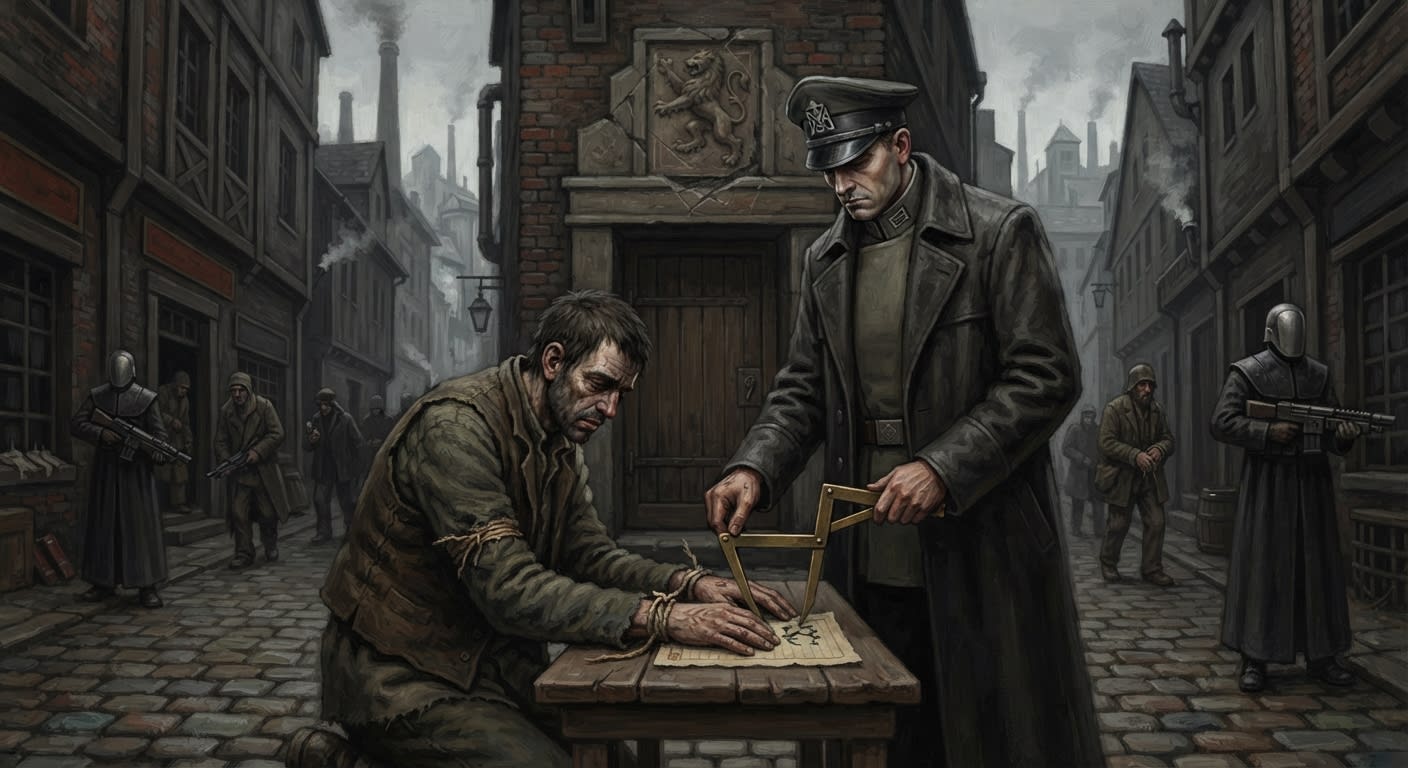
I have no inventory of the beasts. In that age a guild's heraldry was its memory. The device over the hall door recorded who had paid for the hall, whose sons had been apprenticed under it, and which masters had carried the banner on feast days. A lion over a lintel was a pedigree. The Examiners took it down with a blade and a prayer to Saint Verral. What remained above the door was plaster, bare stone, or the geometric remnant the Codex permitted: a lion stripped of mane and muscle until it looked like a surveyor's diagram of one.
The first Codex contained eleven errors, which went undiscovered until A.S. 114. One of them fell on Augsburg. A dyer's vermillion sample was cross-listed under sanctioned crimson, which made a lawful colour criminal on the page and, in due course, in the street. Fines followed, then appeals, then one branding. The Codex was corrected in Strasbourg. The brand could not be corrected anywhere.
An earlier draft of this entry stated that the Augsburg guilds "surrendered their crests without disturbance."
Withdrawn. Three guilds rioted in the season of the first scraping; the Bureau of Purity handled the riots and the Bureau of Heraldry handled the paperwork. No register open to me says which three guilds, or in which cities. The earlier sentence claimed a peace for Augsburg that the record does not contain. The record contains no riot there either. Both absences are now filed.
#On the Alphabet Arriving Late and Finding Work
For sixty-eight years after the first scraping, so far as any register shows, Augsburg's handwriting remained its own affair. Then, in A.S. 178, Procurator Maxentius della Torre signed the Edict of Graphic Uniformity, and the Triune Alphabet became the only script the Synod recognises.
The scraper had been a crude instrument. It could remove a beast, but it could not read. The Alphabet gave the Bureau of Purity something finer:
- twenty-three approved letterforms;
- a nib filed to forty-seven degrees;
- phonetic tables governing spelling in every Synodal tongue;
- verification of gravestone inscriptions before the chisel touches stone;
- a rolling quarterly audit of penmanship, carried out by White-Mantled Inquisitors with brass angle-gauges the width of a thumb.
Literacy became a licensed act. The Index Damnatus had acted on finished books. The Alphabet acted on the single pen-stroke, before any word existed.
A city already used to bare lintels was well placed to learn the rest. The guild halls that lost their crests in A.S. 110 now carried name-boards, charter copies, apprentice rolls and posted prices, all lettered by hand and all within reach of the gauge. The wall once read for beasts was now read for angles.
#On the Three Hands
In A.S. 182, four years after the Edict, three calligraphers of Augsburg were condemned for handwriting the Bureau judged "suggestive of doubt."
The warrant cites letterforms and nothing else. The three did not provoke the Edict, which was four years old when it reached them. They did their trade in a city under audit, and the audit found their curves wanting. Their serifs curved where serifs ought not to curve. Their descenders, the tails that drop below the ruled line, implied questions where only statements were licensed. The evidence against them was their own writing, read as doctrine. The presiding Inquisitor sentenced them to five years in the Paper Mines of Ulm.
I do not know their names. The published record gives three hands and a sentence. I suspect Records declines to add the names because a name attached to a graphic offence would have to be written down by someone, and whatever that someone wrote would then be audited.
The Mines lie outside Ulm. There they press condemned scholars, clerks and witnesses into archival stock, redaction vellum and penitential forms. The only writing a calligrapher may do there is the transcription of Bureau inventory lists, in the licensed hand, at the licensed angle. As theology, I find the arrangement hard to improve upon. Three people whose letters implied doubt were sent to make the paper on which other people's certainty would be written.
Of the three warrants, Records can produce three. Of the three discharges, Records can produce ██████.
#On Present Compliance
What follows is inference from the enforcement record, and I label it as such. No census of Augsburg's signs has reached my desk.
A city corrected twice on the same surfaces learns to correct itself. I would expect Augsburg's shopfronts to carry geometric beasts or none. I would expect its guild boards to be lettered by men who own a gauge and use it before the Inquisitor arrives. I would expect its primers to come from licensed presses, and its parish ledgers to be kept in a hand so correct that it reveals nothing about the person holding the pen. I would expect its gravestones to wait for their spellings. And I would expect the Lictors of Purity to be seldom needed there, which is what every Bureau means when it writes "orderly."
The one present-tense witness I have is a junior Sigil Inspector posted to the city. The Inspectorate that scraped the guild lions is still at work there, a century on, and has moved down the wall to where the children draw.
The wall above the old guild doors has been read twice, once for the beast and once for the hand. The Bureau of Purity has not announced a third reading. It did not announce the second.