
#On the Origin of the Instrument
The Edict of Graphic Uniformity is a short instrument with a very long reach. Procurator Maxentius della Torre of the Bureau of Purity set his name to it in A.S. 178. From that year the Triune Alphabet stopped being one approved hand among many in the Synod's scriptoria and became the only script the Synod recognises. The change matters to lawyers and to nobody else, until the day it matters to everybody. Before 178 a clerk wrote well or badly. After 178 he wrote lawfully or otherwise.
The Bureau that issued it was already old. It had held its present shape since the reforms around A.S. 80, and its Index Damnatus had been condemning names for ninety-eight years before anyone thought to regulate the strokes those names were written in. The Edict gave the existing machinery something new to feed on: the shape of the letter itself.
I am told the pen used for the signature had its nib filed to forty-seven degrees. I am also told that the Bureau of Rites sanctified the ink in a ceremony lasting eleven hours, and that the pen and the paper were blessed separately, as instruments of different rank should be. I was not present. I give the duration because the Bureau gives it, and because eleven hours is about what it now takes a provincial notary to write his own surname correctly.
#On What the Edict Requires
Its requirements are few, and each one is total.
First, the letters. There are twenty-three, each licensed by the Standing Committee on Graphic Standards, which meets beneath the Tower of the Quill, and each with a prescribed geometry: angle of entry, order of strokes, length of the terminal. The Porta Verbi takes fourteen strokes in a fixed sequence. The Clausura is one downstroke and a leftward curl, made without lifting the pen. Apprentices master the last letter on their first day and spend the rest of their training atoning for that confidence.
The Committee holds that the forms derive from the primal shapes of sacred utterance. The Committee's exemplar was a Carolingian minuscule specimen obtained from a library in Ravenna. Both statements sit in the Committee's files without visible discomfort, and I have no intention of introducing any.
Second, the spelling. Every language spoken within Synodal territory is to be written according to the Bureau of Purity's phonetic tables. A word that cannot be rendered in the twenty-three forms is denied official recognition. It may still be spoken. It may be shouted in a tavern, sung over a cradle, muttered at a magistrate's back. It may not appear in a register, a contract, a baptismal roll or a judgment. The Bureau is careful to say that the Edict abolished no sound. It abolished the sound's standing, and in a Synod made of paper that is most of what existing amounts to.
Third, the act. Literacy became a licensed activity, licensed the way surgery is licensed: anyone may attempt it, and the Bureau will attend to the results.
#On the Verification of the Dead
The Edict's best-known provision concerns people who can no longer object to it.
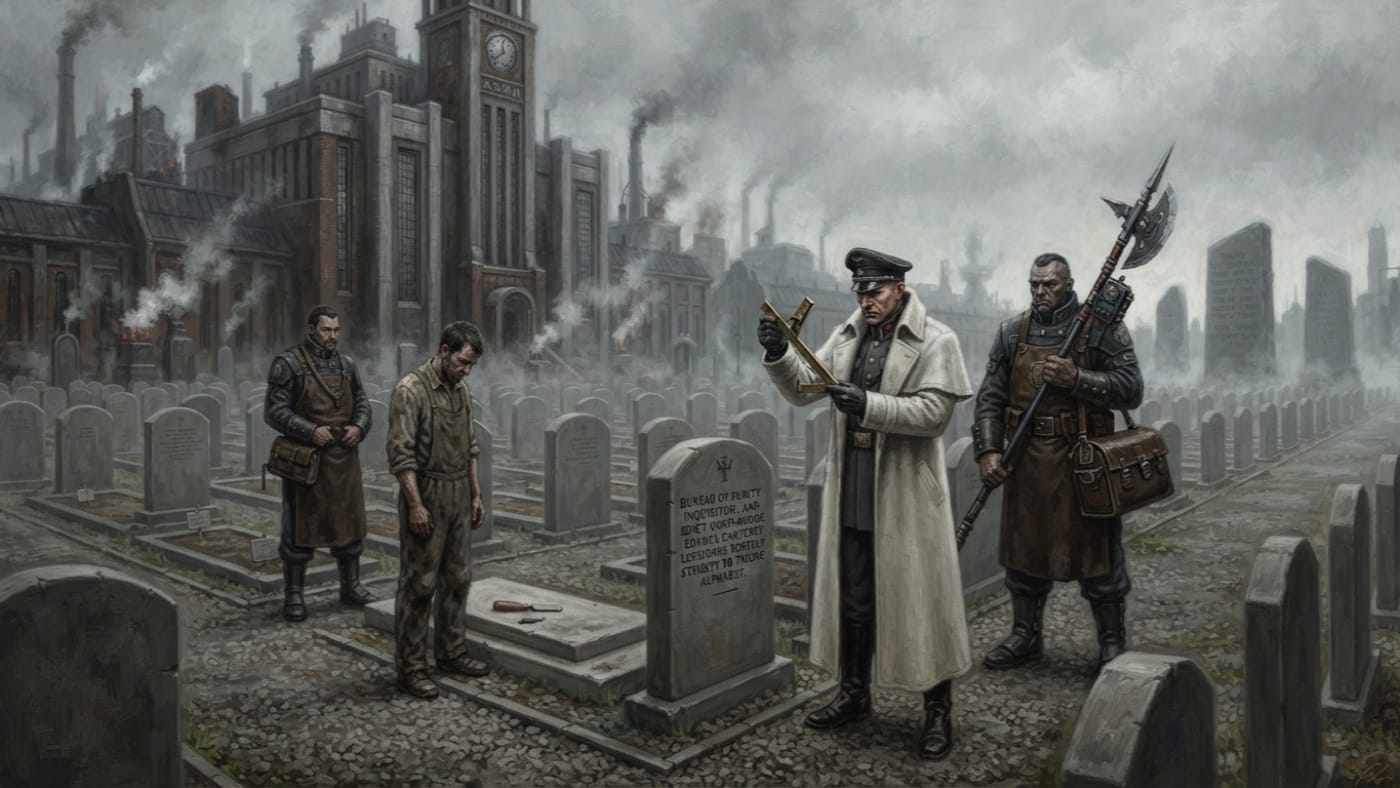
No name may be carved on a gravestone until the Bureau has verified it. The family files a Form 14-C, the Application for Posthumous Inscription, and a Form 14-D, the Phonetic Verification of Deceased's Name Against Current Bureau Tables. I draw the reader's attention to the word current. The dead are spelled against the tables in force on the day of application. They are spelled against nothing they knew while living.
Verification takes nine days on average. Burial does not wait for it, and the Edict has never claimed otherwise; it says nothing against a grave and a great deal against a stone. So the body goes into the ground, the mound stays bare, and the stonecarver stands in the churchyard with his chisel idle, being paid by nobody, while a clerk two towns away decides whether the grandmother's name contains an unlicensed vowel. If it does, the stone will carry the nearest permitted spelling. Her grandchildren will visit a name she would not have answered to.
For six years this service cost nothing. In A.S. 184 the Bureau introduced a fee of six copper stamps, ending a generosity it had evidently never intended.
#On Enforcement in the Provinces
Enforcement moves in a fixed order: standard, inspection, prosecution.
The Committee sets the standard. The White-Mantled Inquisitors inspect. They go through the market streets in their white mantles with glass chains at the wrist, reading shop signs, parish notices, ledgers and children's primers. Non-compliant material is confiscated. Each quarter the Bureau audits penmanship across its territories with brass angle-gauges, each one calibrated to the forty-seven degrees of the original nib. Where an inspection finds error, the error is corrected. Where it finds intent, the matter passes up the punitive hierarchy of Purity to the Lictors. The Edict did not create the Lictors. It gave them handwriting to read.
The first great application came the year after promulgation. In A.S. 179 the Lombard vernaculars were classified as Category Three Verbal Contraband. Bureau theologians found that their vowels carried seditious frequencies, and I report that finding as theology, which is where it belongs. In practice, children were taught in school that their grandmothers' speech could not be written, so for every official purpose it had never been said. Family names carrying sounds the tables could not hold were entered under the nearest licensed spelling, and sons signed baptismal rolls with names their fathers did not quite own. Priests in the Lombard parishes, I am informed, dream in the proscribed vowels and wake up in a state of procedural anxiety.
Lombard grandmothers, as a class, received the news in exactly the vowels under discussion. The children learned the approved forms. They learned the other words faster. Such is pedagogy.
Augsburg followed. In A.S. 182 three calligraphers were convicted because their handwriting was read as doubt: serifs curving where no license allowed a curve, descenders leaning as though asking something. They were sentenced to five years in the Paper Mines of Ulm. Records holds the sentence. Records has not shown me any release, and I have not asked to see one.
#On Precedent, and the Stones That Ignore It
The Edict has one embarrassment, and it stands seven monoliths high.
The Treaty-Stones of the Steppe Gate were erected in A.S. 76, one hundred and two years before della Torre signed. Their script looks like the Triune Alphabet. Some catalogues describe it as archaic pre-doctrinal script. Doctrine calls it a Triune variant and explains the resemblance by calling the stones proleptic: they anticipated the form that would later ratify them. I give the year the stones were raised. I do not claim it dates every carving on them, and I make no claim about whatever lies further down.
Within the treaty's own jurisdiction the stones are enforced by clause-spirits that respond to mispronunciation. In A.S. 94 an arbiter misread a clause, and the night that followed is called the Red Pronunciation. That violence belongs to the Steppe Gate. The Edict has never claimed it. A bad Clausura in Augsburg brings an Inquisitor with a gauge. A bad syllable in front of the stones brought something with no file number.
Casualties of the Red Pronunciation: approximately one hundred.
Corrected by the Bureau of Doctrine, A.S. 95: approximately one thousand. Doctrine published the revision a year after the night itself. It did not publish who counted the first time, or how.
There is a second complication, and it is newer. Since the first discovery in A.S. 194, the Burnless Archive beneath the Steppe Gate has been producing folios in licensed letterforms that no living scribe is recorded as having written. They are found with the ink still wet. They are flawless, better than any hand the Committee has examined, and they would pass every audit the Edict prescribes. Nobody has proposed auditing them. The Committee has not licensed whatever writes them, and it has not been able to locate the author in order to refuse. I record that the folios exist. I do not say how.
#On the Present Application
It is now A.S. 201, twenty-three years after promulgation: one year for each letter. The Committee has asked me not to call this a coincidence, and I have not.
The audits continue every quarter. The gauges are recalibrated against the original angle. Forms 14-C and 14-D are printed in quantities the Bureau of Records describes as adequate, a word that tells you how many people are dying. The tables are revised as Doctrine requires, the dead are spelled against whatever is current, and the stonecarvers go on waiting. The instrument works exactly as written, which is the most anyone can say of the Synod's law and more than I would care to say of the Synod's lawyers.