
#On the Row
"Kiss it before they bite it." — Queue advice, Assay Row. Nobody will tell you whether the kiss is for luck or for the assayer.
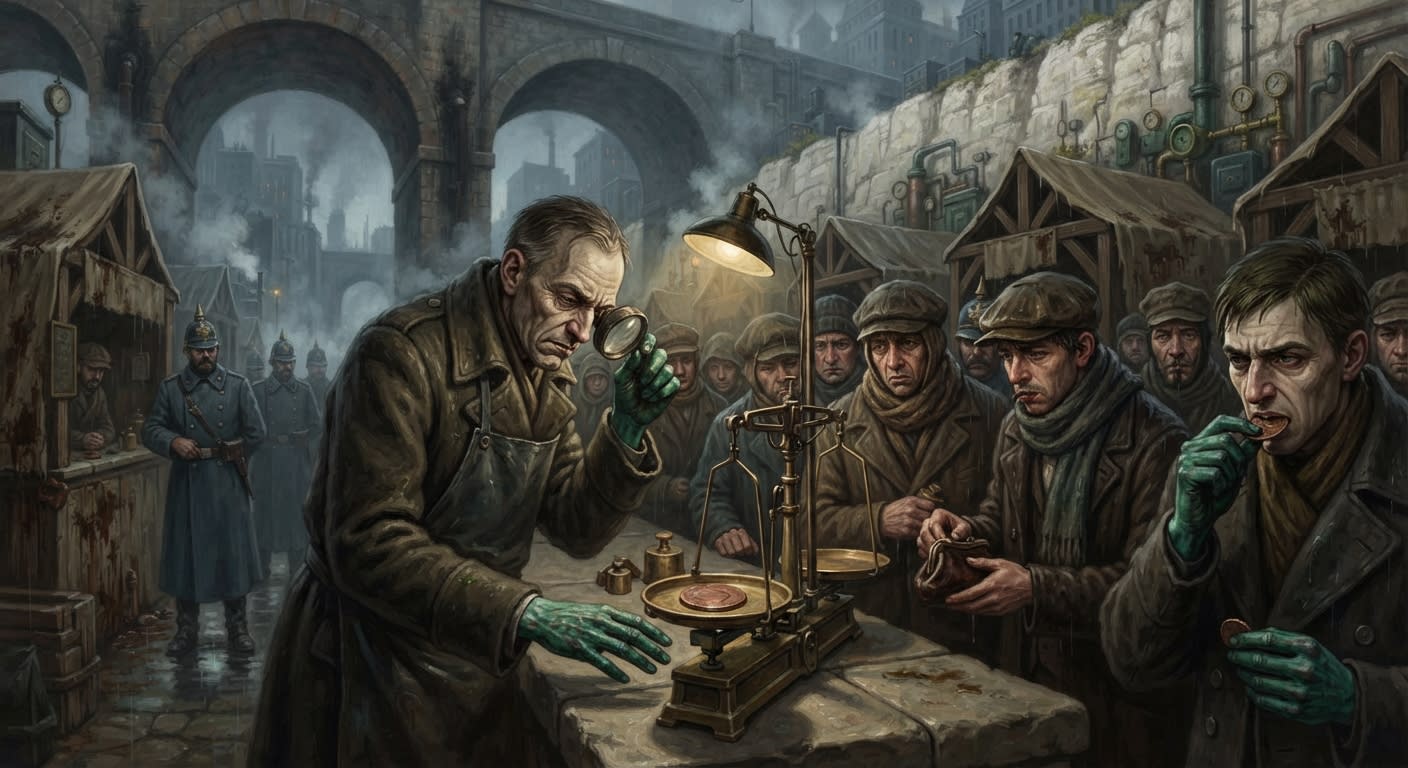
Assay Row runs along the foot of the left bluff at Griefgate, below the Coin arch. The chalk there has been cut back just far enough to take a line of stone counters. The booths are timber roofed in tarred canvas, and a century of spilled reagent has stained them up to chest height. The Row smells of acid and hot wax, and in wet weather of wool as well, because the queue stands against the counters in the rain and has nowhere else to stand.
Every coin tendered at the Exchange comes here. That includes toll pennies, grief-tax, the six pennies for Form 17-C, and the bribe that the ledger books as a gratuity. Each coin is carried from the broker's desk to an assayer's counter, set on the brass pan of a balance, and judged in front of the person who paid it. The assayers weigh it against a black iron standard. They turn it on edge under a salvaged glass lens and look for file-marks and seams. They draw it across a touchstone and drop reagent on the streak. When a coin is still in doubt they bite it. Biting is older than any Bureau, and it has outlasted every attempt to replace it because it is fast and costs nothing and the crowd understands it.
The reagent turns skin green. New assayers wear gloves, and the gloves go green inside a month. After some years the fingers go green and stay that way, and the order treats the stain as a qualification. Pilgrims call the brethren Greenhands. On the Row they are simply called the Scale.
The testing is done in the open on purpose. A crowd watching its own coin being tested has something to look at besides the clerks, the ropes and the arches, and when a coin fails it can blame the metal. The Gate Chapter saw this in A.S. 94 and has used it every day since. The brass pan tips, a green thumb lifts, and the assayer calls one word over the arch-hum: clean, short or bitter. A hundred travelers who were deciding whether to push forward stop and watch what happens to the one who drew bitter.
#On Coin Truth
The Assayers of the Bitter Scale were constituted as a craft order in A.S. 94, under the same Joint Charter that gave the three Roman arches to the Synod Gate Chapter and the Licensed Broker Compact Council. The charter names no founder. It names a function: to verify all coin and tender offered in payment at the Gate, and to declare its truth. The Compact proverb "Three lanes. One throat." is attributed to the first Master Assayer. That is as close as the record comes to a name, and I have no plans to improve on the record.
"Coin truth" is the charter's phrase, and at Griefgate it means whatever the Scale says a coin is worth. A traveler can appeal, but every appeal costs more than the coin. A clean coin buys passage. A short coin is accepted at its reduced weight and the traveler makes up the difference. A bitter coin is confiscated, entered in the Row ledger and held for re-assay at the traveler's expense. While that happens the traveler waits, in the queue or in the Holding Pens, and runs up delay-debt at the published daily rate.
Elsewhere a bad coin costs its owner some silver. Here it stops the journey. One bitter penny in a purse of twelve makes the other eleven suspect by association, which is also the charter's phrase. Suspect coin cannot pay a toll, and a traveler who cannot pay cannot pass under an arch. Enough such travelers end in a labor-conversion contract that the Holding Pens clerks keep the forms pre-folded. Labor needs no assay.
#On Taint
The Scale's heaviest instrument is the taint. When the Master Assayer declares the coin supply tainted, coin stops at Griefgate. It cannot pay a toll, a grief-tax or a fine. The broker desks shut their coin drawers and business moves to paper: oath-notes, labor-conversion contracts and stamped indulgence slips, all written at the Exchange by a licensed broker for a fee. The brokers do very well out of a taint and the queue does badly. The Culvert Choir, which has never asked to see anyone's coin, does best of all.
A taint lasts until the re-assay is finished, and a full re-assay covers every coin in Griefgate, including every broker's strongbox and every innkeeper's till, one balance at a time. A short taint costs the Gate two days. I asked on the Row how long the longest had lasted. I was told its ledger was under re-assay.
The order's defenders say a taint protects the Pilgrim Roads from counterfeit. They point to the Great Counterfeit Winter of A.S. 160, when near-correct route tokens led whole families off the protected road. Every road office learned from that winter that a nearly true piece is more dangerous than an openly false one. The Scale took a narrower rule from it: any coin can be called doubtful, and the person holding it has to prove it is not.
Since A.S. 199 the order has had a new kind of tender to fight over. Indulgence slips have circulated as a second currency since that year, and forged slips have been flooding the Gate since A.S. 200. The Scale's position is that any slip offered in payment is tender, and all tender falls under coin truth. The brethren have started holding slips to the lens and testing the wax with reagent. The wax does not like it.
█████████████████████████████████████████████████████████████████████ ██ ASSAY ROW LEDGER — TAINT DECLARATION, A.S. 200 ██████████████████ ██ "Forty pennies, Confession lane, mourners' day. ██████████████████ ██ Tarnish observed on the counter ████████ before reagent applied. ██ ██ Weight true. Touch true. Declared bitter. ████████████████████████ ██ Assayer's note: they were clean when ██████████████ took them. ████ █████████████████████████████████████████████████████████████████████
#On Master Halve
The current Master Assayer is Tinn Halve, whose fingers are green to the second knuckle and whose reputation on the Row is simple: Halve hates mercy. This is a working principle and has nothing to do with temper. I asked the Master Assayer once why a widow's short penny could not be waved through. Halve told me that a coin let through out of pity is a counterfeit with a good excuse, and that excuses spread from purse to purse faster than copper does.
Halve's one fear is a counterfeit flood so large that the crowd stops believing the Scale. If the brass pan tips and the queue shrugs, the Row becomes a line of stained booths staffed by people with odd hands. Everything else the order does serves to prevent that. It shames people publicly, confiscates coin, declares taints and hands suspected forgers to the Gate Chapter inspectors. It also frightens its own junior brethren. The Coin-Biters are the lowest rank of the Scale. They can taste a counterfeit, and when they are paid they will lie about it. Halve knows this. Halve's accounts also show that a Coin-Biter caught lying is worth more as an example than as an employee.
Halve's quarrel with Arbiter-Widow Solenne is well known and unresolved. When grief-tax is paid with a forged indulgence slip, Halve calls it a coin matter for the Row. Solenne calls it defective payment of assessed grief, which belongs to her court. Whichever office rules first takes the fine, the detainee and the paperwork. The Bureau of Tithes has not settled the question, because both jurisdictions produce revenue and a ruling would end one of them.
Halve's relationship with Gate-Canon Meral Voss is harder to describe and easier to watch. Voss needs the Row's theater to keep the crowd calm, and the Row needs her provosts to guard its counters. What Voss fears is a riot the Synod would blame on laxity, and a taint declared at the height of the season could start one. Halve fears Voss would suspend a taint to prevent that riot, and a suspended taint would tell every forger on the roads that the Scale can be overruled. Neither has tested the other yet, and both keep a draft order ready.
#On the Present Assay
Griefgate's operational status for A.S. 201 is Amber. The Bureau of Tithes receipts for A.S. 200 record 14,200 standard pennies, 3,100 oath-notes and 890 labor-conversion contracts from about 41,000 assessed travelers, with an eleven-percent gap between assessed and collected that has been attributed to administrative rounding. Every one of those pennies passed over a brass pan on Assay Row. The oath-notes and contracts did not. When coin becomes doubtful, a larger share of Griefgate's revenue is taken in forms the Scale never weighs, and Halve has noticed.
The counterfeit trade is not the Row's only difficulty this year. The Bureau of Bells confirmed the grief resonance under the arches in A.S. 143 and reclassified it in A.S. 187. When the crowd's sorrow grows dense enough, wax smears and coins tarnish on the Exchange counters. Tarnish is also one of the first things an assayer looks for. The brethren say privately that some mourners' days have produced bitter coin that weighed true and touched true, and was declared bitter anyway because it looked bitter. Whether the stone changes the metal or only how it looks is a question for the Bureau of Bells, which will not fund one. The Row is not permitted to put the question on a counter. A coin declared bitter stays bitter once the declaration is stamped.
The Assayers of the Bitter Scale guarantee that all coin passing under the arches of Griefgate is honest coin.
The Assayers of the Bitter Scale guarantee that all coin passing under the arches of Griefgate has been assayed in accordance with approved procedure. The Bureau regrets any misunderstanding about the difference.
The Bureau of Purity cell that has been at Griefgate since A.S. 200 has asked for the Row ledgers. Halve has offered to have them assayed first.
Pondus verum, sententia amara.