
#On the Approved Page
"Read it aloud. Copy it clean. Leave the edges to the Creator." — Scriptorium house rule, Rhineland, attributed; date unrecorded
The Articles of Covenant were never forbidden. Hold on to that fact, reader, because every clerk who has handled the file tries to lose it by the second page. The Articles were an approved text: a numbered instruction in Covenant doctrine, copied in the monastic scriptoria of the Rhineland, read aloud to novices, set as recitation, and consulted by examiners who wished to know whether a copyist understood what he copied or merely had a pleasant hand. By A.S. 56 they were already in circulation, already dull, already trusted.
Nobody in the surviving record can say who composed them, which chapter or council first issued them, or how many Articles a complete copy was meant to hold. Copies differ. The Bureau of Doctrine calls this a copying fault. I call it the ordinary condition of a text that has been useful for a long time. The formal Synod, constituted at the Concordat of Strasbourg in A.S. 90, inherited the Articles the way a new abbot inherits the kitchen cat. Its catalogues file them as "predecessor instruction," which is an elegant way of admitting nobody remembers signing for them.
Their work was humble. A novice learned the Articles as he learned the hours, by repetition, under a lector who struck the bench when the cadence slipped. An abbot used them to test a new copyist's orthodoxy. A travelling examiner used them to test the abbot's. The Eternal Creed told the faithful what to believe. The Articles drilled them in how to say it in order. They were short enough to memorise, grave enough to swear by, and safe enough to leave open on a desk overnight. The whole scandal turns on that last quality.
Several provincial teaching digests, and at least one Purity lecture of the last century, describe the Articles of Covenant as "the seven articles of Cologne" or "the Allegiance in recitation form."
Corrected. The seven articles proposed at the First Council of Cologne in A.S. 27 were never adopted; their wording and numbering remain disputed, and they bind no one. The Common Allegiance of A.S. 55 is a seven-page instrument composed in the Palatinate, issued under Augustinus's authority with material work by Kratz and Sabine, and ratified at Worms in A.S. 87. Neither is the Articles. The later Catechism of Obedience is not the Articles either; it borrowed the word "Article" the way a bishop borrows a carriage. The digests have been withdrawn. The lecturer has been reassigned to a parish without books.
#On the Third Article
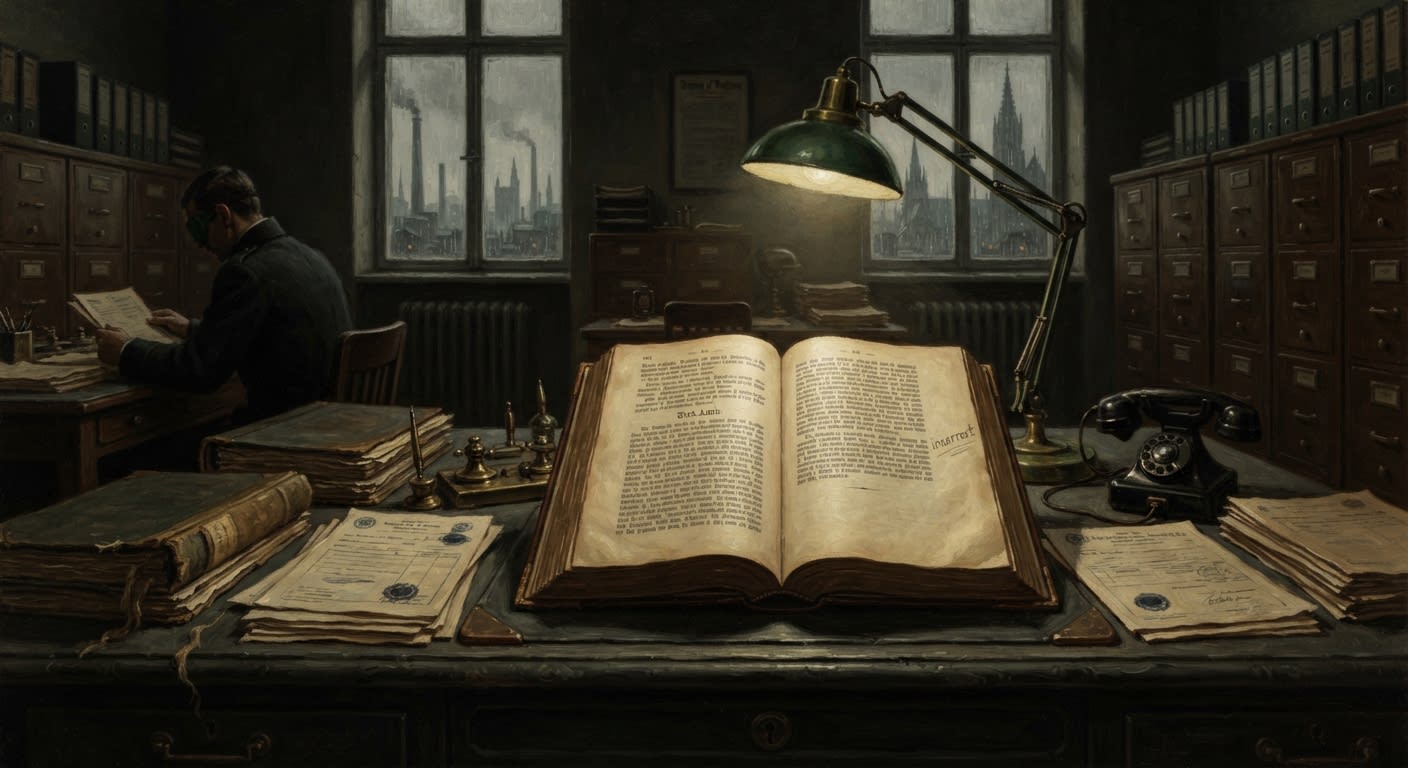
In A.S. 56, during the audit that became the Great Purge of Margins, examiners at a house of clean copying in Strasbourg opened a copy of the Articles and found one word pencilled beside the Third Article: incorrect.
The hand was unknown, and it has stayed unknown. The single witness said the mark was already there when the page dried. That statement is a lie, a miracle, or evidence that someone annotated the Article before its ink had set, which points to the copyist himself or to someone standing at his elbow. Silence treated all three possibilities as equally criminal. In this one respect Silence was consistent.
A note on names. The Bureau of Silence was not chartered under that title until A.S. 82. The auditors of 56 were censors of the emerging authority, working in one of the growing offices of the interim government. Silence later absorbed their files, their methods and their vanity, and now signs their work after the fact. I use the later name because the file does, and I do not argue with files in public.
A pamphlet would have been easier. A pamphlet argues, and argument can be answered, refuted, burned, and hanged with a text in its mouth. One pencilled word does not argue. It grades. Incorrect claims that the reader held the Article up against something outside itself (the weather, the harvest, the body, the ledger) and found that it failed. The equations of Trier and the tidal notes of Ghent were knowledge, and knowledge can be confiscated. The Strasbourg pencil was a method, and a method walks out of the building with whoever learned it.
THIRD ARTICLE: TEXT AS COPIED, STRASBOURG, A.S. 56 [wording sealed] Marginal annotation: incorrect (pencil; hand unidentified) Comparison against clean exemplar: [removed] Examiner's note: "The Article is correct. The copy is correct. The margin is incorrect." [struck through by a second hand]
#On the Purge That Followed the Margin
The Strasbourg copy was not the first seizure. Trier came first, with its hymnal and its correct acoustics. The Articles were the find that frightened the auditors most, because hymnals may be ornamented while the Articles were meant to be recited exactly. Within weeks, surrender orders reached every house of copying in the Rhineland, including Mainz, Ghent, Cologne and Strasbourg. Every annotated book was to be yielded for "doctrinal auditing," a phrase that has buried more men than cholera.
Forty-seven scribes were executed between A.S. 56 and 58. Twelve libraries were confiscated. Licensed Redactors re-copied the approved texts clean, and the marked originals were sealed. Copies of the Articles were recalled wherever the auditors could find them and reissued from a clean exemplar. An archivist who should not have told me says that Silence's later copies of the Articles have margins ruled narrower than any other approved text of their size. I have measured three. The archivist was right, and has since been transferred.
The marked copy went into a sealed file in A.S. 56 and stayed there for more than thirty years. When the Forbidden Stacks beneath Strasbourg were organised after the Concordat of A.S. 90, the file went down the stairs with the rest of the early audit material. It has not come back up.
#On the Ashen Use
The Ashen Circle did not have to steal the book, because it only needed the word.
By the time Silence declared victory in A.S. 58, incorrect was moving through Rhineland cellars faster than any courier could have carried the Articles themselves. Purity interrogation records, which I have read and which do not officially exist, note three uses. It served as a greeting between strangers who had not yet decided to trust each other. It served as a warning pencilled on a lintel, meaning that the house was watched. It was also a joke, said with a straight face over any official pronouncement: a harvest forecast, a sermon on hygiene, a notice that bread would arrive on Tuesday. The Ashen Circle Scholar still uses it in all three senses and trusts the listener to work out which is meant.
The Circle learned a second, costlier lesson from the Articles. An approved text travels where contraband cannot. After the Purge, Interdiction Squads began finding recitation copies of the Articles with lemon-ink between the lines. The ink showed stress figures, fever intervals and bell ratios when warmed over a candle, and nothing but devotion when cold. The permitted text had become a permitted crate, and the same Article a novice chanted at dawn might carry a bridge calculation by dusk.
The Bureau of Purity once proposed entering the word incorrect on the Index Damnatus. The Bureau of Doctrine objected that its own examiners needed the word to mark catechism papers. The proposal was withdrawn, and Purity has not forgiven the adjective.
#On Present Custody
As of A.S. 201, the marked copy remains in the Forbidden Stacks. Silence acknowledges that the file exists and denies that it contains an annotation. Purity classifies both the acknowledgement and the denial. Doctrine, which owns the approved text and so owns the embarrassment, maintains that the Articles have always been correct and that the Third Article in particular has never needed defending. Doctrine has defended it in four circulars since A.S. 150.
In the older Rhineland parishes the Articles are still set for recitation. A Doctrine Street Vicar who hears a novice stumble before the Third Article is instructed to note the pause, the novice's name and whether he smiled. Nobody has yet explained what the smile is supposed to prove. Every vicar I have questioned says he knows it when he sees it.
The Articles were composed, by whoever composed them, to bind the faithful to the Covenant in fixed words and a fixed order. They were copied because they were safe, recited because they were short, and left open on the desk because nobody thought them worth guarding. One stranger with a pencil used that trust to show that an approved page will take a correction as easily as an obedient man takes an order. Silence hanged forty-seven scribes over the discovery. The word has outlived all of them and every clerk who signed the warrants.
The wording of the Third Article remains sealed. I have read it, and I decline to say whether I agree with the pencil.