
#On the Articles Nobody Has Read
"Give the Creed to the mouth in pieces, and the eye need never be trusted with the whole." — Bureau of Doctrine, Custodial Instruction to Parish Readers
Every citizen of the Synod has recited the Creed today. Most did it before bread. Many did it again at a ferry slip, a ration table or a school inspection, or under the raised hand of a Street-Vicar in a square that had just gone quiet. Almost none of them could tell you where one Article ends and the next begins. They could not tell you how many Articles there are, or in what order the master copy sets them down. They are not meant to know. The mouth receives what the eye is denied.
That is the first doctrine of the Articles of the Creed, and the only one I am licensed to state in full. The Articles exist for those who hold the text. Those who recite it may feel the seams in the cadence, the way a reader feels the binder's thread under a folio, without ever seeing the stitching.
The Eternal Creed is required at dawn, at chapel, at transaction, at correction, at inspection and in oath-adjacent commerce. No citizen may lawfully own a written copy. Children learn call-and-response fragments. Parishioners learn the dawn cadence, merchants the transaction clauses, and soldiers interruption recovery, because artillery and officers both have a talent for breaking a line at the worst syllable. Each class holds its pieces and nothing else. Fitting the pieces together is a custodial function, and custody belongs to the Bureaus.
#On Division as Custody
A prayer is spoken. An Article is filed. The whole art of the Bureau of Doctrine lies in that difference. The living recitation was cut into numbered parts by Doctrine's harmonisers, who owned inkwells and ledgers. The saints had nothing to do with it.
Division made the Creed something the Bureaus could handle. An Article can be cited on a correction slip. It can be assigned: this one to the parish, that one to the counting-house, a third to the barracks. It can be quoted without surrendering the rest, or amended without admitting that the rest was amended. Above all, it can be prosecuted. A man who stumbles in "the Creed" has stumbled somewhere in the fog. A man who stumbles in a numbered Article has stumbled at a fixed address, and Purity keeps the directory.
The Strasbourg standard gained state force under the Concordat of Strasbourg in A.S. 90. That was a constitutional settlement made by the living after the founders were in the ground. From that year the Articles were state property in the fullest sense: the public recited them and the Bureau possessed them. The Catechism Third Revision of A.S. 104 hardened public enforcement. It sent Street-Vicars into the squares carrying correction slips, and each slip has a printed column for the Article at fault. The citizen does not know the Article's number. The slip does.
The Synod overworks the word "Articles," and the provinces pay for it. The Catechism of Obedience has Articles of its own. They form a separate instrument, printed and taught, and they are more dangerous for being readable. The Articles of Covenant were an approved teaching text that could safely lie open on a desk. Then, in A.S. 56, someone found a pencilled word beside the Third Article, and the text stopped being safe. The seven articles proposed at the first Council of Cologne in A.S. 27 were never adopted. A lecturer who presents them as the Creed's ancestors is citing a draft that lost the vote.
A Bohemian parish digest instructs its readers that "the Articles of the Creed number twenty-one, of which the Ninth defines heresy and the Nineteenth requires its report."
Corrected. The digest has confused the Creed with the Catechism of Obedience. Catechism Article 9 defines heresy by declining to define it and makes later declarations retroactive to first thought. Catechism Article 19, added in A.S. 134 under Grand Inquisitor Severian, makes suspected heresy reportable within twenty-four hours and treats silence as shelter. Neither is an Article of the Creed. The Creed's article count is not a public figure. The digest's compiler has been invited to forget the one he printed.
#On the Tablet Exception
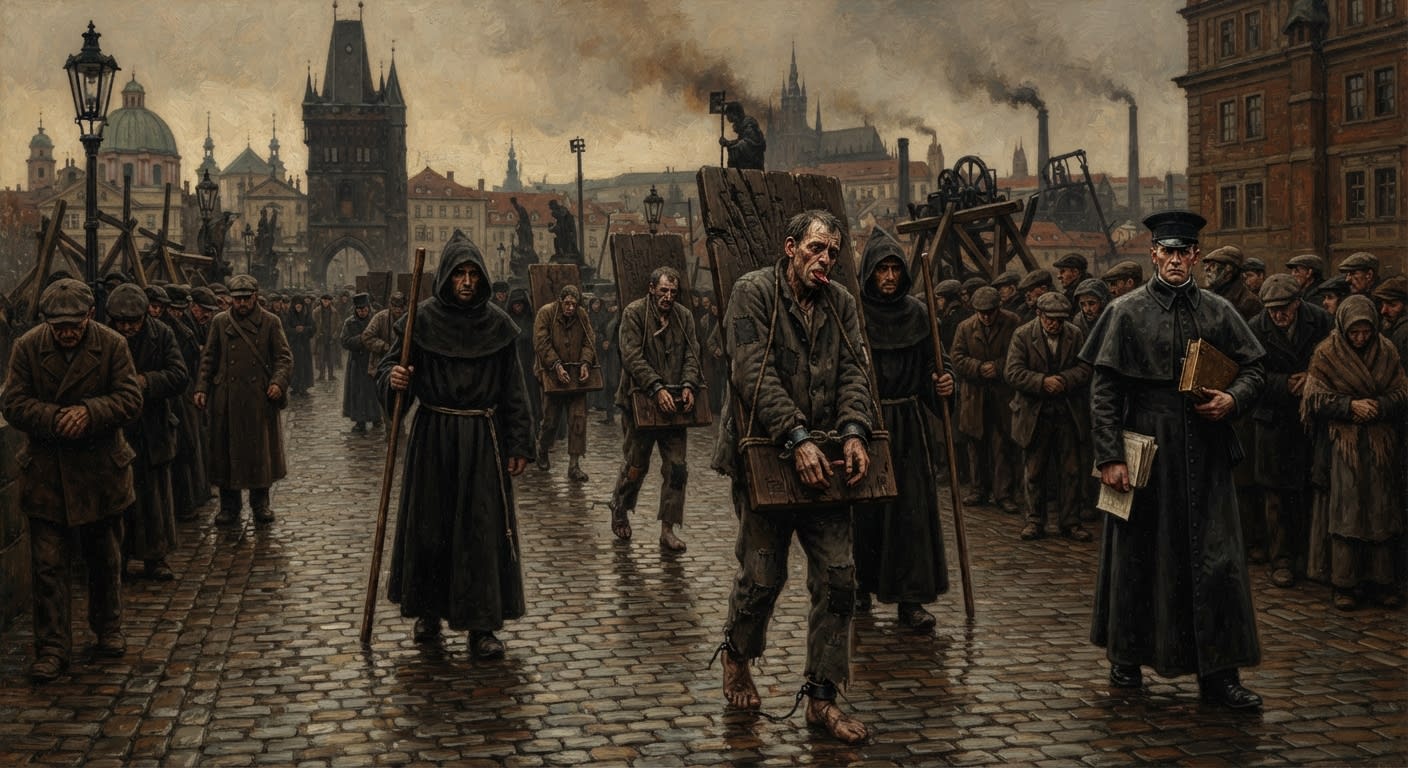
In all the Synod there is one place where a citizen may see Creed Articles written down. They are on the plank in front of a man whose tongue has been nailed to it.
Since A.S. 94 the Order of Saint Ephrath has conducted the Procession of Tongues in Prague under Bureau of Purity authority. The condemned carry tablets of dense oak. Both faces are engraved with Articles of the Creed, cut deep enough to hold a nail-head. Provincial minds find this scandalous: an oral Creed, walking through Prague in carved letters, in daylight. Provincial minds have misunderstood what a tablet is.
A tablet is not a copy. It bears only the Articles authorised for that convict and that face. Each board is matched to one condemned person, whose name is branded in small letters along the lower edge. The crowd cannot read those letters and was never meant to. The crowd is not the audience. The Ledger is. The engraving works the same way. It is deep enough for iron and useless to a reader on the bridge. By the second street the grooves around the nail have darkened, and after that nobody is reading anything.
The Triune Knot faces the crowd and the Purity seal faces the convict. Every onlooker therefore sees whose instrument this is. The man carrying it is reminded, at a distance of one nail's length, who is holding whom.
The nailing is done in private, in the Chapterhouse courtyard, with tongs, a single square nail and one blow. The hands are tied to the tablet's edges with tarred cord. A man who drops the Creed while his tongue is nailed to it has committed a second offence, and Purity prefers to process one at a time. The march leaves the Chapterhouse, crosses Charles Bridge and passes through the university quarter. The route was fixed in A.S. 96 and has not moved since. Afterwards the tablets return to the Ephrath warehouse, where the brothers sand them and file them by year. The older nail-holes have worn smooth. The newer ones still splinter.
So the written Creed exists in public on four conditions: as an instrument, as evidence, as a surface for the wound, and as a Ledger object. It never exists as something a citizen may consult. The tablet does not break the oral rule. It shows what a written Article costs the man who carries one.
A Rationalist broadside seized in a Dutch harbour claims that "the only full Creed in the Synod is carried across Charles Bridge every year, and any man who stands close enough may learn it."
Corrected. No Procession tablet bears the complete Creed in order. What the broadside calls the Creed is a set of authorised extracts, divided among many convicts, many boards and many years. Anyone standing close enough to read an Ephrath tablet is standing inside the Procession, and the Order keeps a tablet in every size.
#On Count Disputes
The Articles have a number. The number has variants.
Doctrine's internal copies do not agree on how many Articles the Creed contains. The explanation on file is contextual enumeration: each count is correct for the purpose of the copy that holds it. The explanation is sealed, and so are the counts. Any citizen who hears two numbers argued in a tavern must report the argument, the arguers and the tavern. Correct enumeration is never at issue in such a case. The offence is the idea that the Creed can be counted by someone who has not been cleared to hold the tally.
DOCTRINE ANNEX IV-B — TABLET CONCORDANCE, EPHRATH WAREHOUSE, PRAGUE Articles authorised for engraving in oak: ███████. Articles never to be cut in any material: ████ and ███████████. Count used by Ephrath cutters: █. Count used in the Doctrine master: ███. Reconciliation: "Each is correct for its purpose." Cutter's pencil note on the struck folio: "Then which one am I nailing him to?" Answer: classified.
This is tolerated because the vaults can hold disagreement safely. Mouths cannot. The proof is the Bavarian Creed Adjustment of A.S. 178. Doctrine ordered Munich into Strasbourg cadence over three syllables in the fourth line of its public recitation. Those syllables changed no meaning, and meaning was never the charge. The Bureau can live with three different enumerations of its own sacred text in its own sealed annexes. It will not live with one old stress pattern in a Bavarian throat. For a clerk, that settles what the Articles are for. They regulate cadence and they locate fault. Theology follows behind with the lamp.
#On Present Custody
As of A.S. 201 the division stands. Doctrine keeps the master and its terminal clause. Records keeps the attested variants, in columns that do not agree and are not meant to. Purity keeps the corrupted forms it needs for prosecution, so that a false Article can be read into evidence against the tongue that invented it. Shadows keeps the versions that no other Bureau will admit to holding. Ephrath keeps the oak.
The Procession has marched every year without interruption, from A.S. 94 to this one. In A.S. 199 the Bureau of Bells sent a delegation to record the march's acoustic profile for its reference on doctrinal acoustics. In the same year a Judge was seen at the foot of Charles Bridge while the tablets went by, their Knots facing outward and their Articles cut deep. The Prior's report said only vidit: he saw. Purity wrote in the margin: What did he see? The file does not record whether a Judge is cleared to read.