
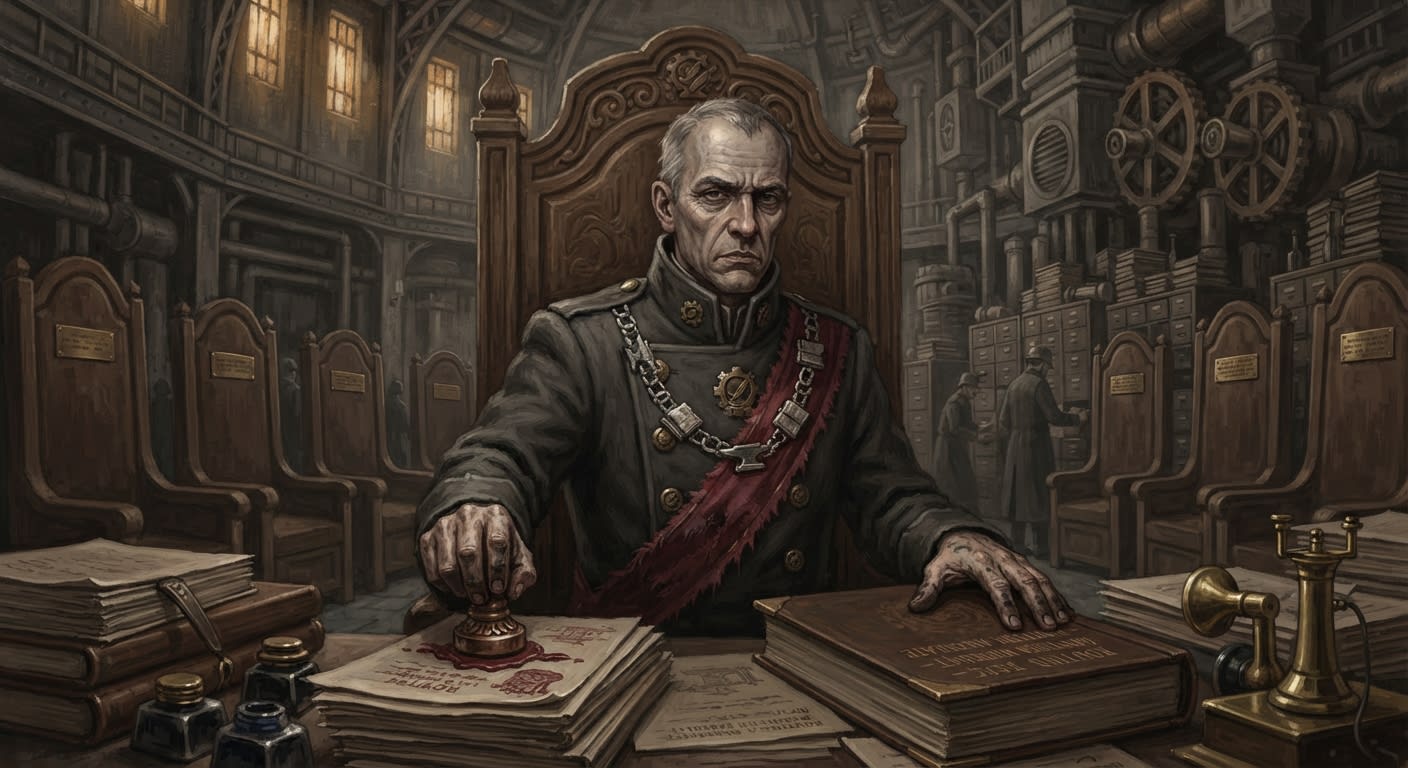
#On the Office That Pretends to Be a Person
"The seal outlives the hand. Press accordingly." — inscription on the lip of an archonal seal-press, Strasbourg
An Archon is a man seated in a chair that was carved before him and will be dusted after him. The chair is the Archon. The man is its current tenant, admitted on sufferance, expected to die tidily and leave the wax in good order.
The Synod uses the title for several creatures at once. It names the head of a Holy Bureau. It names the civil master of a great city or of a hierarchate's machinery. It names a threshold of seal, below which certain knots may not be untied, certain files may not be opened, and certain furnaces may not be cooled. Foreign jurists, in the rare years when foreign jurists are permitted to ask questions, request a definition. Strasbourg supplies three and bills them for a fourth.
The elasticity is deliberate. A word that means magistrate on Monday and Bureau sovereign on Tuesday can be pressed into any vacancy the constitution failed to anticipate, and the constitution, having been drafted by men with deadlines, failed to anticipate a great deal. The title takes the blow. When an Archon errs, the Archon is replaced. When an office errs, the office has been misread, and a misreading is corrected by circular.
#On Seats, Seals, and Recognition
Archonal authority is older than the Synod and younger than the Synod's claims about it. The Office of Bells received its constitution in A.S. 52, under the interim council that governed before anyone dared call it permanent. Benedict Veyrault gathered the scattered wartime registries into the Bureau of Records around A.S. 78, and later painters hung a chain of office on him that he may or may not have worn that year. These men exercised archonal functions before there was a constitutional Archon to hold them. The Synod files them retrospectively, in the same way it files the calendar.
The formal rank dates from the Concordat of Strasbourg in A.S. 90. That settlement fixed the Holy Bureaus at twelve and placed each under an Archon or a Procurator. There is a thirteenth, which does not exist and whose head therefore attends nothing. Concordat Hall was fitted out between A.S. 90 and 93. Its first semicircle of thrones stood by A.S. 92, and the speaking order was fixed after the successor council of A.S. 93. Since then the order has been amended by death, by precedence suits, and on one occasion by an armrest.
In the Hall, a seat means recognition, and recognition means jurisdiction. The Assembly of Thrones is advisory and procedural. It cannot command a single regiment. Even so, no Bureau that lacks a chair there has ever held a portfolio in its own name. A seat entitles its holder to the crimson writ of operational mandate, a line in the Tithes allocation, and the right to be wrong in public under his own seal. Any body without one enters the Hall as someone else's guest.
The clearest proof is the Bureau of Medicine, which employs more staff than Relics and Heraldry combined and keeps seventeen laboratories on the Rue des Cendres. It holds no Archon's seat. It sends no representatives to the Assembly and receives no crimson writ, and when it appears in Concordat Hall it does so under the borrowed seals of Mercy and War. Medicine measures the dying of half a continent. It cannot sign for its own coal.
#On Bureau Archons
A Bureau Archon owns a noun. Records owns memory. Bells owns lawful sound. Heraldry owns meaning wherever meaning can be painted on cloth. The ownership is interpretive. The Archon decides what the noun covers this year, which sounds modest and amounts to sovereignty conducted through a dictionary.
Theobald of Worms, first Archon of Heraldry under the A.S. 90 settlement, received a portfolio of banners, crests and municipal devices and treated it as an inventory. His successors read it more broadly. By A.S. 194, Casselius of Mainz was addressing the Seal-Cutters' Guild as Archon of Masks and Seals while still holding Heraldry. The two Bureaus remain separate in charter and united in his person, and Records calls the arrangement "irregular but not prohibited." The charter clerks of A.S. 92 intended one Archon to decide what a sign means and another to cut the die that makes it lawful. Casselius does both before luncheon.
The Archon of Bells guards a portfolio rooted in the A.S. 52 constitution, ratified at the Concordat, and committed to codical custody when the Bell Codex was ratified in A.S. 115. He is active as of A.S. 201 and appears to be immortal, although the office itself would be the first to deny it. Veyrault died in A.S. 118. The Ledger has not yet forgiven him, and his inkwell sits in the Archon's study, refilled every year and never dipped.
Archonal authority can also be lent out. Deputy Archons and Sub-Archons exist, and a few are even named in public. Deputy Archon Werrenrath and Sub-Archon Provisional Yvette Langres both carry the rank in its diluted form, much as a curate carries a bishop's crozier to the vestry: with care, briefly, and without the right to strike anyone with it.
Earlier provincial primers describe the Archons as a single ladder of equal rank, one to each Bureau, each answerable only to the High Synod.
Corrected. One Archon holds two Bureaus. One Bureau with a thousand staff holds no Archon. Some Bureaus are governed by Procurators, some Archons govern no Bureau at all, and some Archons have Deputies who have Sub-Archons who have provisional clauses. The ladder has been reissued as a staircase in a building under renovation.
#On Territorial Archons
The older public meaning survives in the provinces, where "Archon" still means the man who administers the city. In that usage he is magistrate, enforcer and the final signature on a hanging, and he turns law into spectacle because spectacle saves on police. Provincial catechisms teach children to bow to the Archon's carriage and to count the axles. The two lessons are one lesson.
Kanzleiburg refines the type. Its Archon sits on the Archonate Isle as the Northern Hierarchate's routing authority. His name appears in ordinary registers, and I omit it because naming him would suggest he matters more than his routing tables. In theory he answers to Strasbourg. In practice he governs northern logistics: rail priority, reserve depots, Hamburg liaison, winter coal and the fourteen days of stores that stand between the northern front and a very short sermon. The Archon of Kanzleiburg does not rule. The Archon routes.
This is the territorial form stripped of theatre. Kanzleiburg's Archon condemns nobody from a balcony. He delays their freight. A provincial Archon who burns a heretic in the square has made his point once. An Archon who can reorder the grain trains makes his point every morning.
#On the Archon Seal and Archon-Tier Silence
Below the chairs and the cities lies the true meaning of the rank. It is a threshold, and the Synod prices it in wax.
The Bureau of Records classifies certain folios "Archon-tier only," and the phrase does exactly what it says. Clerks below the tier may carry such a folio but may not read it. They may catalogue it by weight. The seal-binders of Records tie knots that no hand below Archon rank may undo; lesser officials who try are prosecuted for the fraying. My own warrant provides that local officers below Archon rank may not detain me. I carry it the way a pilgrim carries a relic, and invoke it far less often than I am tempted to.
The threshold also works as a lock on catastrophe. At Brast, the furnace called Saint-Combust stands under a standing directive: maintain the rites, monitor the hymn variants, and do not cool it without an Archon's seal. No chaplain, engineer or Ordnance inspector may put out that fire on his own judgement, however alarming the pressure needle. Doctrine calls this reverence. Engineering calls it the cost of a signature that has to travel from Strasbourg by rail. Both descriptions are true, and the furnace keeps burning while they argue.
Emergency powers are measured against the same line. An Inquisitor-Regent may supersede and command any officer below Archon seal within her jurisdiction. That clause tells you exactly where her weather stops.
#On Present Use
As of A.S. 201 the Archons are indispensable, disliked, and jealous of their jurisdiction. Most of them are competent, which Strasbourg forgives more slowly than vice. They quarrel in Concordat Hall over precedence, over cushions and over which of them owns a word, and each Bureau dispute that runs a decade is a decade in which no province has taken up arms instead. The Assembly spends their pride for them, one docket at a time.
The office is useful because a title can take blame while the machine that holds the title carries on. A grain failure can be pinned on the Archon of a city. A misfiled famine becomes the fault of the Archon who filed it. The seal remains clean. The chair is reupholstered, the wax re-poured and the new tenant sworn in, and within a season the petitioners are bowing to the same carriage and counting the same axles.