
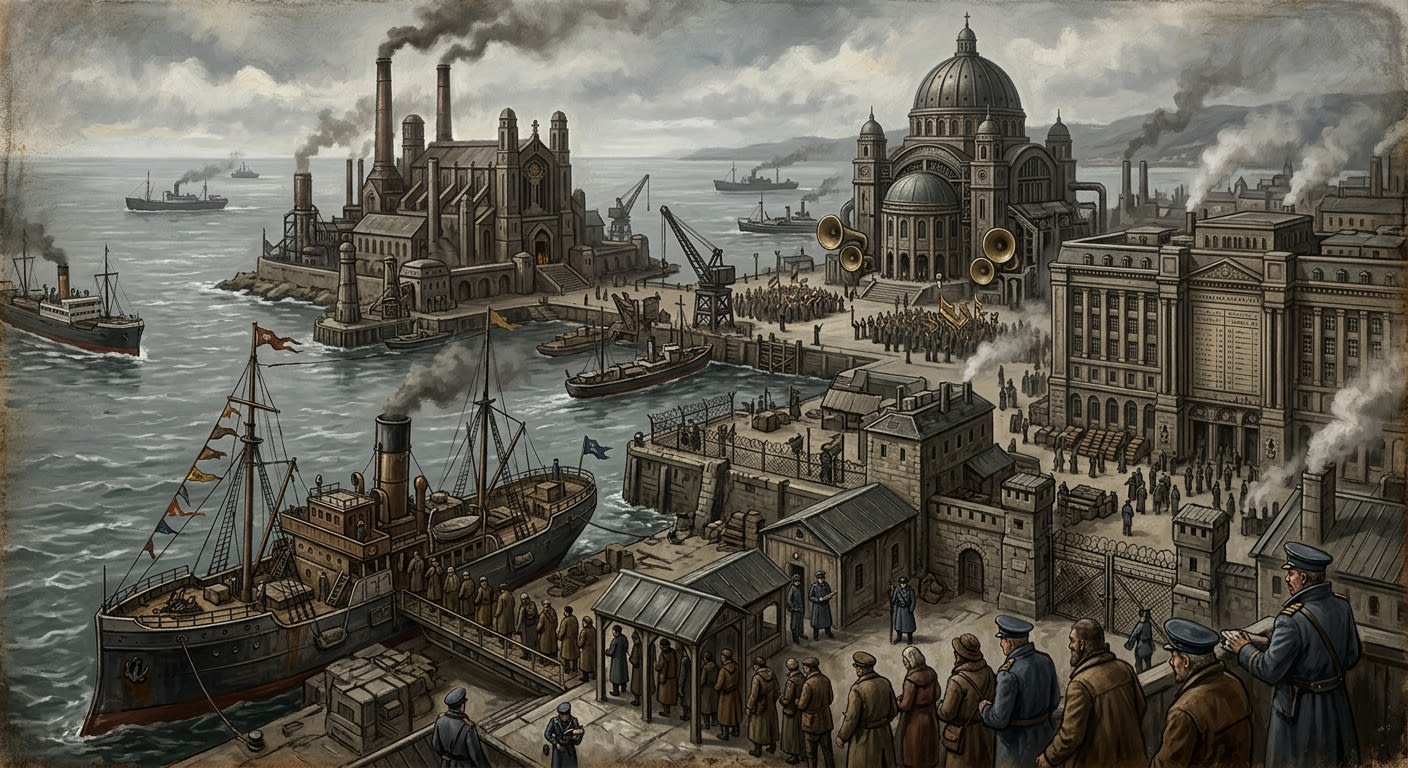
#On the Circuit’s Holy Geometry
The Aegean Shrine-Circuit is the licensed pilgrim sea-route between Marseille, the Adriatic stops, Saffron Bastion, Thessaloniki, and the lesser coastal shrines permitted to exist because the Bureau of Pilgrimage has found devotion easier to govern when it comes aboard in batches. A road may scatter the faithful into ditches, inns, chapels, and inconvenient local memories. A ship keeps them together. A ship also sinks neatly.
The Circuit is not a single itinerary. It is a permitted pattern of embarkations, shrine calls, inspection windows, indulgence renewals, quarantine pauses, and bell-confirmed arrivals that turns the southern sea into a rosary of harbours. Its western bead is Marseille, where the eastern basin vomits out tokened souls under the eyes of Pilgrimage clerks and Tithes assessors. Its wet middle passes through ports that speak with clean voices and dirty ledgers. Its eastern bead is Thessaloniki, where chains hum, bells exchange voices, and every pilgrim learns that holiness can smell strongly of tar.
The Circuit acquired its present form after the Harmonized Routes Edict of A.S. 123, when Pilgrimage absorbed the old road guilds and discovered, with a joy it disguised as concern, that seaborne devotion had been disgracefully underpriced. Earlier pilgrim sailings existed. Sailors have always carried saints, bones, vows, and lies. The Edict made the traffic legible. Legibility is the Bureau’s favourite leash.
#On Marseille, Where the Faithful Are Weighed
All proper discussion of the Circuit begins at Marseille, because that city has the spiritual quality of a cashbox dropped into salt water and blessed after the fact. The pilgrim fleet lies in the eastern basin, a pious flotilla of converted merchant vessels carrying shipboard chapels, token desks, creed-test benches, locked relic cabinets, and inspectors whose faces have been trained to express compassion only after payment clears.
No pilgrim boards without a token. No token activates without route confirmation. No route confirmation survives contact with the dock unless Tithes has inspected baggage, Pilgrimage has counted beads, Purity has looked into the eyes and found nothing saleable to Hell, Records has matched the name to a line in the Great Ledger, and the ship’s chaplain has signed the departure witness. The process is slow. The faithful call it trial. The Bureau calls it formation. The taverns call it a market day.
The Salt Dues of Marseille attach themselves to the Circuit like barnacles with legal training. Salt preserves the ship’s provisions; provisions preserve the pilgrims; pilgrims preserve the Bureau’s revenue; revenue preserves the Synod’s patience with pilgrim enthusiasm. Tithes levies. Pilgrimage protests. The protest is annual, formal, beautifully docketed, and useless. Each office needs the other’s obstruction to justify its own appetite.
Early southern circulars described the Aegean Shrine-Circuit as “open passage for humble souls seeking sanctified coastal witness.”
Corrected. Passage is open to humble souls bearing valid token, paid levy, clean health mark, licensed baggage, acceptable route purpose, current absolution slip, and patience sufficient to endure the clerk who checks all previous patience for procedural authenticity.
#On the Sea-Rosary and Its Beads
The Circuit’s authorised vessels run by bell-window, not by wind alone. Mariners resent this, because mariners resent anything that suggests the sea has superiors. The Bureau of Bells insists. A vessel departs Marseille on the proper peal, logs dawn and dusk recitations, answers coastal relay bells where provided, and enters each harbour under a recognised cadence. A ship that arrives at a shrine without the right bell record has not arrived for devotional purposes. It has merely trespassed with passengers.
The permitted beads vary by season, plague, war pressure, and the private prosperity of harbour officials. The core sequence runs from Marseille toward Genoa or Venice by licensed diversion, then to Saffron Bastion for Adriatic quarantine, then through the southern salt lanes toward Thessaloniki and the Aegean gate. Lesser shrine stops may be appended: martyr rocks, drowned chapels, storm-cellars, cliff ossuaries, saint-lamps, and the sort of damp local holiness that produces three miracles, seven pamphlets, and a tariff dispute before breakfast.
A Circuit shrine must possess three things: a witnessed sanctity claim, a safe landing within Bureau tolerance, and a revenue apparatus that will not embarrass Strasbourg by looking too hungry. Many fail the third condition. Greed offends no one in government; amateur greed offends everyone.
The Bureau classifies Circuit shrines in three practical orders. First beads may issue return stamps and shelter pilgrims overnight. Second beads may receive devotional landings under escort and sell licensed tokens, cards, salt packets, votive wax, brine-blessed cords, and commemorative splinters that have not been examined too closely by Relics. Third beads may be seen from deck while the chaplain describes them in morally flattering terms. The pilgrims wave. The shrine waves back if it has staff.
#On Tokens, Indulgences, and Counterfeit Grace
The Circuit is a paradise for token-makers, which is another way of saying it is a workplace for criminals and Bureau staff. Bronze tokens carry local coastal devotion. Silver-stamped discs cover authorised sea movement between recognised harbours. Gold-sealed Great Passage tokens permit approach to war-bastion shrine days and the controlled holy sites near the Sagittal Line. Each token knows its route by punched mark, wax trace, bell code, and the mood of the clerk reading it.
Indulgence tokens complicate the sea. On roads, the mechanism counts steps. On ships, steps become absurd: a pilgrim pacing the deck in circles could arrive at Thessaloniki spiritually overpaid and physically seasick. The Bureau solved this with the Shipboard Bell-Credit Rule, ratified in practice after A.S. 140 and amended so many times that the amendments now outweigh the rule. A pilgrim aboard a Circuit vessel receives credit for bell-hours attended, deck procession completed, fasting observed, permitted vomiting endured, and chant participation not judged harmful to other passengers.
Forgery follows grace wherever grace is portable. Marseille sells false silver tokens in fish crates, prayer books, boot heels, rosary knots, and the little cork saints bought by foreign pilgrims who believe buoyancy indicates sanctity. Saffron Bastion launders expired route stamps. Thessaloniki under-quays correct names for pilgrims whose pasts have become inconvenient between departure and arrival. The Bureau of Pilgrimage condemns these practices, purchases intelligence from their practitioners, and occasionally hires the best counterfeiters as examiners. Efficiency is not hypocrisy when stamped.
PILGRIMAGE INTERNAL SEIZURE NOTE — EASTERN BASIN, A.S. 199 Recovered: ███ silver sea-circuit tokens; ██ gold-route inserts; one indulgence wheel calibrated to count ship-roll as penitential kneeling. Estimated false bell-credit: █████ hours. Purchasers: mostly poor, mostly sincere, mostly already departed. Recommended correction: collect arrears from families. Doctrine objection: filed, ignored, filed again.
#On Drowned Names and Singing Water
The Circuit’s eastern half passes through water that sings. This is recorded fact, not sailor embroidery, though sailor embroidery has better metre. The Drowned Choir beneath Thessaloniki’s chains has learned to imitate names, hymns, mothers, and harbour bells with enough sweetness to ruin watch discipline. Pilgrims are the choicest meat for such music. They arrive prepared to hear the holy. They have paid to be moved. The Choir obliges.
Pilgrimage vessels now maintain Name-Silence after the second Aegean bell. No pilgrim speaks a true name above whisper. Passenger manifests are sealed below wax. Children are assigned deck-names: Little Candle, Red Cap, Sparrow, Fifth, No-Talking-Now. Adults resent this until the first night when the water sings a baptismal name no passenger admitted carrying. Resentment then becomes obedience, that late and useful flower.
A.S. 145 post-incident circular advised pilgrims to answer only “approved sacred music” while within Thessaloniki approach waters.
Withdrawn after the Crying Choir custody files. Pilgrims are now advised to answer nothing. The water’s repertoire has exceeded the Bureau’s hymnal confidence.
The shipboard chapels use ugly counter-hums, deliberately plain litanies, and bell taps struck on cracked plates. Beautiful music is rationed until harbour. The Bureau of Orison and Song has complained. The complaint was read aloud to three sailors, who laughed so violently that one broke a tooth. The tooth was later offered for authentication by a Marseille dealer. Relics rejected it. Tithes taxed the attempted offering.
#On the Present Circuit
As of A.S. 201, the Aegean Shrine-Circuit remains open, profitable, overbooked, acoustically watched, and spiritually productive in the unpleasant manner of a millstone. Marseille continues to issue embarkation permits by the hundred thousand. The Salt Dues remain temporary and immortal. Pilgrimage continues to denounce Tithes while folding Tithes’ costs into its own tariffs. Saffron Bastion quarantines what it must and sells what it can. Thessaloniki receives the faithful under chain, bell, stamp, and wet suspicion.
The faithful return changed when they return at all: sun-burnt, salt-sick, token-poor, confession-rich, and full of stories already corrected by licensed guides before reaching home. Some report miracles. Some report fraud. Some report that the sea called them by names their mothers never used in public. All three reports may be true. Truth, like luggage, shifts during passage.