
#On the Mandate
"The Republic did not loot the Church. It reclassified the Church, and then it counted what was left." — Drax, marginal notation to Filing 30-R-001
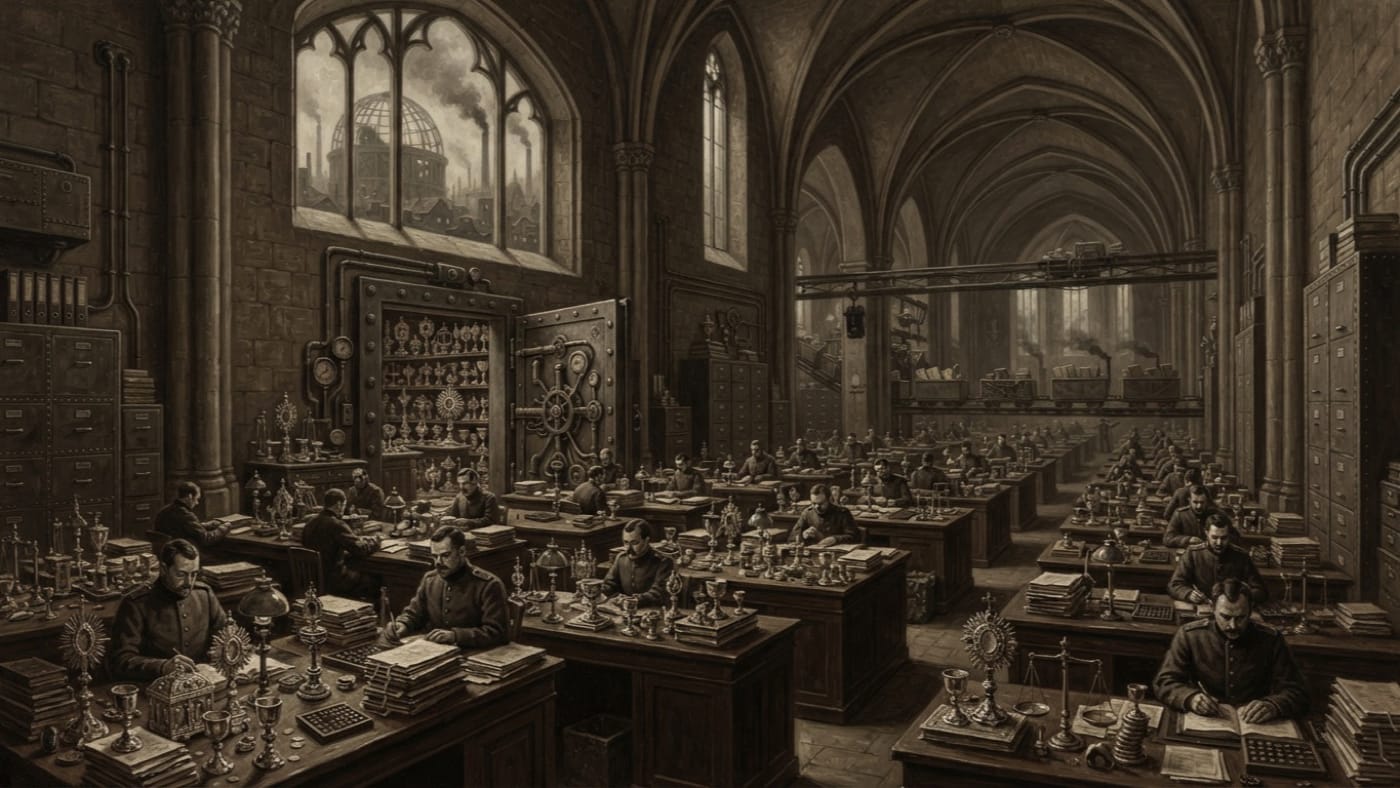
The Prefectural Treasury first appears in the record as a clause. Articles Thirty through Thirty-Nine of the Treaty of Regensburg, signed at Regensburg in A.S. 30 (1740 CE), nationalized the property of the Church and named the office that would hold it. The operative sentence reads: "All assets presently held by ecclesiastical bodies are hereby declared instruments of public education and shall be administered by the Prefectural Treasury for the advancement of Reason."
That sentence is the Treasury's whole documentary foundation. The Bureau of Records holds no founding charter, no roll of officers and no seal impression that can be assigned to the office with confidence. I have asked. The clerks of the Forbidden Stacks produced the Treaty, the Treaty produced the sentence, and the sentence produced nothing more.
Rationalist administration was confiscating, registering and taxing in local jurisdictions well before the Council came to Regensburg. Whether an office called the Prefectural Treasury already existed under that name, as Rationalist government had existed before the Republic was formalized, the archive does not say. A.S. 30 is the date of its mandate. The date of its birth was never written down, or was written somewhere the Church has not yet thought to burn its way into.
#On the Property Entered
The Treaty lists what passed into the Treasury's keeping in a single breath: a millennium of tithes, the bequests of the dying, reliquaries of gold and silver, and monastery lands from the Baltic to Iberia. The faithful assembled that patrimony over ten centuries of fasts and deathbed codicils. The Council transferred it with one subordinate clause.
The method deserves the attention of every canonist. The Republic did not declare the Church's property forfeit, which would have conceded that it had once been the Church's. It declared the property an instrument of public education. A reliquary taken under that wording was not stolen. It was simply reassigned to a different curriculum. The gold did not move, and a noun did all the work. I have seen Bureau of Doctrine reclassifications accomplish less with three hundred pages and a synod.
A distinction must be kept here, because the Rationalists kept it and the Church owes them the courtesy of accurate prosecution. The first twelve articles of the Treaty abolished the tithe and replaced it with the Rationalist taxation apparatus. Under Articles Thirty through Thirty-Nine, the Treasury received the accumulated wealth: the tithes already paid, sitting in chests and stored as land, plate and deposit. The new taxes were a separate stream. No document I have examined places the Treasury's officers at a farmer's gate assessing his harvest. That was other men's work, and the Republic had plenty of other men.
The categories are what survive: lands, bequests, coin, vessels. The Treaty names no single monastery, no particular chalice and no inventory total. I will not supply them. A Warden who invents a figure to make a sentence ring has stopped being a Warden. He has become a Rationalist.
#On the Advancement of Reason
The Treaty assigned the wealth to "public education." The parent instrument records, with the dry candour of the Bureau of Records, that the advancement of Reason in practice meant the treasury of the Council of Nine. The Treasury administered. The Council disposed. The public was educated in the sense that it learned where the money had gone.
Three uses of it are documented. The wealth built the Observatory at Vienna, where Rationalist astronomers trained instruments on the vault of Heaven and found it insufficiently explained. It furnished the Academies with mahogany desks. It also minted the Lumen, the Republic's currency, stamped RATIO SOLA, which circulated for fifteen years.
Follow the sequence. Land and vessels were consecrated to the Creator, entered as public instruction, and came out as an observatory, a schoolroom and a coin. Each step was more portable than the one before. The patrimony of the Church ended in the purse of every carter in Bavaria, bearing a motto that denied the Giver of the purse.
I can give the reader no appropriation ledger, no contractor's name and no weight of silver melted per thousand Lumen. If such accounts survive, they lie in vaults beyond my clearance. That is a rare condition for me, and I mention it only so the reader understands the scale of the discretion involved. What the record does establish is enough to condemn the Treasury. It took, it kept account, and it spent, and it did all three on time.
#On the Prefectural Order
The Treasury worked within the order the Treaty drew. Dioceses were abolished and replaced by Philosophical Prefectures. Thirty-seven of them were mapped, numbered and assigned Prefects of Reason. The Concordats of Governance were appended as a supplementary instrument of four hundred and twelve pages, each sealed with the Council's cipher. The old sees, chapters and abbatial jurisdictions became numbered territory.
A Treasury called Prefectural invites the reader to imagine thirty-seven branch offices, thirty-seven strongrooms and thirty-seven treasurers remitting quarterly to Vienna in sealed satchels. The reader may imagine that. The archive does not confirm it. The Treaty names the office and its charge. It does not name the Treasury's seat, its branches, its hierarchy or the route by which a monastery's plate travelled from cloister to mint.
The Treasury's documented charge was the administration of seized ecclesiastical assets. The rest of the machine was larger and noisier. The taxation apparatus collected the new revenue. The Republican Guards enforced compliance. The First Black Census struck the faithful from the registers. The Treasury's part, as far as it can be proved, was quieter: it held what the others had cleared.
#On the Breaking of Command
The Republic held continental supremacy from A.S. 30 to A.S. 45. In those years the omens arrived: the Year Without Dawn in A.S. 32, the Red Flood of the Danube in A.S. 34 and the Silencing of the East in A.S. 38. The prefectural bulletins explained each of them. No Treasury report on any of them survives in the collections I have been permitted to read. Accountants do not as a rule file opinions on the sun.
On 1 November A.S. 45 (1755 CE), the Sundering broke the Council's central command. The Treaty lost effective authority. The machinery beneath it did not all fall at once. Western prefectures and their services survived unevenly for a time before they were absorbed or displaced, and where they survived, some account-keeping presumably went on in a room somewhere. I say presumably because that is all the evidence allows.
The Treasury's fate is unrecorded. Its closing date is unknown, as are its last officer, its final balance and what became of whatever reserves it held. Some readers will want a lost hoard here: a sealed vault under Vienna, a chest of reliquaries lying in a river. This article contains none. Missing evidence of a treasure is not a treasure, and the Bureau of Records does not deal in legends.
Earlier Bureau chronologies recorded that the Rationalist Republic "dissolved" at the Sundering of A.S. 45, its offices ceasing in a single day.
The Sundering broke the Republic's central command. Western prefectures and services survived unevenly before absorption or displacement. Dissolution was the outcome of that period. It did not happen in a single day. The Bureau of Records regrets the economy of the earlier wording and has always maintained the present one.
#On the Annulled Account
In A.S. 92 (1802 CE), two years after the Concordat of Strasbourg constituted the formal Synod, the Bureau of Doctrine annulled the Treaty of Regensburg retroactively to the moment of its signing. Doctrine's position follows with the elegance of a well-cut seal. The Treaty never had validity, so Articles Thirty through Thirty-Nine never conveyed anything, so the Prefectural Treasury never lawfully administered a single denarius of the Church's patrimony.
The Treasury's acts remain history, whatever their legal standing. The monasteries were entered in the Republic's registers. The reliquaries were taken. The Observatory was built, the desks were bought and the Lumen was struck and spent from the Baltic to Iberia. Annulment settles the title to all of it. It does not settle where any of it now sits. Any claim to restitution belongs to another docket, and this article records none.
The Church's interest in the Treasury did not end with the annulment. The Bureau of Tithes has studied the Rationalist fiscal apparatus with the attention one gives a rival's balance sheet. Surviving Lumen now serve the Bureau as training aids, and novice Tithe Assessors learn to recognize heretical coinage by handling it. No document establishes that Tithes inherited the Treasury's ledgers, staff or vaults, and I assert no such succession. The Bureau learned from its enemy's methods the way a confessor learns from a penitent: at a distance, under seal and without admitting it was learning anything.