
#On the Naming of the Warnings
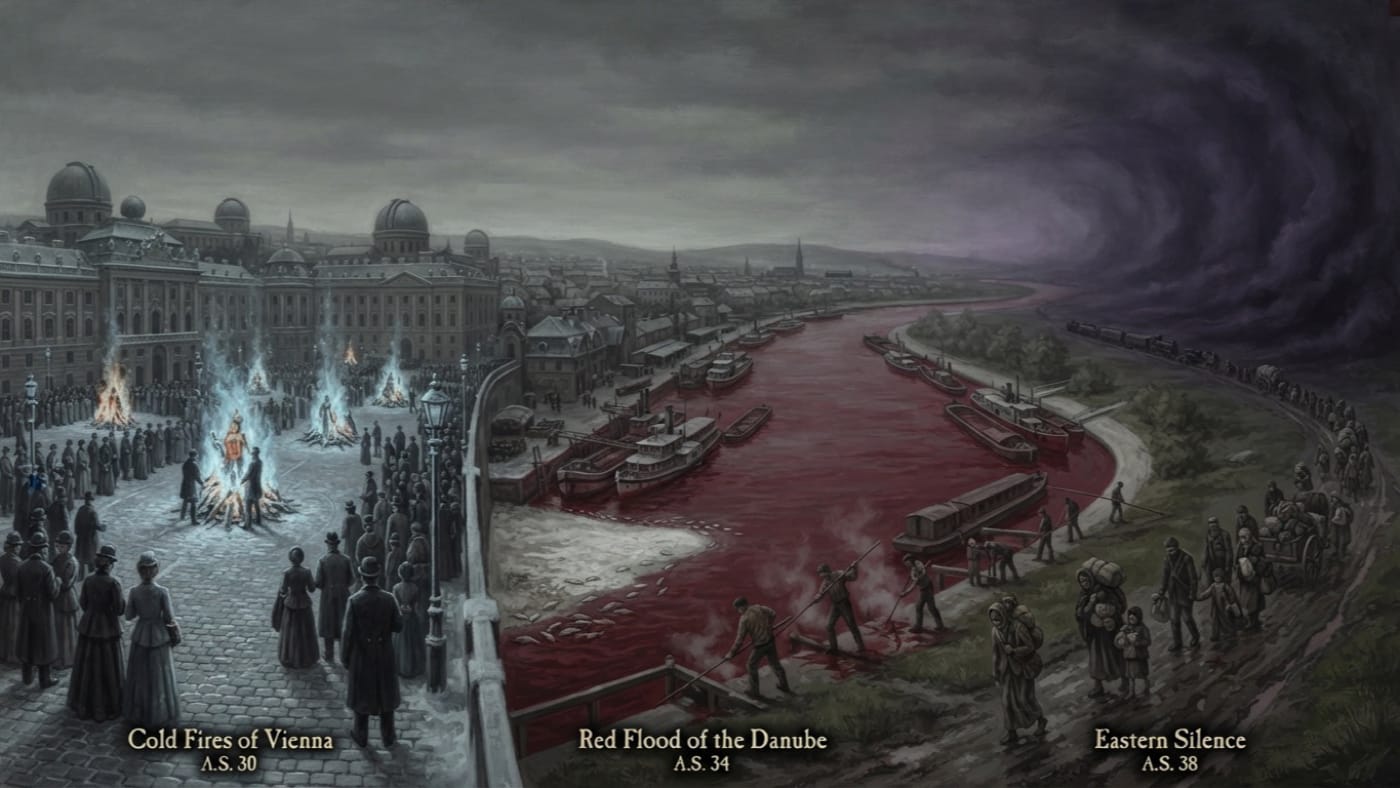
"First cold fire. Then absent sun. Then blood water. Then silence. Then Hell." — Hieromnemon Valerius Drax, plate on the Red Flood of the Danube
Four disasters fell on Europe in eight years. Nobody who lived through them called them a sequence. In A.S. 30 the fires of the Black Procession at Vienna burned without heat. In A.S. 32 the sun failed to rise. In A.S. 34 the Danube ran crimson. In A.S. 38 the Balkans stopped answering their letters. On the first of November, A.S. 45, the East opened, and the Sundering gave the four the ending they had lacked.
The intervals were two years, two years, four years and seven. Fifteen years separate the first heatless pyre from the catastrophe.
The first omen fell in the year of the Treaty of Regensburg, which gave the Rationalist Republic its formal constitution and its supremacy across the continent. Rationalist administrations had governed for some years before that. Nobody has established the year they began, and I will not invent one for them. The Holy See of Vienna had been dissolved. What remained of the Church prayed in basements and wine-cellars under the Cellar Saints, fed whom it could, and kept records it had no means of publishing.
The grouping came afterward. The Bureau of Doctrine put the four together once there was a Bureau to do it, and it reads them as one warning that the Republic refused to hear. That reading is the Bureau's. The years and the order belong to the record.
#On the Cold Fires
The Cold Fires are the burning at the Black Procession. They are the same event, and the Codex does not count them twice. The Rationalist authorities in Vienna paraded forty-seven saint-effigies through the boulevards under mourning cloth and brought them to seven pyres in the Heldenplatz. The crowd had come for spectacle and warmth, since November in Vienna gives little of the second. The pitch caught. The flames rose high, bright and orderly. People pressed forward to warm their hands and drew them back numb.
The eyewitness accounts agree on the light and on the cold. Frost formed on coat-buttons within reach of the flames. Frostbite is recorded among people who stood closest to the fire, and deaths from exposure are recorded among those who stayed to watch the effigies burn down. The heat a pyre owes its audience never arrived.
The Rationalists called it "a chemical marvel" and set their natural philosophers to look for the compound. The Bureau of Doctrine, classifying the event retrospectively in A.S. 92, named it Elemental Rebuke. In Doctrine's reading the Creator withheld the warmth of fire from an act of sacrilege. In the Rationalists' reading somebody had mixed the pitch badly. Both readings are on file. Only one of the parties is still filing.
#On the Days Without Sunrise
Two years later the sun stopped coming up. The Year Without Dawn brought no blackness. The sky turned a flat, depthless grey that gave noon the strength of a winter dusk and left no shadows. The stars disappeared from it. Observatory logs at Vienna recorded a brightening in the east that rose to a certain pitch and went no further, day after day.
The canonical count is forty days. The Bureau's own count is fifty-seven, and the Bureau of Records reconciled the two by ruling that seventeen of those days fell below the threshold for classification as distinct temporal units. I preserve both figures because both are documented. The difference is a matter of counting policy. Physical measurement does not settle it, and no physical measurement has been offered.
Grain blackened in the fields. Cattle stopped grazing. Rhineland shepherds reported their flocks walking in tightening circles. River pilots could not tell bank from channel, and ships on the Atlantic approaches went aground on coasts they never saw. Professor Gérard Molyneaux of the Académie des Sciences at Vienna attributed the grey to a volcanic eclipse caused by an eruption nobody could locate, and the Académie praised his reasoning. That explanation belongs to the Republic. The Codex does not adopt it as a cause, and it adopts no other cause either.
Two things from these forty days outlasted the grey. Later birth registers describe a cohort of infants born in that season who had grey eyes and made no sound. They are the Greyling Cohort, and the registers are the only claim I make about them here. In one district of Lyon, a Cellar-Prior called Calistus led the faithful through the Hollow Fast: forty nights without bread, undertaken against a plague creeping in from the Rhône. The plague stopped at the district boundary. When the fasters came out, they had lost their tongues. The Hollow Fast happened inside the second omen and is a subordinate episode of it. The Bureau does not count it as a fifth.
Doctrine holds the Year Without Dawn as the second omen by position and designates it Total Luminous Withdrawal. Older primers attach severity grades to the designation. I have left them out, because no one has ever shown me the scale.
#On the River's Three Weeks
In A.S. 34 the Red Flood of the Danube turned the river crimson for three weeks. The first reports came from the toll-houses near Passau, then from the ferrymen at Linz, who refused crossings, and then from the docks at Vienna, which closed after labourers burned their hands hauling mooring ropes soaked in red water. Some stretches of the river boiled and others steamed. Backwash drowned villages along the banks. The dead fish lay so thick that the shallows went white with their bellies.
The Republic's hydrologists blamed iron deposits, mineral displacement from the Carpathian basin, and heat from underground. Each explanation was published, praised and posted on the quay walls with instructions not to drink the water.
The Bureau's holding is Blood Tithe of the World: the river paying blood ahead of the war that was coming. This is doctrine. No assay ever established that the Danube ran with human blood, and I have never presented that finding to anyone. The fish, who were best placed to judge, left no testimony.
Several local primers give the duration of the Red Flood as forty days.
Corrected, as the dossier on the Flood already records. The Flood lasted three weeks. Forty is the canonical count of the Year Without Dawn, and forty nights belong to the Hollow Fast at Lyon. A clerk who mixes up his forties will find that the Codex corrects them for him.
#On the East That Ceased to Answer
The Eastern Silence had no single day on which it began. In A.S. 38 the correspondence from the Balkans began to fail, and it failed unevenly. A parish missed its grain return. A magistrate sent no quarterly tally. A posting station closed with a fever. Couriers went out and did not come back, and then caravans did the same. Across Serbia, Thrace, the Wallachian marches and the western passes, the gaps in the mail grew from one district to the next until the gaps were all that came from the East.
Settlements stayed on the maps for months after anyone had last heard from them. Tax columns stayed open for them.
The refugees arrived before the explanations. They came west along the Danube roads with children, icons and bread gone grey at the crust. They reported forests that moved without wind, churches blackened from the inside overnight, and valleys that people walked into and found changed when they walked out. I set their accounts down as testimony, because testimony is what they are. The Republic set them down as sedition.
Vienna's answer was quarantine. Travel east was forbidden. Accounts of the supernatural were prosecuted as disorder. The official holding was that the eastern districts were suffering a "regional communication failure," which was accurate in the way a coroner is accurate when he writes "stopped breathing."
The Silence did not lift after a season. It deepened for seven years.
#On the Classification Made Afterward
On the first of November, A.S. 45, the Balkan theatre opened, and the demonic host came out of it in the open. The Republic's central command broke within the season. Some of its western offices kept functioning for a time, unevenly and without instructions from anyone. The hidden Church came up out of the cellars because there was no longer a government it needed to hide from. The Sundering has its own plate, and it gets no more than this paragraph here.
The four omens became a sequence only when someone looked back at them. The grouping took shape in Church memory after the Sundering. The Bureau formalized it decades later, through retrospective classifications such as the Elemental Rebuke and Total Luminous Withdrawal entries of A.S. 92, long after the formal Synod had been constituted at A.S. 90. The Bureau's holding is that the Creator warned the Republic four times in fifteen years and that the Republic filed each warning under a natural cause.
The record supports the order, the years and the Republic's explanations. The record does not show a shared mechanism behind the four omens. It does not show that the cold at the Heldenplatz and the silence in Thrace came from the same hand, and it does not show what finally broke open in the Balkans in A.S. 45. Doctrine asserts the connection, and I transmit that assertion faithfully. I would not have this office if I did otherwise.
Doctrine's position is convenient for Doctrine. A Church that could not publish a single prophecy between A.S. 30 and 45 found, once it had a Bureau, that it had foreseen all of it. The surviving evidence is still available to anyone with clearance to read it: the observatory logs, the toll rolls, the Prefecture's eleven lines and the refugees' depositions. None of it says what the Bureau says. None of it contradicts the Bureau either, and that suffices.