
#On the Years So Named
This survey, entered in A.S. 201, concerns a label and the record that carries it. "The Plague Years" is the name the surviving account of early-bastion unrest gives to a period in the Rhineland when sickness, hunger and the curfew met in the same streets, and the curfew lost. The survey does not concern a disease. The record names no pathogen. It holds no count of the dead that the Bureau would sign, and it gives no first year of sickness and no last.
What survives is narrower: the curfew riots of A.S. 78 through 83 (1788–1793 CE), six years of disorder, securely dated. The Plague Years ran through them. The record does not say whether they began before A.S. 78 or ended after A.S. 83, and I decline to answer on its behalf.
The same account calls the period "the long grey decade." That is rhetoric. In that sentence a decade measures weariness, and an epidemiologist who counted ten years from it would be counting adjectives.
ERRATUM — Survey correction, A.S. 201 The published account of the Lantern Mercy Preachers places "the Lull of Names, the Plague Years, the long grey decade" in a single breath after the riots of A.S. 78 through 83, as if they were three names for one sickness. They are not to be read so. The Lull of Names is a separate subject with its own file. The Plague Years designate the Rhineland unrest surveyed here. "Long grey decade" is description. None of the three is to be filed as a synonym for the Breach Plagues of A.S. 112 or the Schism of the Unspoken, whatever vocabulary they share.
#On Exhaustion under Curfew
The record names the pressures plainly, and I will not ornament them: hunger, cold, disease, the loss of children. It adds a fifth that no physician treats, which it calls the amputation of hope. These arrived house by house, in no order the record troubles to supply.
A curfew asks a population for a particular kind of labour. The household must be indoors at the hour, the lane empty at the bell, the lamp out when the lamp is told. In a healthy year this is discipline. In a year of sickness it asks a woman to leave a fevered child without the neighbour across the lane, because the lane is closed, and to wait for the bell before going out for bread that may not be there. Grief keeps no hours. The bell keeps nothing else.
The early administration had men to enforce the hours: the truncheon-bearers whom later registers file among the Wardens. Their instruction was obedience. They met the public at the corner, the doorway and the queue, at dusk, the hour when exhaustion is most inclined to argue. A Warden at such a corner tells a starving man to go home and endure. The man has been enduring for some years. What he is asked to endure at that corner is the instruction itself.
The account I rely on states this with a candour I would not have permitted in my own draft. Men will endure hunger, cold and loss. They will not endure being told to endure these things by someone holding a truncheon. The Ledger had no column for that distinction. It required one.
#On the Insufficiency of Force
The administration had three instruments of public calm, and the account names them with an alliteration I admire: the bell, the brand, and the boot. The bell called the hour. The brand marked the offender. The boot did the rest.
Each worked, for an evening.
Take a crowd at a crossing in A.S. 80. I name no crossing, because the survey has none to give. A file of Wardens could break such a crowd in a quarter of an hour. Dispersal is a simple operation: the crowd becomes persons, the persons become doorways, the doorways close. The report is written: order restored. The following week the same persons stand at the same crossing with the same complaint, sharpened by a bruise.
This is the low-grade mutiny that the account attributes to "half the Rhineland." I set the fraction aside. It is the sweep of a writer warming to his subject, and nobody with a pen and a census ever counted it. What it describes is real enough without arithmetic: disobedience that would not organise, elected no captains, published no demands, and simply returned. Lanes opened after the bell. Queues broke their columns. Men stood where they had been told not to stand, went home when struck, and came back. There was no muster and no banner, nothing a general would recognise. A rebellion can be defeated. This could only be repeated.
The record compresses the lesson into a sentence, and the sentence is worth more than the six years that purchased it: A mob dispersed by force reassembles. A mob soothed by a familiar voice does not.
I am a servant of the brand, and I do not apologise for it. The brand is a fine instrument for marking a man. It does nothing about his reasons for standing in the street, and the boot does less. The administration learned at some expense that it had built a machine for scattering crowds and had nothing for keeping them scattered.
#On Licensed Consolation
The remedy was slow. The Curfew Ordinance of Quiet Hours dates to A.S. 94 (1804 CE), eleven years after the last riot in this survey and four years after the formal Synod first sat. A reader who sees a straight line from A.S. 83 to A.S. 94 has drawn it himself. The record does not say the sickness lasted until the Ordinance, or that the Ordinance ended it. It says the Ordinance came later, and it says what the Ordinance did.
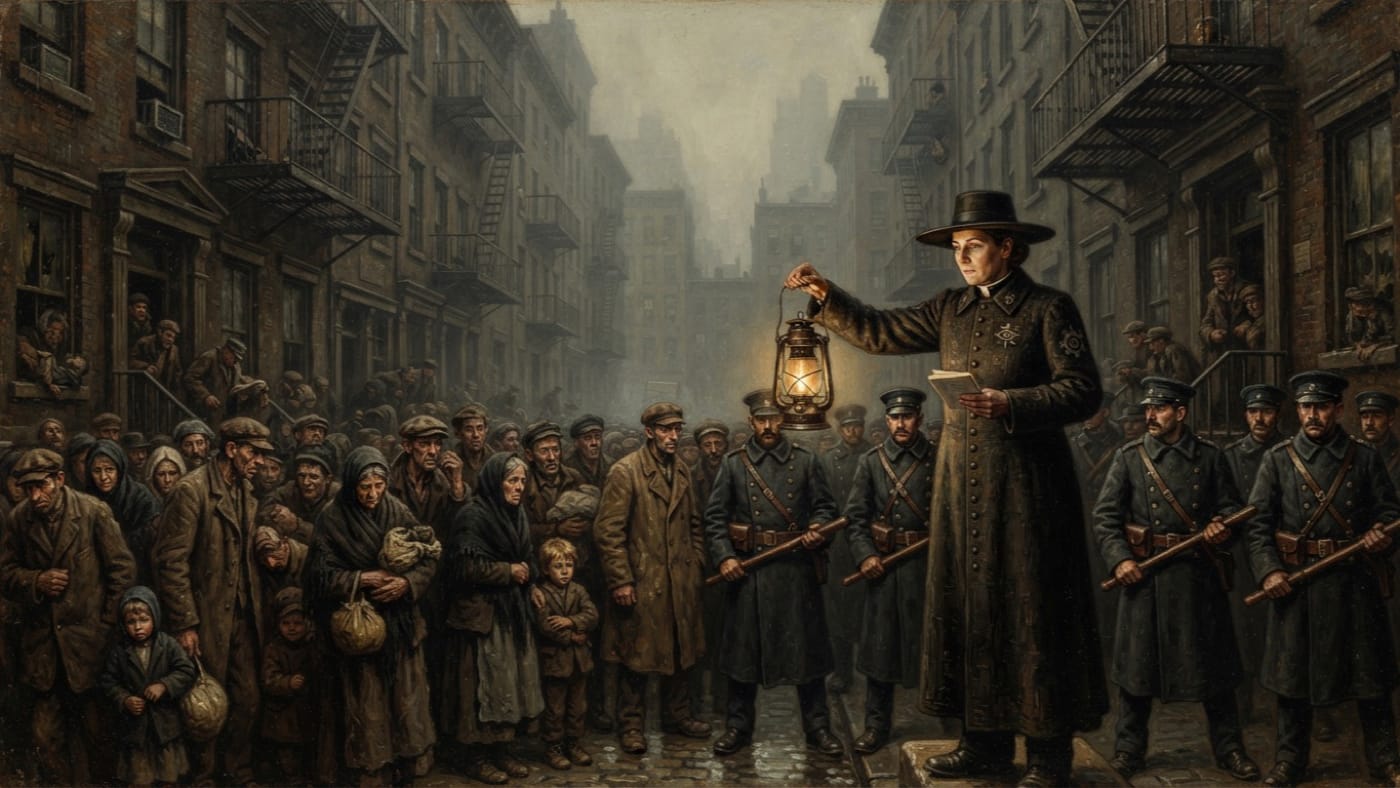
It created the Licensed Consolator. The clause, ratified in the margin of a supply requisition, provides that persons of approved temperament be stationed at crossing-points during hours of darkness, bearing sanctioned lanterns and approved texts of comfort, to reduce disorder.
Observe the distribution of duties. The Bureau of Rites wrote the texts. The Bureau of Purity vetted the temperaments. The Bureau of Records stamped the lanterns. That made three Bureaus for one kind word, each answerable for a third of it: the words, the mouth and the lamp. No Bureau was answerable for whether the comfort comforted.
That was the design, and I defend it. The Consolator was posted to the crossing, the same corner where the Warden had failed. The Warden had stood there with a truncheon and said go home. The Consolator stood there with a lantern and said, in phrasing approved by Rites, much the same thing, more gently, in a voice the lane might come to know. The sentence did not change. The speaker did.
The ordinance states its own purpose: to reduce disorder. A quiet street was what it had to produce. A widow who went indoors comforted and a widow who went indoors exhausted were, for the purposes of the requisition, the same widow. Consolation was licensed as an instrument of order. Nobody claimed it was medicine, and nobody prescribed it for the fever.
#On the Inheritance of the Years
The Plague Years produced an office. The office produced a difficulty of its own, which the record calls by no grander name than meaning it.
The administration chose people of approved temperament and sent them into the fog, night after night, to say comforting things to the grieving. It did not foresee that someone who says you are not alone to the bereaved for enough nights may come to believe the sentence. Nor did it foresee that the bereaved, hearing it together, might come to believe it of each other. Grief shared at a crossing makes acquaintances, and acquaintance at a crossing after the bell is what the Bureaus would later file as congregation.
What followed belongs to the Lantern Mercy Preachers and to their file. This survey stops at the crossing. It records that the curfew was enforced by force and failed, then enforced by comfort and held, after a fashion, at a price the Bureau of Purity is still invoicing.
The Church could not beat a population into calm, so it licensed someone to talk the population there. The Bureau has always regarded this as a triumph, and it has always kept the talkers under surveillance.