
#On the Instrument
"Iron keeps the feet honest." — saying of the departure yards
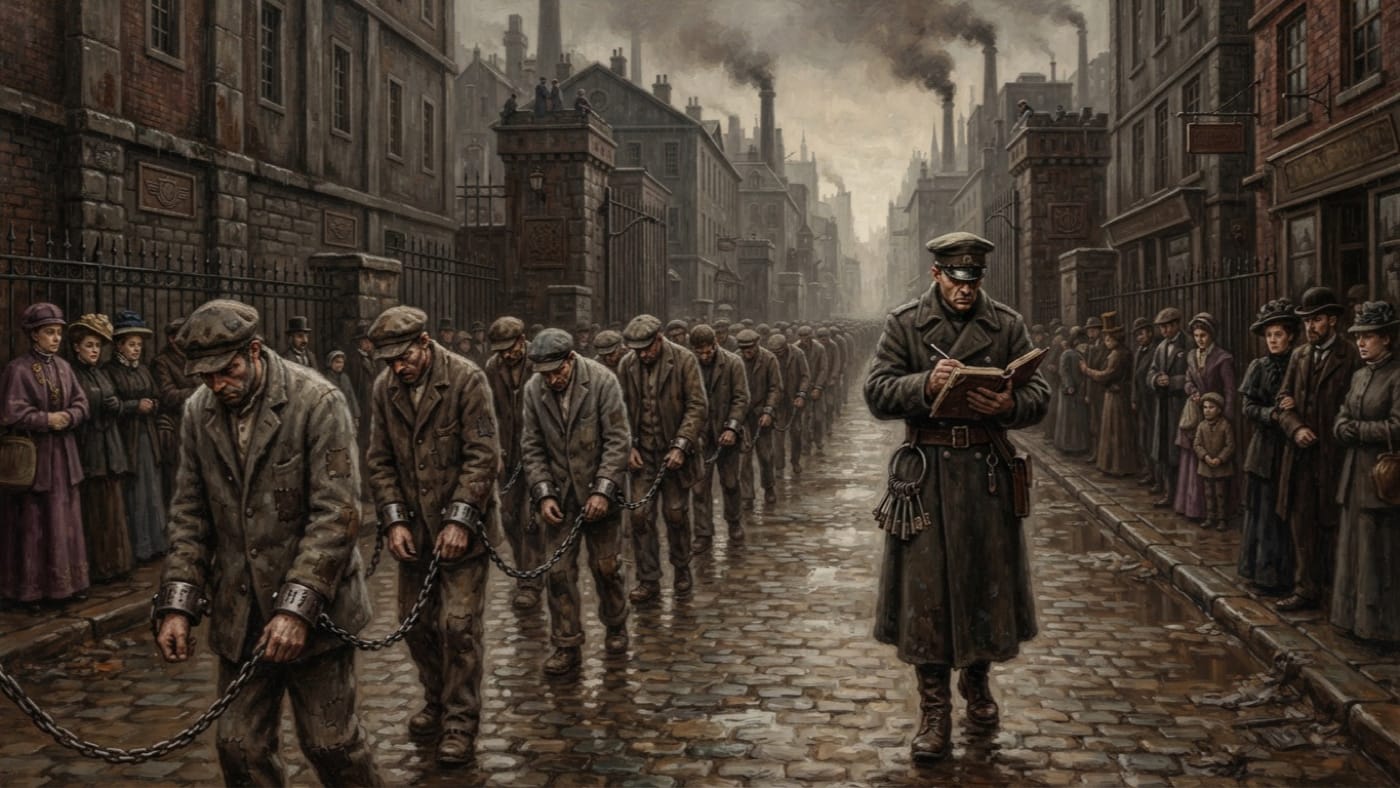
The pilgrim-chain is ordinary iron with a sacrament fastened to it. On the march it runs wrist to wrist down a column of penitents, with a cuff at every joining. Each cuff carries a serial number, and each number answers to a line on a slate held at the head of the column. Doctrine holds that the condemned are corrected by walking and that the Church is entitled to watch the correction happen. The chain makes both claims enforceable. A man who walks of his own will may stop of his own will. A man fastened to forty others walks when they walk, and his penitence is shown to every parish the column passes through. That display is the purpose of the chain, and the Bureau of Rites has said so more beautifully than I intend to.
I have handled the thing. It is cold at Prime and warm by the third bell, and by evening it smells of the wrists inside it.
#On Oath and Iron
From A.S. 94 to A.S. 108 the Jubilee walked unchained. The condemned swore oaths at departure and marched under escort, and the arrangement trusted the road to do what the escort could not. The road declined. Pilgrims left the column at market towns, at river crossings, at the edge of any parish sympathetic enough to open a cellar door. A generation of heretic cells and black markets was stocked with penitents who had walked off the end of their sentences. The Handlers' lore remembers one such desertion as the First Jubilee Flight and counts its defectors in thousands. No record I would sign fixes its year, its route or its organiser, and I leave all three unfixed.
The iron came in A.S. 109. The Handlers who carry its master keys were licensed under Jubilee charter in A.S. 112. The Bureau of Pilgrimage existed for neither event. It was established in A.S. 123, took over the chain, the Handlers and the roads in a single consolidation, and has run all three ever since as though it had forged them. Three dates, then, and three separate hands. Readers who want one tidy founding may consult the Bureau's pamphlets, which are tidier than the record.
The Codex entry On the Pilgrim-Chain Handlers blamed the Bureau of Pilgrimage for the collapse of unchained delivery figures before A.S. 109 and implied that the same Bureau introduced the chain.
The Bureau of Pilgrimage was established in A.S. 123. The chain was introduced fourteen years earlier under Synodal and Jubilee administration, and the surviving record does not name the office responsible. The Bureau has been informed that it inherited the instrument. It has asked that "inherited" be amended to "perfected." The request is denied.
#On Links, Cuffs and Keys
The earlier entry calls the chain "a single continuous run of links," and on the march it is exactly that, unbroken from the first wrist to the last. It is continuous the way a procession is continuous. A Chain Keeper with the proper key can open it at a segment joint, and does so at bridges, at latrine halts, and whenever a body has to come out of the line. The same entry credits the forging to contracted foundries. I have no reason to improve on that attribution and several reasons to leave it alone.
The cuff is stamped with the pilgrim's route tag: name, offence class, destination shrine and serial number. That is identification. Permission belongs to a different piece of metal, the bell-hour token struck by the Route-Stamper, which records whether the bearer may be on a given road and at what hour. The cuff states who you are, and the token states whether you are allowed to be where you stand. The two are checked against each other at every shrine. A pilgrim whose cuff and token disagree becomes a problem that nobody on the road wishes to own.
Custody of the keys is ranked. The Link-Runner carries the lowest keys, which can tighten or loosen a cuff and do nothing else. The Chain Keeper's keys part one segment from the next. The master set belongs to the Handler and stays on the Handler's person. At night it is tied to the wrist. In the morning it is kissed. A lost master set ends a career, and a stolen one ends a career and summons the Bureau of Purity.
Inspection comes before the first step. The Handler marks both wrists with ash. The links are counted aloud, every lock is tried, and grit is shaken out of every cuff, because road sand under iron turns a bruise into a wound by the second day. "Rust tells," the Handlers say. A filed link shows a brighter face than its neighbours until the first rain dulls it. A tired counter who skips a link at dawn is how a column comes to lose a segment by noon.
Three configurations are authorised. Road marches go single-file, bridge crossings go paired, and crowded urban processions go in what the Handlers call centipede groups. The centipede came out of an efficiency review in A.S. 160, which wanted more penitent faces visible to more spectators per street. It achieved that.
#On the Common Pace
A chain distributes everything put into it. When one pilgrim stumbles, the wrists ahead are pulled back and the wrists behind are pulled forward, and both neighbours stumble a little in turn. A man who lunges toward a baker's window drags six others with him. A woman who collapses becomes a dead weight hanging from two cuffs, and the column must stop, lift her or haul her. Shared restraint turns one person's exhaustion into a hazard for the whole column. The Church never preached that kind of solidarity, but the iron enforces it every mile.
Water is poured from the Handler's mercy gourd, staggered down the line, and entered on the slate against the cuff serial of whoever drank it. The quota formula dates from the Road-Mercy Scandal of A.S. 136, when Handlers were found selling relief and fourteen of them were burned. It was last revised in A.S. 141. Rest and bandage cloth are counted the same way. Since the Bellway Harmonisation of A.S. 148, the Bureau of Bells has also required each column to reach each shrine-post within its bell-window. A column that halts for its weakest member loses time, and one that leaves its weakest member behind must open the chain, record the opening and explain it. Every road the Church has sanctified passes through that arithmetic.
#On the Count and the Confession
At every shrine the column halts and the reconciliation begins. The Route-Stamper counts bodies, reads cuffs, checks tokens and sets all of it against the Handler's slate. The count must agree. It always does, and the work that ensures it agrees is done on the road between shrines, by people paid for it.
The confession is then taken while the pilgrims are still chained. They kneel on the shrine stone with their wrists joined, and shrine clergy write down what they say on pre-ruled vellum strips. The Handler cannot hear a confession and has no authority to absolve one. The Handler's work at the shrine is logistical: the pilgrims must kneel and speak, the strips must be gathered and sealed, and every refusal must be marked on the slate. Sealed packets travel with the column to the Bureau of Records. Repeated refusals and suspected heresy go to the Bureau of Purity, which receives them gratefully and returns none.
The chain stays shut through all of it. The Handlers have a superstition that a pilgrim unlocked at a shrine is called back to it. The procedure manual reaches the same conclusion by another route: a pilgrim fastened to the column cannot leave the shrine while confessing.
#On Release and Completion
A column ends in one of three ways, and the ledger keeps them separate.
The first is unlocking. At the destination the Handler's master set opens the cuffs, and the pilgrims are handed over to whoever receives them, whether that is a relic-site, a labour yard or an ossuary. The sources record the handoff and nothing after it. Absolution, restored standing and the road home are matters for other offices, and I have not found them written into this one.
The second is cessation. A pilgrim who stops breathing on the road is unlocked at the roadside and entered on Form 17-C, Cessation of Ambulatory Penitence. The Handler signs it and the nearest shrine-priest countersigns it. The form accounts for the cuff and makes no claim about the wrist. A column can therefore deliver every serial on its slate while delivering considerably fewer people, and the Bureau counts both outcomes as a completed journey.
The third belongs to the chain itself. The iron goes back to the depot, where its links are counted against the departure tally, its locks are tried, and it is hung up for the next column.