
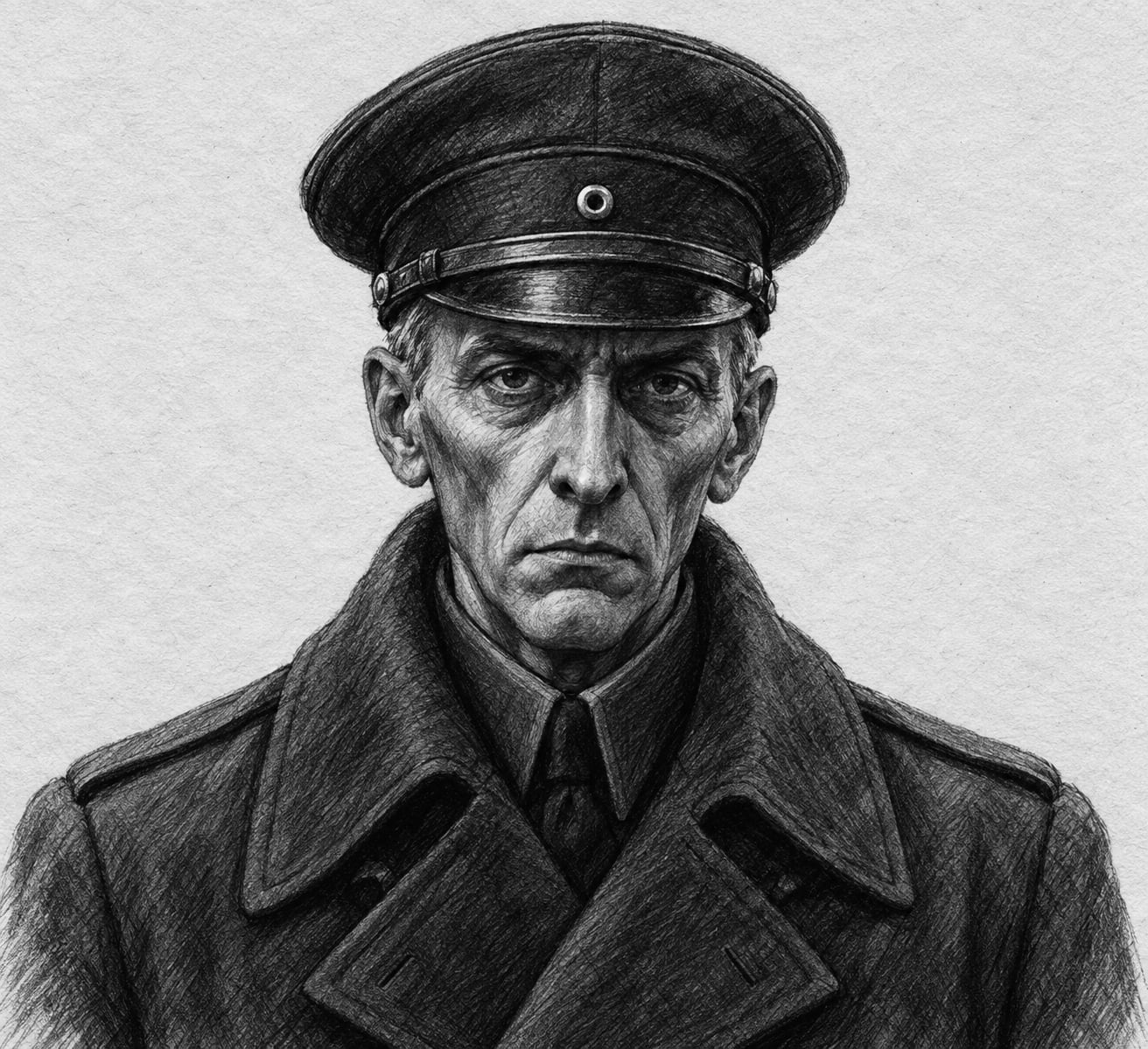
#On the Station
"The Republic wanted a man at the barrier who could weigh a sack of salt and also decide whether it had been blessed."
The Philosophical Prefect appears in the Ledger exactly once, and the appearance is a failure. In the autumn of A.S. 31 (1741 CE), a year after the Treaty of Regensburg gave the Rationalist Republic its formal shape, an official with that title stood at the Cologne bridgehead and examined what crossed the Rhine. His name is not recorded, and neither is his rank in the Republic's administration. What survives is his remit. The account preserved under Saint Ignatius the Carrier gives it as the inspection of documents and parcels and of "items of potential superstitious significance."
The whole office lies in that last clause. Any customs-house can tally barrels of wine. The Republic required something further of this post: a judgment about which objects the faithful still revered, and which of them a traveller might be fool enough to carry over a river in daylight.
He did not stand alone. Four Republican Guards served at the same barrier, and the account places them there with him without saying anything more about the arrangement. It does not say who answered to whom, who held the keys, or who wrote the evening report. I decline to draw the organisation chart the record withholds. A barrier with four Guards and one examiner of superstition is description enough. The Guards brought force. As far as the account shows, the Prefect brought the question of where that force should fall.
#On Documents and Parcels
"Everything that crossed was a confession, if one knew how to read it."
His duties named three kinds of thing, and they are worth separating, because the Republic did not. A document declared in ink who the bearer was and what he was doing. A parcel made the same declaration in wicker and cloth, and could lie just as easily. The third category was the one this barrier existed for: an object whose offence lay entirely in what the faithful believed about it. To a Rationalist a loaf is a loaf, and a finger bone wrapped in linen is a finger bone. The Prefect was posted to find the second kind of object inside the first.
The stakes were plain. The Republic counted sacred objects as contraband, and a man found carrying relics was exposed to the Rationalist tribunals. What those tribunals did to such men is recorded elsewhere in this Codex, in entries I do not recommend before meals. The Prefect himself is not recorded as trying, sentencing or executing anyone. His post was where the question got asked. Other men supplied the consequences.
That is how doctrine came to a river crossing. Cologne's ordinary traffic still moved over the Rhine as it always had: clerks, carters, washerwomen, men with letters for their cousins. They now passed one more official, and he put one more question to each of them, and in that way faith became a dutiable good.
#On the Breadbasket
"The Prefect looked at the basket. The Prefect looked at Brenner."
Ignatius Brenner, a parish clerk of Cologne, came up to the bridgehead in his ordinary brown clerk's coat with a wicker basket on his left arm. It was covered with a checked cloth. Under the cloth was black rye bread, and under the bread were three apostolic phalanges, taken from their reliquary in Cologne before the Republic could dispose of them.
The Prefect asked his business. Brenner said he was taking bread to his sister in Deutz. The Prefect looked at the basket and at the man carrying it, then waved him through.
The attested act ends there. I have given it almost exactly as the account gives it, because every word I added would be mine and not the record's. The record allows him one question, two looks and a gesture. It does not put his hand on the cloth.
Brenner had no sister in Deutz. He chose the kind of story a clerk would choose, domestic and dull and impossible to check from the western bank. Nothing in the record says what the Prefect believed. The phrase "waved him through" settles only what he did. He may have suspected the basket and declined to search it. He may have been paid, or quietly devout, or at the end of a long day of baskets. The Ledger supports none of these, and I will not counterfeit an answer to flatter either the Republic or the faithful. Doctrine is free to see the Creator's hand in that gesture. All the Ledger records is a man who looked at a basket.
On the far bank the bones met the Republic a second time. At the Deutz landing a Republican Guard, a different man with no recorded connection to the bridgehead barrier, lifted the corner of the checked cloth, saw bread, and put the cloth back. That act was his alone. The Ledger keeps the two inspections apart and so does this entry. One official asked and looked. One soldier lifted and looked. Neither of them found anything.
I record this without irony, since none is needed. The Republic placed an examiner of superstitious objects at one of its busiest crossings. Three of the most sacred objects in the Rhineland passed under his eyes in a basket. He let them go to Deutz on the strength of a sister who did not exist.
#On What Passed Beyond the Barrier
"Bones are patient. Inspectors are paid by the day."
Brenner took the basket to the brewer Aldric Hartmann, whose cellar served the clandestine parish network later remembered as the Cellar Saints. Hartmann hid the bones beneath his brewery. They stayed there for fourteen years, until A.S. 45, the year of the Sundering on 1 November (1755 CE). From then on the Republic had more pressing enemies than parish clerks.
After the cellar the phalanges passed through several custodians, and in A.S. 48 (1758 CE) they came into the hands of Brother Tomislav at Kalnik Ridge. There they were among the relics that blazed against Maldrake's host. Brenner was not present. In A.S. 104 (1814 CE) the Church canonised him, and the Bureau of Relics authenticated the bones whose concealment had begun at the Prefect's barrier.
I state the chain of custody precisely so that no reader gives the Prefect a share of the miracle. Brenner carried the bones and Hartmann hid them. Whatever burned at Kalnik Ridge, neither man lit it, and the official at the bridgehead had even less to do with it. His contribution was an omission, and the Church does not carry omissions in procession.
#On the Surviving Record
"The Ledger remembers him for the one thing he did not do."
Other Prefects at other barriers presumably found what they were posted to find. If so, they left no mark on this Ledger. This one is remembered because the basket went through. His office survives in the record only as the place where its purpose failed, and it is not recorded anywhere else.
The rest is outside the record. Nothing establishes when the post was created or when it ended, and the Republic's collapse after A.S. 45 does not give it a closing date. Nothing records the man's name, what became of him, whether he ever learned what had passed under his eyes, or whether he would have cared. The Church has no claim on him. As far as the Ledger can show, the Republic got exactly the inspection it paid for.