
#On the Disaster and Its Authorized Name
The Penance March of Extraordinary Zeal never marched. It is the name the Bureau of Records gave to the Knife Mile Catastrophe of A.S. 137. The name lies over the disaster the way a pall lies over a stretcher: neatly, in the approved colour, with the shape underneath still visible to anyone who stays a moment too long.
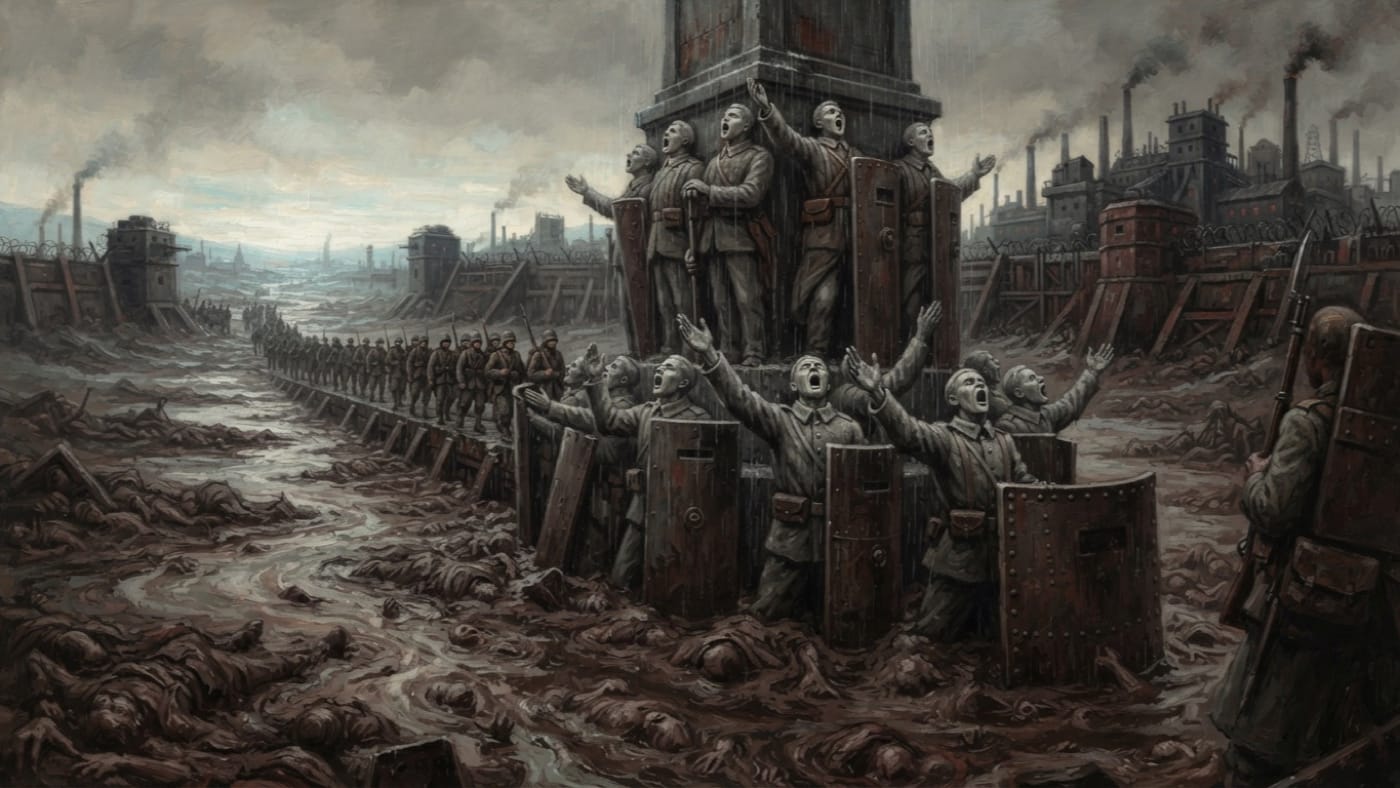
The facts under the pall are simple. The Knife Mile is a contested sector of No Man's Land facing the Ravelin of Vigilance, the outwork that watches the northern approach to Bastion-Constantinople. Constantinople is the southern anchor of the Sagittal Line, where the Line meets the Bosphorus. Raids had shaved the sector's parapets down to stakes. Then the ground gave way. Flesh-Mud took men to the knee, then the belt, then the shoulder, and kept them. A company of Shield Paladins drove their tower-shields into the mire, hooked rim under rim and braced their arms through the straps as they sank. That was the emergency Mud Lock, a causeway made of iron and men's backs. The Radiant Fusiliers crossed it and fired from the far lip until the breach closed. Whole companies died waist-deep to buy that crossing, and it was worth buying. The Bureau of War has never claimed otherwise, and on this one point War and I agree.
The paperwork came afterward. The corrected forward annals record that within three months the Catastrophe had become the Penance March. No procession, route or founding rite goes by that name. It is a title fixed to a drowning.
#On Penance and Extraordinary Zeal
The title makes three claims at once. I admire it the way a joiner admires a mortise he did not cut.
Penance gives the event a purpose. A drowned man is a misfortune. A penitent is a theological event: a debt owed, a debt paid, and a creditor satisfied with the payment. Families who could not be given a body could be told the account was settled.
March gives it order. Marching men keep step, follow orders and move toward an end. The word takes a company sliding downward into slurry and stands it up in column.
Extraordinary Zeal is the masterstroke, because it reaches inside the dead and gives them an intention. Zeal belongs to the will. By naming it, Records made a claim no deposition could disprove, because the only men who could speak to their own wills were under the mire.
The proclamations finished the work. Records declared that the men had deliberately immolated themselves as anchors for the Line, offering their bodies so the Line might rest on them. Note the verb. Immolation is altar language. It needs a victim who consents and a fire that consumes. The Knife Mile supplied neither. It supplied a swallowing.
I keep two things apart here because Records joined them so expertly. The Paladins who formed the Mud Lock chose, in the worst minute of their lives, to turn their shields and bodies into a road. That choice is documented. It had tactical value, and it was brave. The Bureau's account stretches that minute backward over every man in the sector. Sappers who went under before any order was given became volunteers after the fact. One company's decision was spread across a catastrophe like a single altar cloth dragged over a common grave. The cloth is genuine, and so is the grave.
Records proclamation, as carried in commemorative copies: the men of the Knife Mile "deliberately immolated themselves as anchors for the Line."
Corrected by Doctrine for restricted readers. The men of the Knife Mile drowned and sank in Flesh-Mud. Some, under orders and by their own resolve, braced their shields so that others could cross on them. Anchors may stay in the hymnody. Anchors also go to the bottom.
#On the Witnesses Required to Read
Testimony is the natural enemy of a good title. The survivors of the Knife Mile had seen the mud close over faces. They had walked on shields with men still strapped beneath them. Their depositions said so in the unlovely grammar of men who have just come out of a trench. That grammar could not stand beside the word zeal.
Records dealt with the depositions in several ways. Some testimony was destroyed outright. Other depositions were sealed, shortened, rearranged, or replaced with proclamations wearing the witness's own name. A portion went into restricted appendices, where officers may study it and families may not. These are different fates for different sheets. Any clerk who says the whole record burned is lying, and so is any clerk who says the whole record survives. I have checked both claims myself, as Warden of the Sacred Ledger.
Then came the stroke that lifts the Reframing above ordinary falsification. The survivors were made to read the authorized account aloud at assemblies.
Consider what that does. Read by a herald, a proclamation is a claim. Read by a man with Knife Mile silt still in his boot seams, it is testimony. His presence certifies it, and his scars become the seal. The sentence about willing anchors and joyful descent comes out of the one mouth best placed to deny it, and the denial never arrives. Records did not need the man to believe the sheet. It needed his voice, and it needed him back on the bench the following assembly.
The record does not say what the readers thought while they read. Records was careful that nothing they thought would ever be written down.
The children are another matter. Sons and daughters heard the account in their fathers' voices, assembly after assembly, until they believed it too. A child has no reason to doubt his father's mouth. The Bureau understood this better than any catechist I have trained. It gave the lesson to the one teacher whose authority a child would never examine.
Records keeps harsher instruments for men who refuse to fall in line with the narrative. Nothing in this file shows that they were needed, and I will not invent a cruelty that Records was too thrifty to require.
#On the Faces Given to the Dead
Then Records gave the proclamation a body. Statues were raised showing drowning soldiers in noble poses, mouths open in song.
The sculptors faced a real problem and solved it elegantly. A drowning mouth is already open, and the mud fills it. Each sculptor had to decide what the stone mouth would seem to hold instead, and every one of them chose a hymn. The jaw that the mire forced open became a jaw raised in praise. The arm that thrashed for a shield strap became an arm lifted toward the Creator. The sinking was kept, because it could not be hidden, and the agony was edited out.
Where the figures stand, how many there are, what they are made of and whose chisel shaped them are questions this entry does not answer. Their posture is certain: serene, upright as far as the sculpted mire allows, eyes lifted, throats open. That serenity belongs to the monument. The mud gave the men nothing of the kind.
The statues finished what the assemblies began. A child who heard the account in his father's voice could look up and see it confirmed in a stone face. Voice and image agreed with each other, so the child had nothing left to set against them. This is the coherence Records prizes: an account repeated in every medium the parish can see or hear, until every alternative must argue with the whole parish.
#On the Account That Remained
Two accounts run side by side, and Records keeps both.
The public one sings. It is the account of the proclamations, the assemblies and the open stone mouths, and it holds that penitent men went down willingly so the Line could stand on them.
The restricted one sinks. Its main document is the Ledger of Mud, which Records began after the Catastrophe. It sorts recoveries by depth and consistency where a decent register would use names. Its display copy in Strasbourg is blackened, stiff and partly unreadable, and Records has stamped it Balanced in red wax. The Ledger has its own entry and its own sins, and I will not crowd them in here. It is enough to say that the Ledger counts what the Penance March sings over. The sealed appendices hold whatever testimony escaped the brazier. The Bureau of Mercy keeps its objections on file, where objections are kept.
Records' reasoning has never been hidden from anyone with a reader's seal. A coherent account keeps an army obedient. Despair needs evidence, so a Bureau that controls the evidence controls the despair. The Knife Mile's morale was expected to collapse. Records answered that expected collapse with a title, a script and a sculptor.