
#On the Origin
The Ledger of Mud is a register of the Bureau of Records. Records opened it after the Knife Mile Catastrophe of A.S. 137 to account for the men the ground had taken and kept. I have reviewed it. I did not compile it and I did not stand in the mud that supplied it. I have also never been asked to scrape that mud from my cuffs, and I count this among the quieter mercies of a Doctrine appointment.
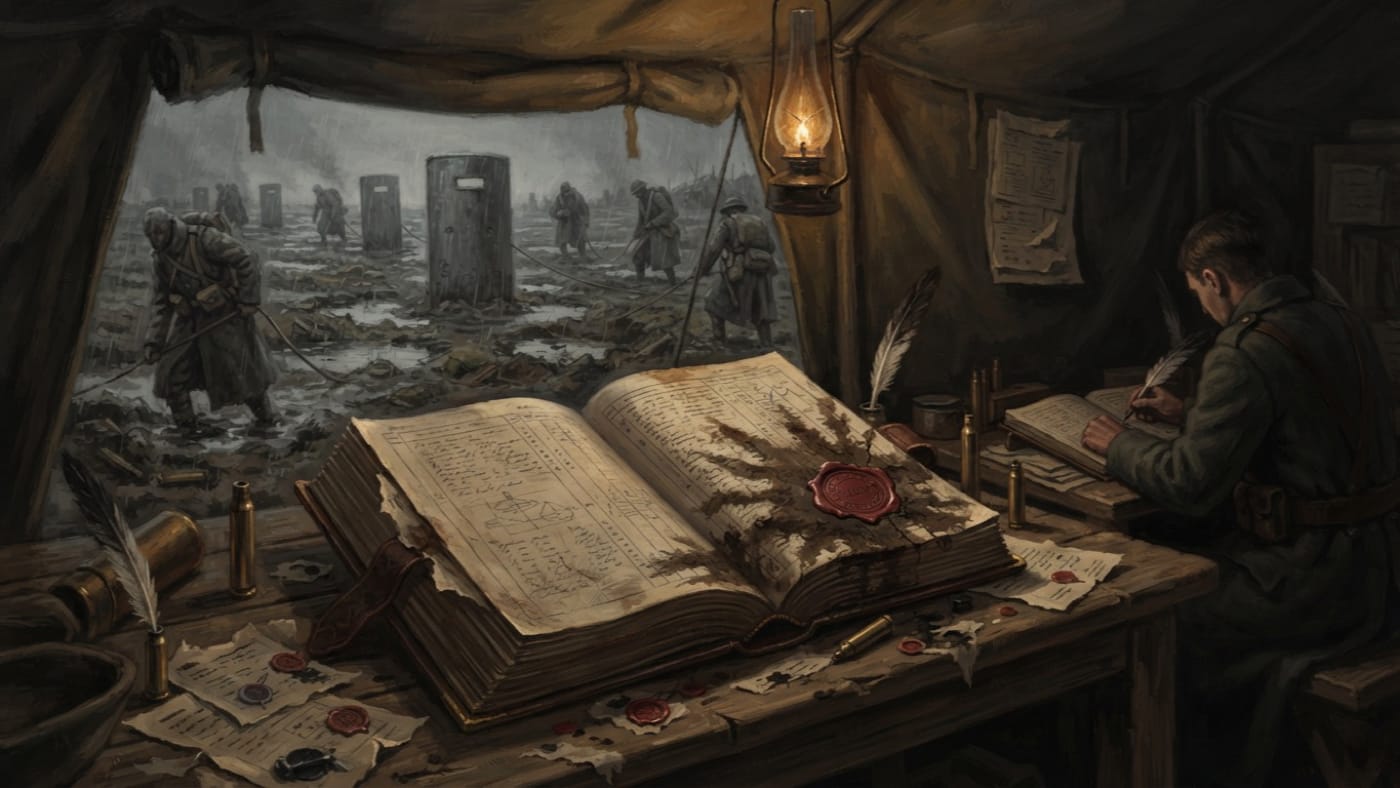
The sector lies in No Man's Land, facing the Ravelin of Vigilance on the northern approach to Bastion-Constantinople. In A.S. 137 rain melted the trench walls during an ordered push. Flesh-Mud took the sappers to the knee, then to the belt, and the enemy poured in. A company of Shield Paladins drove their tower-shields into the mire and hooked rim under rim to form the Mud Lock. Over that causeway the Radiant Fusiliers crossed and fired the breach closed. Whole companies died waist-deep with their arms through the shield loops. Bureau annals entered the action as logistical stabilisation.
The breach was closed. The trouble began afterward, in the ledger tents behind the line, when the clerks reached for their usual materials and found them missing. An ordinary death entry wants a body, or enough of one to name, or witnesses who agree on which man went under. Knife Mile supplied boots. It supplied an arm locked through a strap, a voice below the surface and witnesses who disagreed. Some recoveries were absent. Some were partial or fought over by stretcher hooks. Others came back in a consistency that no clerk could fold into an envelope addressed to a mother. Records needed a column for these men, and it made a book.
#On Consistency and Depth
The first pages classify each entry by what the ground left and how far down it took the rest: ankle-claimed, calf-claimed, viscous, gelatinous, absorbed, shield-bound, rope-lost, voice-heard, boot-only.
The Engineers love a scale, and they have complained that this is not one. They are correct. Viscous describes a texture. Shield-bound describes a posture and a duty. Voice-heard tells you more about the listener than the man. Boot-only describes a boot. The list records what a recovery team could swear to at the lip of a shell-hole with a rope in one fist. Its untidiness makes it honest, which is a quality I rarely praise in a register.
None of these words proves a death. A boot may leave its owner alive and barefoot in a forward dugout, to the lasting inconvenience of the column. A voice under the mud may belong to the man whose name the listener supplied, or to whatever in the mud has learned to use it. The Ledger records what was encountered and how it was classed. It leaves identity to the second book and to faith.
Shield-bound men made their own difficulty. A Paladin who died in the Lock stayed useful afterward. His shield carried Fusiliers, and later ranks pressed him lower to keep the crossing level. Records could not enter him as recovered, because nobody meant to recover him while he was holding up the route. So Records entered him as terrain, with his name attached whenever someone could supply it.
The working extract kept for field use is coarser:
The suppressed four were written by men who saw something and wanted it on paper. The Ledger does not establish whether any face looked up, whether any body was warm, or whether what came back was wrong in the sense the word suggests, and I decline to establish it for them. What the Ledger does establish is that clerks wrote those words down and that a later hand decided the parishes should not read them.
#On the Morning Count and the Evening Correction
Every dawn the Wardens tally the swallowed. Every dusk the Inquisitors revise the tally downward. Records calls this second step harmonisation, and harmonisation has rules. Crude lies offend the Ledger.
The rules are visible in the entries. A man missing below the knee is counted present if the knee remains within friendly reach. A chaplain heard praying beneath the surface is listed as spiritually audible, which puts him in the column of the living for as long as he keeps praying. Three men dragged down on one rope become collective retrieval pending. The rope can still be seen. The men cannot.
The difference between the dawn figure and the dusk figure is the measure of the doctrine. The Warden writes what the mud did. The Inquisitor writes what the sector can afford to have suffered. The Records clerk copies the second figure in a fair hand and files the first where an auditor might one day find it.
The pending column grew fat enough to need a second book, and a third copy is also attested. I am not at liberty to say how many volumes exist in all or which of them is the original, chiefly because nobody has told me.
A pending man is neither dead nor present, and the rest of the Bureau's paper cannot work around him. In the general practice of Records, the ration rolls, the inheritance registers and the rolls of legal existence each need a death either confirmed or denied. A pending entry gives them neither answer. His family cannot inherit what he has not finished owning. His name stays on rolls that no longer feed him and have not yet released his family.
#On Balance
The Ledger did not invent Funerary Arithmetic. It submitted to it. The axiom is one corpse per hymn: a death on a psalm-note is expended faithfully, and a death in silence is a debt to be reconciled. At Knife Mile the auditors imposed the ratio on the mire itself and declared each suffocation a hymn. The surviving accounting claim reads "Ninety-seven hymns completed in mud," and on that strength the cohort was deemed intact.
That sentence counts hymns. It does not tell you how many men drowned or how many stood in the cohort that morning. Readers who quote it as a casualty figure have mistaken a balance sheet for a muster roll, and I hope they continue to do so, because it keeps them out of my archive.
Records keeps competing copies of the advance itself. In one, the Knife Mile volleys ring out like psalms, a miracle of discipline. In the other, the same event is entered as chaos in mud, with volleys scattered and men singing half-psalms before going under. Both circulate. Neither has been independently authenticated as complete. The Ledger of Mud feeds the second account with its boots and pending ropes, and it lends the first account its balance.
#On the Public Account
Within three months of the Catastrophe, the disaster had become the Penance March of Extraordinary Zeal. Proclamations described men descending into the mire on purpose, as anchors for the Line. Statues followed: drowning soldiers posed nobly, mouths open in song. Survivors read the approved account aloud at assemblies. Some depositions were sealed. Others were shortened, rearranged or replaced, and the restricted copies keep what the public editions removed.
The Ledger supplied the vocabulary for this transformation. A family asking after a son could be told Partial, or Absorbed, or Shield. They were never told Still Warm Below. Above every category sat the approved public phrase: Casualties sanctified by terrain. It consoles, and it conceals, and the Bureau that drafted it was content with both.
Reframing proclamations state that the Knife Mile dead immolated themselves as anchors for the Line.
Corrected for restricted copies. The men drowned in Flesh-Mud, and the Paladins of the Mud Lock died as an emergency causeway under fire. No restricted account supports voluntary self-immolation. The public edition retains "anchors." Bronze, once cast, resists revision.
A display copy rests in Strasbourg. It is blackened, stiff and unreadable in several sections, and Records has stamped it Balanced in red wax. On feast days children are marched past it and told that order prevailed. They look at a book in which they cannot read a single name and are told it has been reconciled. Many of them later enter the service of Records.
#On the Present Application
As of A.S. 201 the Ledger remains open, because the sector remains active. War wants the approach denied and keeps assigning men to it. The Wardens still count at dawn and the Inquisitors still correct at dusk, and Records files both figures in their proper places. Ropes still go down and are still written up as pending.
Mercy has filed objections to the abandonment of trapped men. My own Bureau of Doctrine answered by striking the word abandonment and supplying cessation of recoverable status. That phrase belongs to Doctrine's field vocabulary, not to the Ledger's columns, but the Ledger receives every man it describes. He enters as Rope or Voice or Partial, and the dusk hand moves him once more. In the end the clerk dries the page with sand.