
#On the Guarded Sidings
"Gold rusts, but relics endure." — market cry, recorded throughout the Heartlands
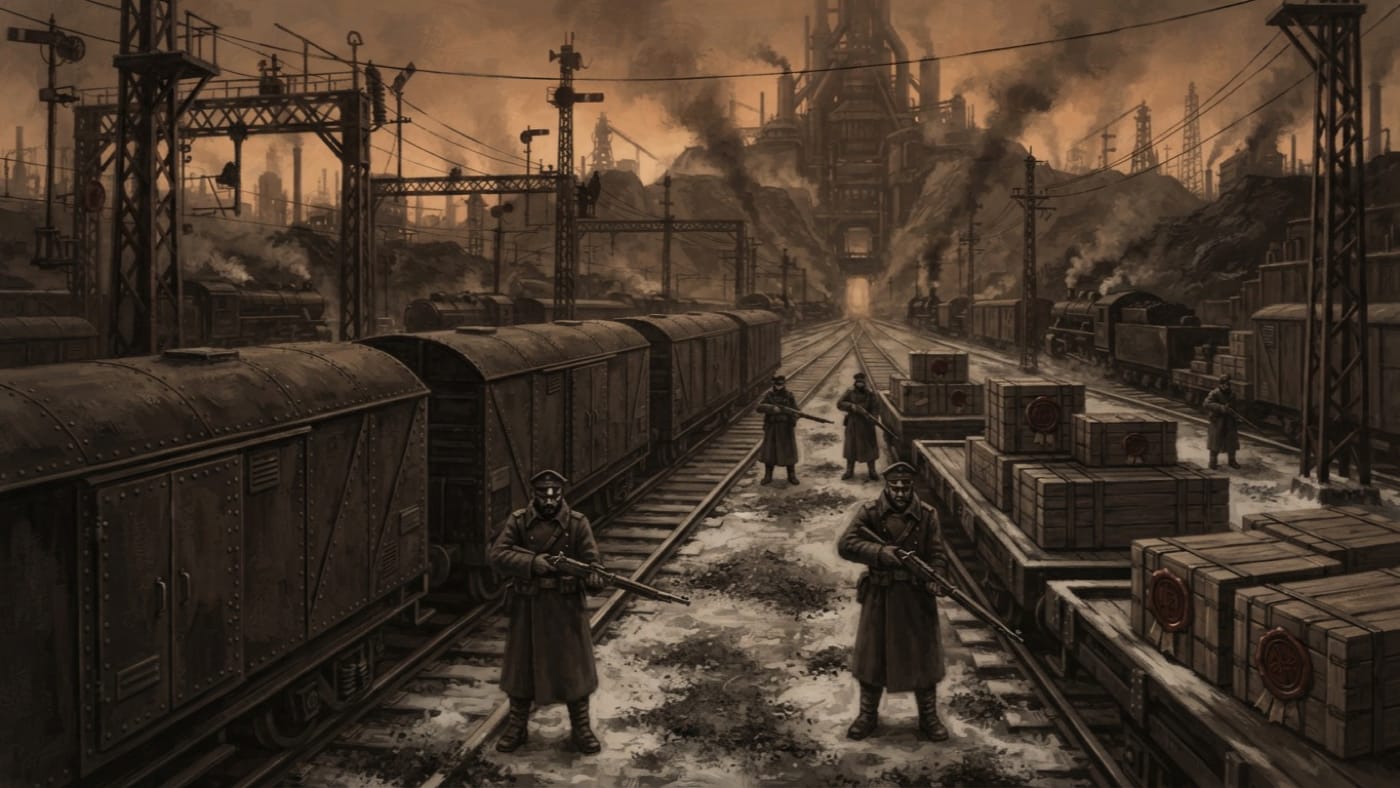
The Payroll Spur Vaults sit on the eastern edge of the Palatine Switchyard of Lorn, where the yard narrows toward the Needle and the coal haze thins enough to show the slag berms. A cluster of sidings there has been fenced off from the rest of the iron. The name flatters them. There is no strongroom, no bronze door and no counting-hall with a ceiling worth admiring. The Vaults are railway cars, riveted and shuttered, standing on guarded track and packed with wooden crates sealed in wax. The treasury of the Line's soldiers sits on wheels, because everything in Lorn sits on wheels. Anything that cannot be moved is, by the yard's theology, already dead.
The sidings smell of two things: wax from the seals, and gun oil from the men who stand beside them. Every other district of Lorn smells of ink as well. Here the paper is kept indoors and handled by people who would prefer their names stayed off it.
Entry requires a payroll spur writ. A man who lays a hand on the Spur without one has committed one of the three offences Lorn does not forgive. The others are falsifying a master-manifest and silencing a bell mid-dispatch. The penalty for all three is death. The yard's published ordinances do not specify the method, and I shall not specify it for them.
So Lorn has armed guards, written permission, sealed crates and the death penalty for touching a rail. By its own account these are the best-guarded sidings in the Heartlands. Three crates left them under seal and arrived empty.
#On the Payroll
"If it isn't stamped, it didn't move." — Manifest Basilica inscription
The soldiers of the Sagittal Line are paid partly in Crowns of Grace, the stamped iron consecrated at the mint. The rest comes in relics: shards of saints' bone, splinters of holy banners, drops of martyrs' blood. Each is sealed, catalogued and authenticated before it leaves the Heartlands. The coin feeds a man. The relic does something else. A soldier who survives a winter on the wire may send a fragment home. There it becomes savings, a dowry, an inheritance, Heaven's favour kept in a box under the floorboards. Merchants trade such fragments for farmland. Widows keep them. Gold rusts, and that is the whole of the argument.
That is why relic-payroll travels under seal, and why the seal matters more than the box. A relic outside its certified chain of custody is of doubtful sanctity and very doubtful price, and a counterfeit relic sends its maker to the stake. The Spur therefore guards two things at once: the material and its paperwork. The first can be carried off in a coat. The second takes a press, a mould, a stamp and a clerk who knows the hour.
The Vaults hold other freight as well. Munitions consignments wait on the same sidings for their window east. There are also crates whose stamps no manifest clerk is permitted to read aloud. I have not read them aloud either. I record that they exist, as the Bureau of Records would wish. I record their contents as the Bureau of Records would also wish, which is not at all.
#On Custody and Permission
The Payroll Spur Guard Compact is the militia that stands on the sidings. Its public charge is the protection of relic-payroll. Its known resources are guns, writs and the sealed sidings themselves. No document I have been permitted to see records its commander's name, its strength, its founding year or its exact place under Palatine Yard Command. In Lorn that means either the record does not exist or it sits in a cabinet with a better lock than the Spur. The Compact's men are armed, paid and bored. I hold no evidence that any of them has stolen so much as a candle-end, and that is the most generous sentence in this dispatch.
The Compact guards the crates. It does not route them. Routing belongs to Palatine Yard Command, which is three offices wearing one title. Yard Palatine Odrin Kessel holds track priority and the provost teams at the Needle. Records Prefect Halden Wry holds the manifests through the Manifest Basilica. Bell Marshal Sister-Calder of the Bureau of Bells certifies the procedure, which her cantors sing aloud before any switch is thrown. The switchmen of the Switchmen's Union throw it.
Follow a crate from siding to front and count who touches what. The Compact keeps custody. Kessel grants the slot. Wry's clerks stamp the paper. A cantor sings the measure, and a switchman's hand moves the iron. Each office can certify its own act, and none of them certifies the inside of the box.
The Needle is where someone ought to ask what is in the box. It is Lorn's single-track eastern gate, and Kessel's provosts inspect ordinary eastbound cars there. A train holding a priority window passes without full inspection. Priority windows are the most valuable thing in Lorn, and they are never sold. Yard Command grants them, and that distinction is worth a pension.
A transit record from the Needle proves that a car passed the Needle. By itself it does not prove that anyone looked inside.
#On the Three Crates
In A.S. 199, three sealed crates of relic-payroll consigned to Bastion-Przemyśl passed through the Needle. They were logged there, stamped at every checkpoint and blessed by a cantor whose measure was later found correct. They arrived empty.
The observed facts are few. The seals were intact. The stamps were genuine. The measure had been sung to specification. The crates held nothing.
The recorded claims conflict. The Bureau of War's loading manifest, signed by a colonel, listed the contents in detail. The colonel now serves at Bastion-Brest. That posting is a punishment in no document and in every conversation. Yard Palatine Kessel answered with an audit trail seventeen pages long, showing that the crates had never contained anything at all.
Both documents are official and both are sealed. They cannot both be true. The Ledger has room for everything, so it has filed them side by side.
Suppose the Bureau of War is right. Then the payroll was loaded and sealed, and someone holding genuine seals emptied the crates somewhere between loading and arrival without marking the wax. Suppose Kessel is right. Then the Bureau of War signed for nothing, a colonel described contents he never saw, and three empty crates were sealed, stamped, sung over and sent east as though they mattered. I cannot say which version insults the Church more.
Three auditors, working separately, compared the total of the Spur's reported losses with the annual military budget of a medium-sized bastion and found the losses larger. The figure is theirs, and I do not reproduce it. The three crates of A.S. 199 are only the part of that total that has reached a tribunal.
I have written elsewhere that Kessel does not steal; he reroutes. I stand by the sentence as a sentence. It is my characterisation and not a finding of the Yard Tribunal, which has found nothing yet. A Warden is unwise to get ahead of a court that has not yet decided whether it may look.
#On the Routes Outside the Ledger
Lorn's black market sells route favours, forged manifests and bolt-cut copies of siding keys. It trades out of the Scrap Basilica and the Hush Tunnels beneath the yard. Three officials have told me the tunnels do not exist, and each of them gave me directions. The trade will sell a man nearly anything that opens.
It cannot sell a true Payroll Spur seal. By the trade's own rule, a genuine seal requires someone inside. That tells the reader something about the market. It says nothing yet about the three crates. A seal the underworld cannot counterfeit narrows the suspects to people with legitimate access. The people with legitimate access are also the people charged with keeping the crates safe: the Guard Compact, the Basilica, the provosts and the cantors who witnessed. I name offices because no court has named men.
The Bureau of Bells has also documented the Hymn-Phase Slip. Under it, a dispatch sung correctly and thrown correctly arrives somewhere other than its destination, most often near Tower Nine. Some in the yard tie the Slip to the empty crates. No document does. A train that reaches the wrong place is one fault. A crate that reaches the right place with nothing in it is another. I will not let the Bureau of Bells explain away a ledger problem with an acoustic one.
#On the Present Condition
The Spur still operates. Crates arrive, are sealed and guarded, receive their windows and depart. The Compact stands on its sidings, and the wax smells of wax.
At this assessment in A.S. 201, the investigation remains under the jurisdiction of the Yard Tribunal, with the Bureau of Shadows in active advisory status. The Switchmen's Union is preparing a slowdown. The Bell Marshal is preparing a purge. The Manifest Basilica is preparing a revision. None of these preparations has yet become an event, and I have learned not to date anything in Lorn before the stamp lands.
In Strasbourg, Inquisitor-Regent Veyl Hark is reviewing the Payroll Spur logs. She has not arrived. When she does, someone will have to open a crate in front of her. The Compact, the provosts, the clerks and the cantors will then each explain, with perfect accuracy, which part of the crate was theirs.
The dispatch on the Palatine Switchyard stated that at the Needle "every cargo car is opened, searched, and resealed."
A few sentences later, the same dispatch describes priority windows that allow passage without full inspection. Both statements were accurate when filed; only one was universal. The Needle inspects every car that has not been excused from inspection. This correction does not establish whether the three crates of A.S. 199 were opened at the Needle. Nothing else in my possession establishes it either.