
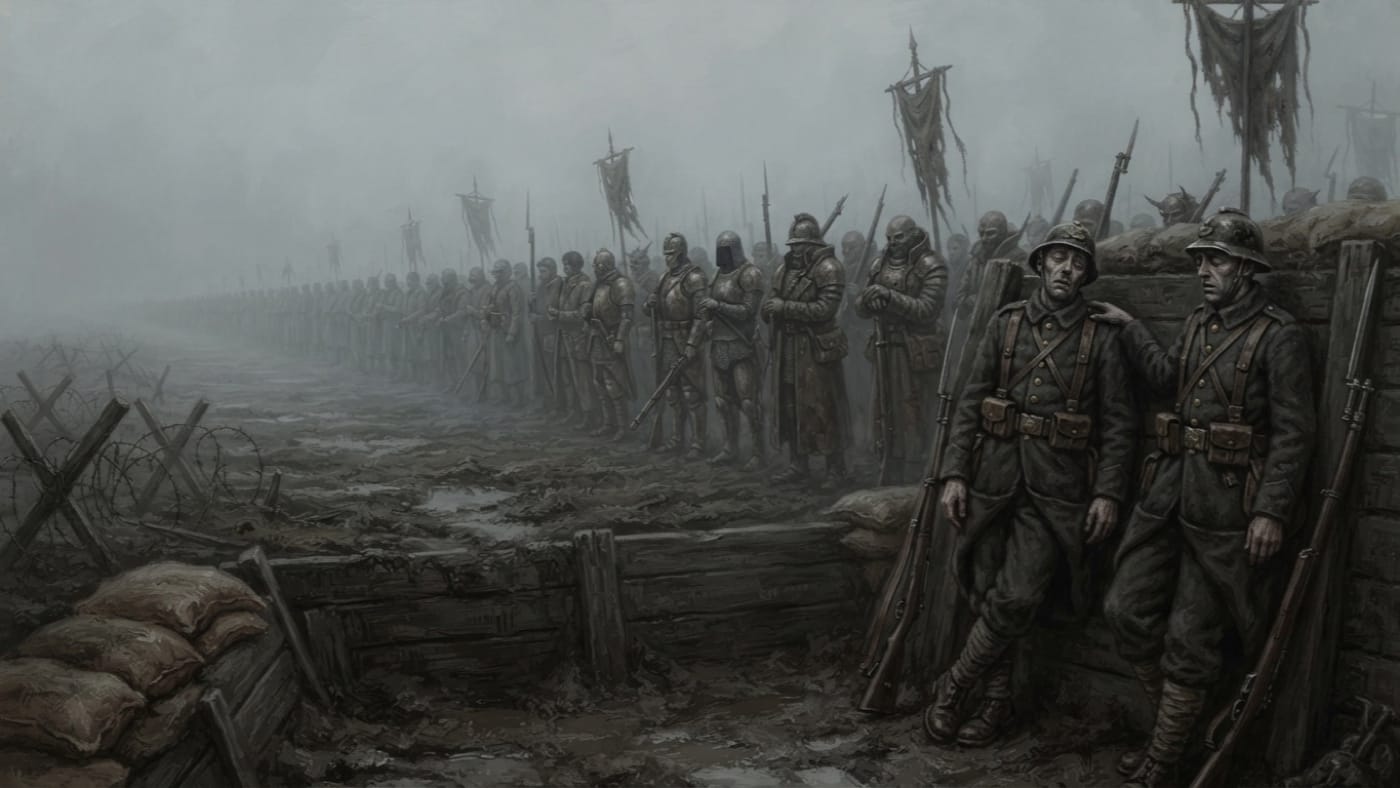
#On the Ranks at the Fog's Edge
Begin with the dew. Every report from the eastern margins of Bastion-Shipka mentions it. It beads on helmets and on the flats of blades, and on flags that should have rotted off their poles long ago. The flags hang heavy and windless instead, like vestments left on a hook after the last Mass of a closed parish. After the dew the reports mention the faces, which are slack. Then the weapons, which are held at rest. Then the ranks, which run back into the grey farther than any observer has cared to count.
This is the Patient Army of Syrion, the Languid Dreamer, Sin-General of Sloth. It is a mixed host. The Bureau's dossiers record corrupted humans standing shoulder to shoulder with lesser demons. Which file is which, the Bureau does not presume to certify from the far side of the wire. Some figures are plainly men, or were. Some are men in the sense that a wax effigy in a crypt is a bishop. A few are wrong in the way peculiar to Syrion's demons. Their proportions hold until the eye leaves them. Their stillness passes for a monument's until the observer notices he has been studying it for an hour.
They stand along the fog margins of the Vales of Stagnance, across the Bulgarian highlands, facing the Shipka pass and its Balkan approaches. That pass is the Sagittal Line's last bottleneck before Thrace. To the north and west the domain runs into old Serbian valleys and forgotten Hungarian marches, and the Army is presumed to stand there as well. Presumed. The Bureau of War draws no deployment map of a host that has never deployed.
#On Their Waiting
The Army does not march. It waits, and when the fog advances, it advances with the fog. It might gain a field's width in a season or a ridge in a decade. Once it gained a road junction while the defenders argued over whether the junction had been there the day before. No drum is heard and no standard dips. The Bureau of Purity has searched for an officer with field-glasses and with its best guesswork, and has found none whose order carries across the line.
The dossier on Syrion records that these ranks have waited since the Sundering of A.S. 45. I enter that year in the Ledger as the Army's documented association, and I stretch it no further than the ink allows. No one has kept a roll from 1755 to set beside the faces standing at the margin in A.S. 201. One pikeman may have held his ground for a hundred and fifty-six years. Another may have arrived last spring and learned the posture from his neighbours. Settling the matter would require crossing over to ask. The Bureau has declined the errand.
What the Bureau can certify is distance, and distance is the whole difficulty. A charging army can be measured in yards per minute, and any gunner knows what to do with that figure. An army that keeps pace with the weather has to be measured against something fixed: a survey stake, a bell-post, the third culvert on the Reed Road. In the Vales the fixed things report late. A sentry looks up one morning and the front rank stands nearer. He reports it. His officer files a measurement. The Hourglass clerks check it against the last measurement, against the stake, and against the stake's own grievances about where it was planted. The result goes to Strasbourg, where it is entered as advance, drift or instrument error, depending on the season's budget.
What anyone can see is inactivity. Territory is what changes hands without being seen. Each season the fog takes a strip of Balkan ground that the map called ours. No shot is fired to transfer it, and no one signs the deed. The Army arrives at its new position as a clock's hand arrives at the hour. Nobody sees it travel, and everybody is late.
The cost falls on the men who watch. An enemy that moves only with the fog never offers a moment when watching may safely stop. A charge ends, a bombardment lifts, a siege breaks or is broken. The Patient Army asks to be observed for as long as the observer can stand it, and then for one watch longer.
#On the Other Shapes in the Fog
The Army is the thing in the fog that can be seen standing still. Other things share the fog with it, and a soldier who mixes up the categories can die of bad taxonomy.
The Still Ones are the hazard most often mistaken for an advanced file of the Army, because they too appear motionless. The difference lies in their behaviour, and it kills. A Still One closes distance only while unobserved. Look away or blink, and it has crossed the ground. The Army's ranks are reported to move with the fog, and no rule ties their movement to anyone's gaze. A sentry who treats every figure as a Still One will exhaust his eyes on a host that has no need of his blinking. A sentry who takes a Still One for an ordinary ranker will blink.
Grey Heralds step out of the fog before an advance and speak gently to tired men: rest now, you've done enough, sleep. By every report the Army says nothing at all. That silence is what makes the Heralds so dangerous. After months of silence from across the wire, a kind voice from the same direction sounds like relief.
The Time-Eaters of the Drag Corridors take away experienced duration. The Cradled offer a dry chair or a warm bed in the mud. The Bureau of Purity has not established whether any of these answer to whatever commands the Army, if anything does. Its manuals file them on separate pages, and the soldier should keep them on separate pages too.
#On the Men Who Must Watch
Here the Army's method becomes clear, if "method" fits a host without visible command. The ranks are reported to take no food. They exchange no signals. They do not answer provocation of any kind: insults, flares, hymns, a boot hurled over the wire by a corporal at the end of his patience. Whatever sustains them, the Bureau has never found the wagons.
The men opposite must eat. They must sleep, relieve themselves, write to their mothers, clean their rifles, stand inspection, hear Mass and keep watching. Every hour of watching costs them, and costs the Army nothing. Syrion's influence goes after the exhausted, and the Line produces exhaustion on an industrial scale. When a sentry's eyes close after nine days spent staring at a hedge of motionless men, the cause is not laziness. He is spent, and the Army has spent nothing.
The watching also damages time. Watches blur together. The clocks at the marsh relays disagree with one another, each in good faith. A sentry asks his companion the hour and is given yesterday's.
So no man watches alone. Each has a companion who can be asked the hour and who is ordered to slap him if the answer comes slowly. The bells ring in irregular sequences, changed often. A bell pattern that starts to sound familiar or soothing, like something sung to a child, is reported at once, along with the man who finds it pleasant. Sentries count primes in a whisper. They touch each item as they name it, boots, belt, watch, tongue, breath, until the litany no longer reaches the man saying it. They chew stimulants. They stamp and pace on the firestep, because a watcher who stands too long starts to resemble what he watches. Above all there is relief. Fog-adjacent posts rotate often and on strict tables, and the Bureaus of War and Medicine are still arguing over the arithmetic of those tables. Every one of these measures helps, and none of them is enough.
Some sentries are found seated at dawn, smiling. Some are not found. On a bad night it is tempting to search the front rank for a familiar face. The Bureau forbids the exercise, and its reasons go beyond morale. Nobody has established that the missing go there. Nobody has established what the human figures in those ranks still feel or intend, or whether they would turn round if they could. Being held motionless does not prove a man has been possessed, and an empty face is not proof of an empty soul. The Bureau of Doctrine keeps that question open on purpose. I have been ordered not to close it, and for once I am grateful for the order.
#On Observation and Engagement
The Bureau of War's standing order reads plainly: observe stationary ranks inside active fog, and do not engage them. Officers who have never seen the Army sometimes ask whether this is cowardice. Officers who have seen it ask nothing. They count their men.
The order rests on how little is known. A patrol sent into active fog to meet the Army must cross ground that may be a Stillness Field or a Drag Corridor, and may return with fewer years than it took out, or never return. A shell fired into the grey lands somewhere, at some point, and its effect is reported by men whose clocks already disagree. Opposite the Line, according to the dossier, stand captured guns aimed at our positions. They are loaded, their crews are ready, and they have not fired since the Sundering. The Bureau does not know whether those guns belong to the Army's establishment. It does know where they point.
The Bureau does not know the Army's strength. It does not know how the ranks are filled, who commands them, what moves them, or whether anything we possess can drive them back for good. Population ratios from other demonic hosts tell us nothing here. Observation does not protect the observer. Its value lies in the record: it tells the bastion where the margin stood this morning, and that is all the protection the order promises.
The Vales of Stagnance: "static enemy territory."
Corrected in the entry on the Vales, and the correction applies equally to the host standing along their margin. A rank of men who have not shifted their feet can still stand nearer than they stood at the last survey. "Static" describes their posture. Their position has changed every season.
Shipka holds, and the Army stands. Each morning the line of dew-wet helmets is measured against a stake that may be lying. The measurement is filed. The watch is relieved, and the man who comes off it is made to walk.