
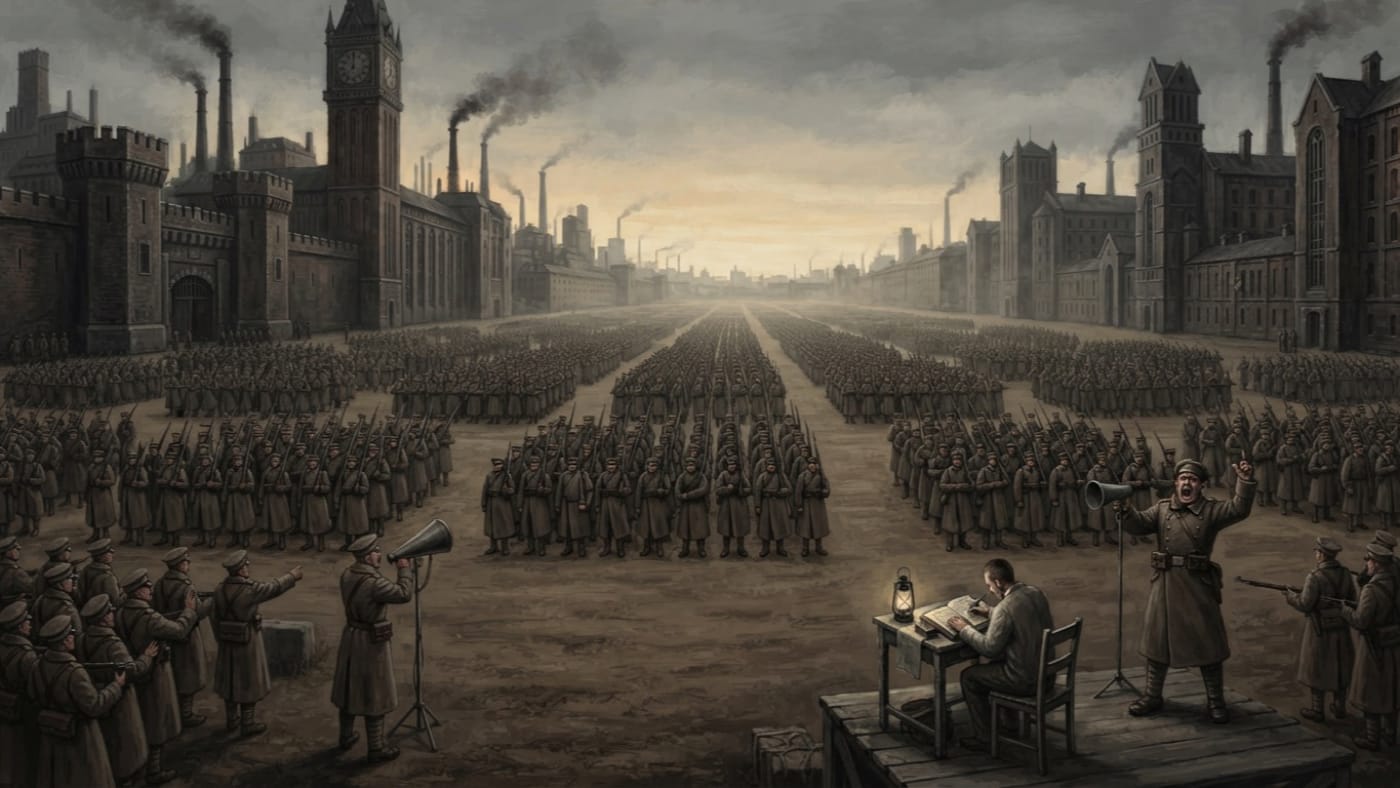
#On the Field at First Light
Ten thousand men can stand on this ground and be called one thing. The field exists for that.
The order reaches the far ranks before anything else does. A sergeant's voice goes out across the Parade Grounds, flattened by the distance, and a block of levies a long way off turns left half a beat late, the way a congregation comes in after the cantor. Another order, and the block steps off. Boots strike the field in a rhythm the Cathedral carillon did not compose and cannot drown out. At the edge of the ground a clerk with a board on his knee writes down that the morning has begun.
The Grounds lie in the Military City, the soldiers' district of Strasbourg, where levies train, veterans retire and the machinery of war is maintained. The district keeps its own laws, markets and priests. The field is its open centre. It is the one stretch of the capital left unbuilt, because men are formed there instead. The Military City has had its folio already, at the length its pride demands. This one stays on the field.
#On Capacity, Which Is a Number
The Bureau of War, in its logistical census of A.S. 196 as the Strasbourg folio cites it, records that the Parade Grounds can drill ten thousand soldiers at a time.
That figure measures ground. It says how many men the field will hold in ordered ranks, with room to wheel and dress the line, before order gives way to a crowd. It says nothing about how many stood there yesterday or how many sleep in the district tonight. It gives no count of the men who pass through in a year, or of how many reach the Sagittal Line with their kit and their wits intact. A quartermaster would ask those questions. The census asks none of them. It was compiled to be recited.
The danger of the number is its shape. Read aloud at a feast-day inspection, ten thousand sounds like an army. A formation at full strength looks complete from the stands: every file dressed, every interval kept, the whole field squared like a page ruled for entries. The eye supplies everything else. The eye has never kept a muster roll.
A capacity is filled one man at a time. Each of those ten thousand places needs a levy who arrived and was fed, who is in neither the fever ward nor the guardhouse, and who can hold a rifle the right way up. When one of them is missing, the ground stays the same size. The census records the field. Recording the men would fall to the Bureau of Records, and I have not been shown what Records keeps.
#On Drill as Observance
The levies come from the provinces of the Dominion through the Continental Levy, and they arrive as the provinces made them. They are farm boys and apprentices, sons who walk with their fathers' gait and speak with their mothers' vowels. The Grounds exist to remove those differences. A file of men whose left feet strike together can be given orders, and a file that takes orders can be sent.
Drill is the oldest catechism the Church owns that requires no literacy. The body learns it before the mind consents. Turn, halt, dress, present. The rifle comes up to the shoulder at the word and goes down at the word. The word is given by a man who received it from another man, and so back along the chain of seals to the Synod. Doctrine calls this obedience made visible. The Levy's instructors elsewhere have a cruder saying, that the feet remember the drum after the head has forgotten the prayer. Both describe the same muscle.
Here I have to be careful, and I dislike being careful. The hymn cadences, the bayonet catechism and the tempo are documented for the Levy at large. I hold no folio that lists the movements taught on these particular Grounds, the hour they begin, the weeks a man spends here or the test he must pass to leave. I will not issue one. A drill manual written by a Hieromnemon who has never carried a rifle would be the most dangerous document in the capital, and I have written several dangerous documents. The Bureau keeps them in a drawer that locks from the outside.
The field shows enough without one. Officers give the orders. Clerks stand at the margins and count. The district's priests bless what the clerks have counted. The Bureau of Doctrine maintains that a regiment in step is a form of prayer. I have stood at the edge of the Grounds and watched ten thousand men answer one voice, and I find the claim harder to mock than I would like.
The levies do not experience it as prayer. They experience a sore heel and a sergeant.
#On the Neighbours
The Armoury stands between the Grounds and the Hospital of Saint Sebastian. Readers with a taste for symbols may make of this what they like. I make of it the shortest possible walk.
The census entry that gives the field ten thousand gives the Armoury weapons for twice that number. That is a second capacity. It measures racks as the first measures ground, and it tells us nothing about how many rifles are serviceable or how many men exist to carry them. Training arms go out to the Grounds and come back counted. The rifles bound for the Line are a separate issue and never pass through the field at all.
Saint Sebastian treats the wounded soldiers who come back to the capital and buries those who die. Mercy holds the general charge of hospitals across the Dominion. My files do not say how that charge is carried out in these wards, so I keep the two apart. What I can say is that the hospital is close. A levy dressing his rank in the morning shares a district with men the war has already sent back, some on their feet and some under the chaplain's hand.
#On the Old Men at the Edge
The Military City is where the veterans retire, and they retire within earshot of the field. Some of them come to watch the drill. Nobody asked them to.
General-Retired Marko Vey commanded a sector of the Sagittal Line for twenty years and came back broken. He now drinks in a tavern near the Parade Grounds, where he tells stories that nobody believes. I have not been given the stories and I will not write them for him. A man who held a sector of the Line for two decades has earned the right to his own lies, if they are lies, without a Hieromnemon improving them.
Look at where he sits. A general who once moved men by the brigade now sits close enough to hear a sergeant move them by the file. The levies who pass his table on the way to the Grounds have commanded nothing larger than a plough-horse. They laugh at him. The ones who come back will not.
#On Readiness in the Rear
Strasbourg lies deep in the heartland, entered in the registers as Zone 2, far west of the Line. Every sealed map makes it a rear city, and a rear city has no obvious need for a field built to drill ten thousand at once. It drills them anyway. The Military City prepares as if invasion were imminent, and nowhere is that preparation plainer than on the Grounds. The capital raises and forms its men within bell-range of the Bureaus that will dispatch them.
The older folios, my own among them, have been too comfortable about the rear.
"Strasbourg has not been attacked in four centuries." — Strasbourg folio, The Military City
The Military City has never been occupied. It has been shelled on three occasions by agents of the Enemy, using ordnance smuggled through No Man's Land. The sentence above treated the absence of occupation as the absence of attack. The record I am permitted to cite does not say whether any of those rounds fell on the Parade Grounds, and this folio makes no claim on the point.
So the drill goes on in a district that has been fired upon, in a capital that describes itself as untouched, under a census that counts the ground and leaves the men to somebody else. Whether the Line will need these levies this year or in twenty is not a question the field answers. It forms them either way, and it forms them to the same standard.
At the far end of the Grounds a sergeant who has never read the census is shouting at the four-hundredth man of the third rank to dress the line. That man is the capacity. The census does not know his name.