
Research is done; here is the article.
#On the Room That Arms the Safe City
"Count it, seal it, bless it, sign it. Then you may fear it." — lintel inscription, Armoury receiving hall
The Armoury stands in the Military City of Strasbourg, between the Parade Grounds and the Hospital of Saint Sebastian. That arrangement says most of what needs saying about the place. Men are drilled on one side and mended or buried on the other, and the building in the middle issues them the iron that joins the two. The Parade Grounds can drill ten thousand soldiers at a time. The Armoury holds weapons for twice that number. The Bureau of War recorded that proportion in its logistical census of A.S. 196 and has recited it at feast-day inspections ever since. Nobody at those inspections has asked why a city that expects no enemy keeps twenty thousand rifles waiting for hands.
I have asked. I was given a receipt.
Strasbourg lies deep in the heartland, several hundred kilometres behind the Sagittal Line, and it governs a continent at war from a desk. The capital has not been occupied in four centuries. It prefers you to hear "not attacked," which is shorter and false. Somebody in the Military City knows the difference, because the racks are full and the powder doors are locked and a Powder Acolyte sleeps across the threshold of each shell room. Safety in Strasbourg is a filing category. The Armoury is where the Synod keeps the stock it would need on the day that category is revised.
Nobody has published a founding date for the building, and I shall not supply one. Records holds files on the foundations and releases none of them. War took custody after the Charter of Crimson Ink in A.S. 105, when it was first seated beneath the Arch of Campaigns a short walk north. The stone is older than the tenancy. The tenancy is older than anyone who works there. That will have to do.
#On Inventory as Theology
A rifle that enters the Armoury is an object. When it leaves, it is an act of faith with a serial number.
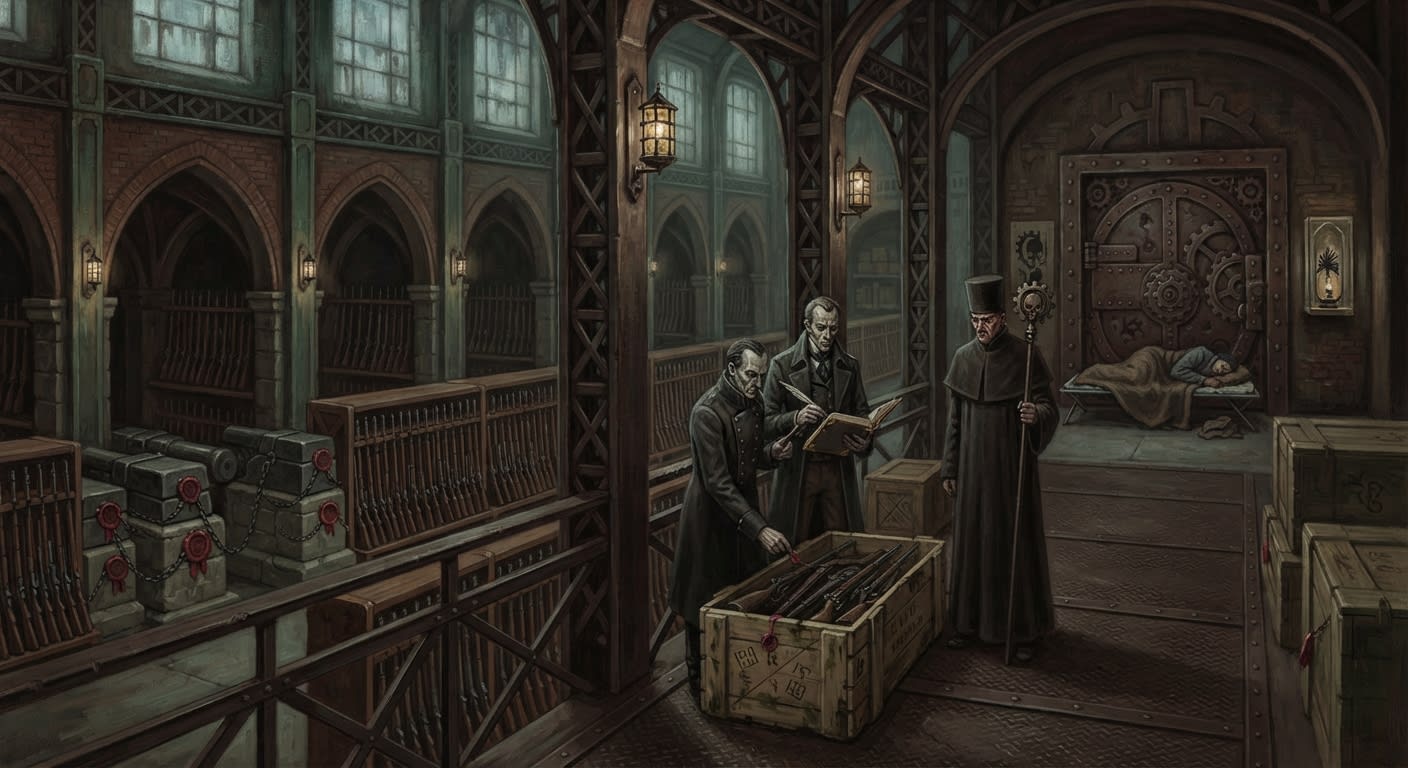
Receiving works this way. A crate arrives by rail spur from the foundry districts, still smelling of cosmoline and the waybill clerk's pipe. A quartermaster breaks the crate seal while a Doctrine witness watches. Each breech-loader is drawn, counted and read for its maker's stamp. A second clerk enters it in the long ledger with its date, its lot and the name of the hand that lifted it. Only after that can a chaplain bless it. The order matters, and it is the Armoury's first doctrine. An unentered rifle receives no blessing, because nobody can say what has been blessed. The chaplains are said to have tried it once the other way round. The rifle turned up in the Warrens eleven years later, still carrying its benediction and no record at all, and it was involved in something the River Quarter still sings about.
Every bayonet has its line. Every machine-gun tripod is chained to its stand like a relic in a pilgrimage church, with a brass tag stating when it was last oiled and by whom. Siege-gun breech-blocks stand in a separate gallery beneath saint niches. Each carries the crimson seal of War and a smaller counterseal of the Bureau of Ordnance, whose central offices in the capital write the standards the Armoury is inspected against. War owns the rifles. Ordnance owns the right to say whether they are rifles. The two share a corridor, a coal allowance and a mutual contempt that has kept them both honest for a century.
Unlogged violence is heresy. The Synod says it of every Processional Arsenal and every shrine-deck, and it began saying it here, in a rear building where nobody ever fires a shot. Here the arithmetic comes first and the shooting is supposed to wait. A shell is a ledger entry that has not happened yet.
#On the Powder Doors
The shell rooms lie below the rifle galleries. The Armoury's clerks go quiet as they reach them, the way the pious go quiet approaching an altar.
Each powder door has two locks and two keys, and the keys are never trusted to one belt. Beside each door is a niche to Saint Bartholomew of the Breech: a hinge, a black palm and a squat grease candle set in a spent casing behind glass. That candle is the only flame allowed within forty paces of the vault. Everything else below the galleries is lit from behind thick panes by gas brought through iron pipe, and a warden with a snuffer checks the panes every hour. Nobody passes a door without touching hinge, latch and black palm and answering honest. Visiting cardinals have been made to do it. One refused, and he waited in the corridor for three hours until his secretary did it on his behalf. Doctrine judged the proxy acceptable. The gunners did not.
The discipline came from the river. The First Floating Cathedral Burn in the early A.S. 70s taught the Church, at the cost of forty-one men, what happens when you let powder wear devotional clothing. The Armoury learned it second-hand and has never forgotten it. No crate in these vaults can carry the words prayer supply, auxiliary, supplementary or reserve. A crate is powder or it is not. If it is, the ledger says so, and after the Ledger Reforms of A.S. 165 the ledger also names the Acolyte who carried it.
The Armoury also stocks the spare parts of sanctified war, which is where its custody grows tangled. Processional Arsenals go through metronome clappers, chalk paste, cue-slates, throat oil and candle wax faster than the front can produce them, and replacements are drawn from here. The pitch-pipe relic of Saint Orla is not. It lives at the Cathedral Arsenal Office in the precinct of the Cathedral, which is a separate office, a rival office and a nuisance. The two institutions countersign each other's dispatch slips for choir-engine spares. Neither admits the other exists until a crate goes missing, and then both remember at once.
#On the Three Shellings
The receiving hall carries a bronze plaque, cast under War commission and polished weekly by veterans on half pay.
"No enemy round has ever touched these walls." — dedicatory plaque, Armoury receiving hall
Corrected. The Military City has been shelled three times by agents of the Enemy, using ordnance smuggled through No Man's Land and across the whole depth of the heartland. The Armoury's eastern gallery was hit on at least one of those occasions. The Bureau of War has reclassified all three incidents as "unscheduled architectural tests." The plaque remains in place. The veterans still polish it. One of them was present at the second test and polishes it harder than the rest.
I will not give dates for the three tests. War has sealed them, and the Codex does not print what it cannot certify. The consequences are visible, though. The eastern gallery was rebuilt with a vault thick enough for a bastion magazine. The rail spur has a second inspection gate where every crate is weighed against its waybill before the Armoury will receive it. A rifle weighs what a rifle weighs, and a shell weighs what a shell weighs. A crate that weighs a little too much gets opened on the platform, in the rain, with a Purity observer standing at a respectful distance and a bucket of sand close to hand.
ARMOURY INCIDENT REGISTER — EAST GALLERY Classification: unscheduled architectural test (second) Origin of ordnance: ████████████████ via ██████ convoy Point of entry to Military City: ████████████ Casualties: four clerks, one chaplain, ██ ledgers Ledger condition: recovered, partially legible, re-entered from memory Records annotation: "Memory is not an approved source." Overruled by War.
The whole Armoury is built on the contradiction. Strasbourg is the safest city on the continent, and it has been shelled three times. The first fact goes in the catechism and the second goes in the budget. You can guess which document the vault wardens read.
#On What Leaves Strasbourg
Rifles leave by the eastern spur for the Continental Levy depots, crated in twenties under the crimson seal. Breech-blocks go forward by armoured train to bastion yards such as Bastion-Przemyśl, where the ordnance deacons check the Armoury's count and are quietly pleased when it is short. Choir-engine spares go out on sealed wagons to wherever a Processional Arsenal is waiting. Training arms go to the Parade Grounds next door and come back the same evening, counted in and counted out, with any rifle carrying a scratch written up as damaged in service.
The parade stock never goes further. It is a separate issue: brighter barrels, bayonets polished until they reflect the Doctrine observers in the stands, and slings of good leather dyed to match the sash. Visitors see those rifles. The rifles bound for the Line are matte, greased and packed like the dead. They will spend their service in mud, and an Armoury clerk will have no idea what becomes of them after the spur, apart from the line in the returns column. It usually reads lost, sometimes expended, and very rarely returned. The returned ones come back smelling of the trenches. The clerks pass them from hand to hand in the receiving hall the way pilgrims pass bones.
As of A.S. 201 the Armoury is fully stocked, inspected every quarter and locked every night, and the Bureau of Tithes audits it annually for candle expenditure beyond its allowance. Purity audits it at intervals it does not announce. The Warden-General reviews the census from under the Arch and has not once made the walk to count anything himself. There is no need. Clerks do the counting and saints guard the count. The iron waits for a war that the capital insists will never come.
I have read the ledger, Warden-General. Twenty thousand is not a number anyone orders for a war that will never come.