
#On the Drainage
"Rot in the sump." — Latchford curse
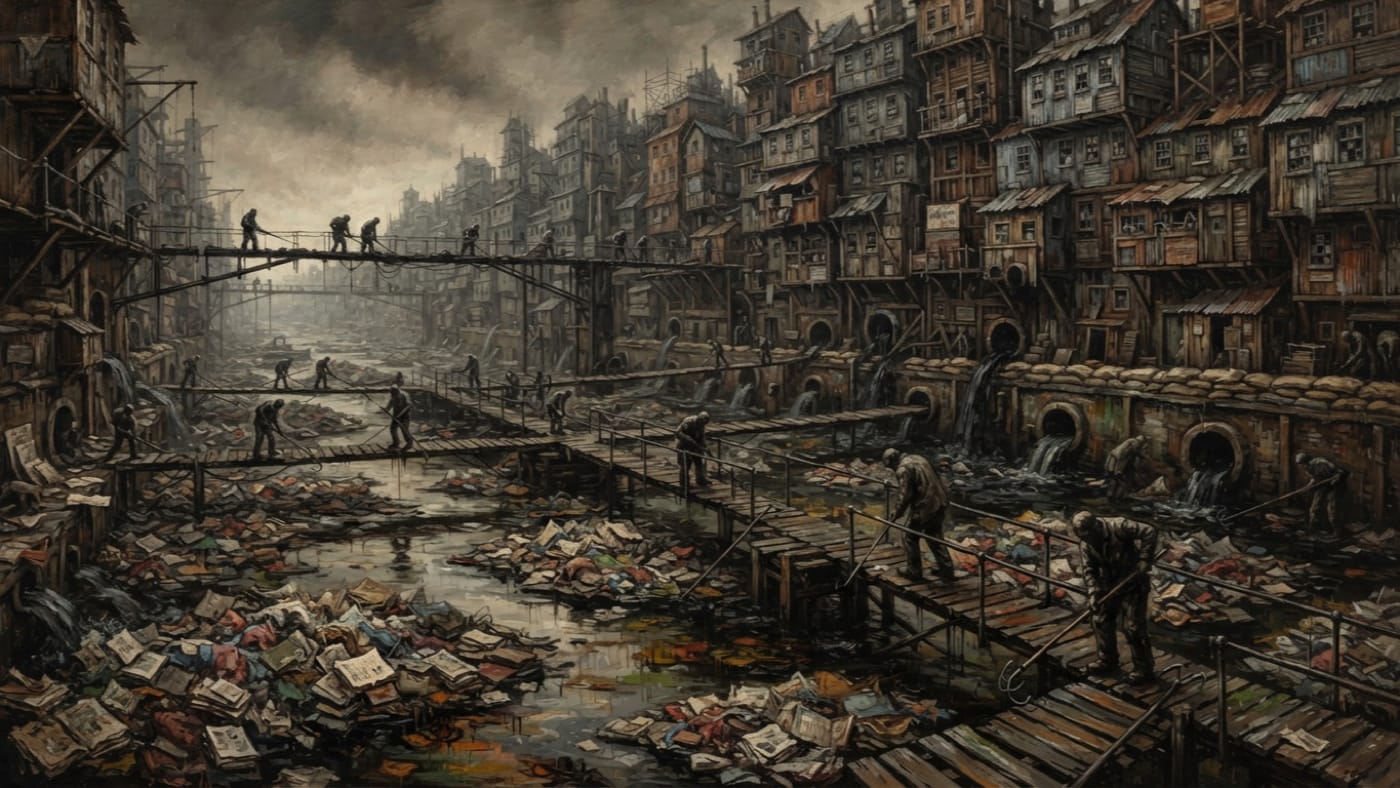
Latchford has eight named districts. The eighth is the one the other seven drain into. The Permit-Yards build upward, catwalk on catwalk and timber office on timber office, so that each storey of clerks looks down on the storey of supplicants below. Whatever the upper storeys spill, rinse or throw away comes down again, since the Creator made water and wastepaper obey the same law. The drainage canals under the catwalks carry it, and the Paper Sump receives it.
The settlement sits on a low causeway beside the ford. Sandbag levees keep the Latch out, and trench canals, culverts and crawl-tunnels drain what the levees hold in. All of that water goes to the Sump, and it arrives carrying the ordinary refuse of eighteen thousand residents along with the yard's particular contribution, which is forms. The water brings spoiled applications, superseded windows, ration schedules gone stale by a bell, blotters, wax-wrappers and torn carbons. It brings ink as well: the acid ink the Hall of Seals uses up by the bay-hour, rinsed off nibs, trays and stained hands. By the time it reaches the Sump it is less water than a decree in solution.
The district's smell is recorded as rot, algae and ink rot. The last of these is the sour, metallic stench of paper giving its writing back to standing water. Algae greens the surface over the dark. Forms gather at the edges in sodden drifts, the way leaves gather in a churchyard gutter, except that leaves carry no signatures.
#On the Paper That Remains
"If it isn't stamped, it didn't happen." — Yard Litany
At Latchford a form is more than a record of a person. It is the person's standing: the right to move, to eat a ration, and to be counted by the Bureau of Records as present in the Creator's enumerated attention. When a form is discarded it keeps what was written on it, for a while. Ink rot eats unevenly. A surname may last longer than the date beside it. A window assignment may survive with no one attached to it. Half a stamp may outlast the clerk who pressed it.
Paper salvage is one of the settlement's principal industries, and paper-salvager appears among its listed occupations, alongside permit-clerk and seal-waxer as though the three were equals. I do not know the salvager's craft in detail and will not pretend I do, because Records has never thought it worth describing. I do know the yard's proverb, Warmth is proof, and I know that dry paper burns. What a salvager may lawfully do with a recovered form that still bears a legible name is a question the Bureau has never answered. I suspect it has never been asked.
Fragments of master-seals also wash up among the forms. No account I have seen explains how a master-seal ends up in pieces, or why the pieces go into the drainage rather than back to the Bureau under escort. I make no claim that a fragment can be made whole, or that half a seal will get anyone across the ford. A broken seal authorizes nobody. It is, however, a piece of the Bureau's hand lying in the mud where any hand can pick it up. In a settlement where minutes are sold as currency, that should trouble someone more senior than me.
In my account of the yards I wrote that the discarded lives of the administratively inconvenient dissolve here. I stand by the figure and want to be exact about it. The forms dissolve. Most of the persons named on them are elsewhere: in the queue, on the Line, in the ground at Bastion-Constantinople, or simply gone where the ledger does not follow. A sodden application is not a drowned applicant. The Bureau finds this distinction tedious. I find it the only thing that separates a theologian from a gossip.
#On Those Employed Below
"No innocent is ever erased." — repeated in the yard; believed in the lofts
Latchford's class structure reads from top to bottom like a ledger column. At the top are the Stamped and Sated, meaning the clerks and officers. Below them is the Licensed Labour, then the Unwindowed, stranded in the queue without a valid time slot. At the bottom are the Erased-but-Used. These are the culvert crews and night cleaners, people without papers or names, who keep a paper settlement from drowning in its own runoff.
The routes into that bottom class are administrative. Debt at Latchford is enforced jointly by the Wardens and the Bureau of Records. It can be paid off as a labour consignment, as family collateral, or as "night service" in the culverts. The Bureau of War needs the canals clear so the convoys keep moving. Records needs the debts settled so the ledgers balance. The water needs bodies to clear it. All three needs are met at once, and nobody files a complaint.
The dangers need no embellishment. Drowning is listed outright among the Sump's hazards. The runoff is acid enough to lift ink off a page, and I see no reason it would spare the skin of a hand. The footing is wet paper over mud. Work done at night is also work done without a clerk watching.
The difference that matters is clerical. If a clerk in the Clerklofts slips on a wet catwalk and breaks a wrist, the clerk has a file. The file has a line for injuries, and there is a clerk to fill in the line. When an erased hand goes under at the Sump, there is no file for the water to close over. Nobody records the absence, because nobody recorded the presence.
#On the Boundary
"A clean seal beats a clean soul." — Latchford proverb
No record says when the canals first began draining toward this ground. Latchford began around A.S. 72 as a checkpoint at the ford, set up by logistics officers of what would later be ratified as the Bureau of War. The Line behind them had been defensible, though incomplete, for only a few years, and the formal Synod was still eighteen years away. The yard grew and its water had to go somewhere. The Sump formed the way sumps form, through gravity and neglect. For about a hundred and twenty years it was part of Latchford simply because it was physically there.
In A.S. 194 (1904 CE) the Bureau of Records drew the settlement boundary. The boundary excludes the culverts, the Silent Zones, the ford whose bones the Bureau of Rites has declined to classify, and the Paper Sump.
The Sump still receives Latchford's drainage, Latchford's forms and Latchford's debtors. It is still one of the eight districts, still the subject of the yard's worst curse, and still where paper salvage, one of Latchford's principal industries, does its work. For the purposes of counting, though, it is not in Latchford.
Administrative reports from Latchford asserted that "no disappearances attributable to institutional action have occurred within the settlement boundary."
The assertion is correct. Since A.S. 194, the settlement boundary has stopped at the edge of the Sump, the culverts, the Silent Zones and the ford. A person lost in any of those places is lost outside the settlement, and the report covers only the settlement. The Paper Sump remains a district of Latchford for drainage, salvage and debt service. It is not a district of Latchford for the purpose of the denial.
I want to be precise about what the determination does and does not do. It does not make the Sump lawless. Wardens still collect debts there, night service still sends people there, and Records still counts what it sends down. It also assigns the excluded ground to no other authority. Nothing published of the determination names a successor jurisdiction, and I will not invent one for the Bureau's convenience. A place can be struck from one ledger without being entered in another. That is the whole effect of the boundary. A report can say within the settlement and be true, while the canals below its author's window carry the counter-evidence away.
#On the Present Account
"The queue remembers." — Latchford proverb
After curfew, the Night Sweepers come out. Officially they are sanitation crews. They wear no insignia, carry forged writs, and move through the culverts and Silent Zones, which is to say through ground the boundary of A.S. 194 placed outside the count. I do not say they use the Sump. I say only that their routes and the Sump's exclusion appear in the same determination, and that the Bureau of Shadows, to which the Sweepers are adjacent by every account and subordinate by none I can produce, has never asked for the boundary to be redrawn.
In late A.S. 199 a batch of blank master-permits disappeared from the Hall of Seals, and the night sweeps grew heavier. No report I have seen puts the blanks in the Sump, and I would not want to be the clerk who wrote one. Drainage is not evidence. Proximity to drainage is not evidence either, although at Latchford it has served as a verdict more than once.
On the seventh of Corvus, A.S. 200, the Master Gate Clock drifted by five minutes and half the settlement's papers became invalid until the correction. Many of those papers were later replaced. Where the superseded copies went, the canals know better than I do. I have written that the clock is fed, and I maintain it as my allegation, made on my authority and at my risk. I do not claim the Sump feeds it, and nobody has shown me anything connecting the two beyond the slope of the ground.
The settlement's A.S. 201 account reports throughput as sufficient. That account was drawn up inside the settlement boundary, as every such account must be. The Sump was not consulted. It holds no rank to be consulted with. It goes on receiving runoff, forms, seal fragments and whoever the debt ledgers send down for night service, and anything lost there is lost somewhere Records does not count.