
#On the Designation
Filed under Relic Artillery, consecrated bell-cannon. Being the description of a weapon the Synod possessed entire on the morning it was wanted, and could not use.
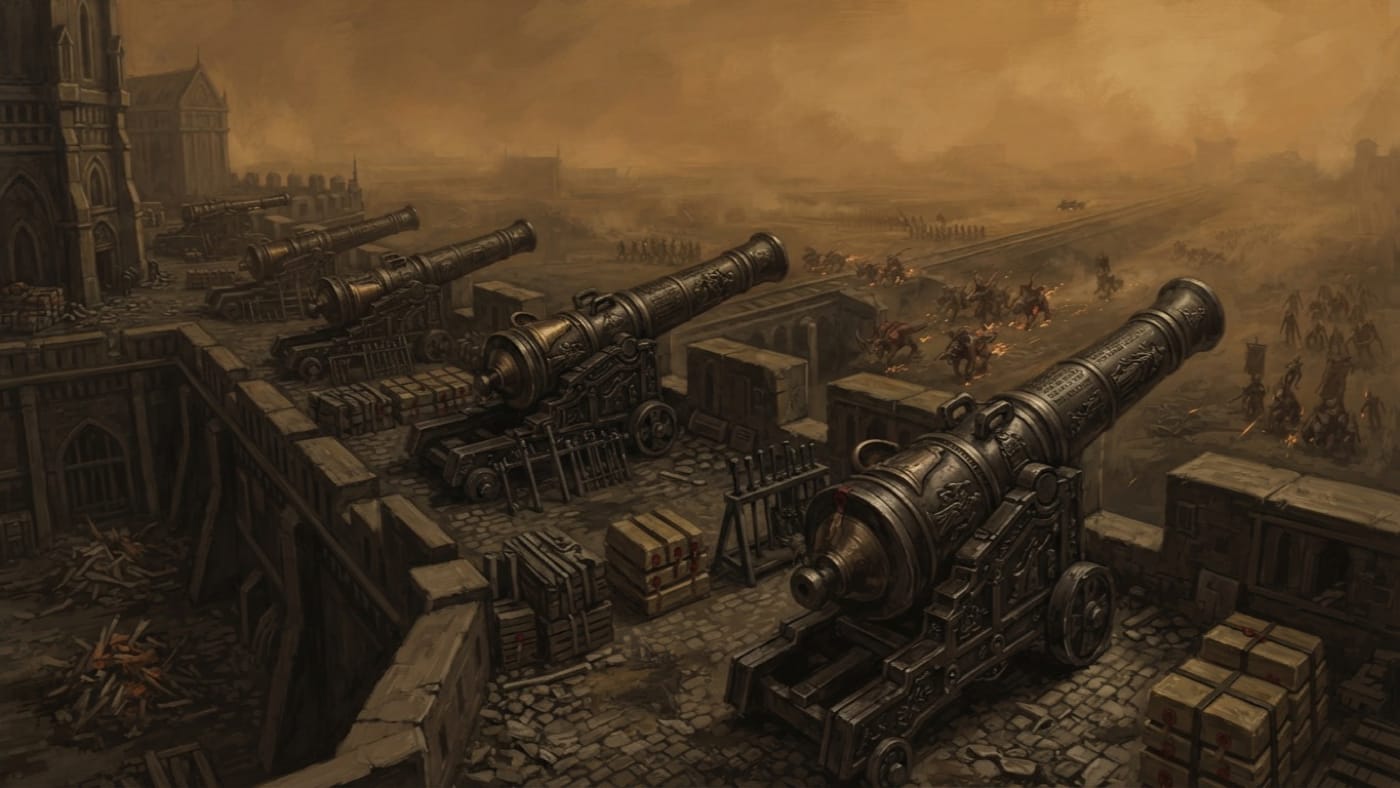
The Orison Mark III is a pattern of consecrated bell-cannon in the relic artillery of the Synod. It is a class of gun. The reader who has come looking for one famous piece with a saint's name lettered on its cheek may close the folio now. The Codex knows four examples, and knows them only by their station: four guns on the southern curtain of the Sixth Ravelin of Bastion-Constantinople, the Ravelin of Correction, which faces the Rail Spur, in the year of our Synod one hundred and seventy.
That year is the date of their documented deployment. Nobody has given this office a year for the pattern's invention, introduction or ratification, and A.S. 170 will not be made to stand in for any of them. Who drew the Mark III, which foundry cast it, what it weighs and how far it throws are questions on which my files say nothing. I do not fill silences with brass.
The files do say this much. Each Mark III required a crew of eight to load it and a choir of twelve to fire it. Without those twenty people a gun of this pattern is consecrated iron on a carriage. It is inventoried and blessed, and it is as dangerous to the Enemy as a baptismal font.
#On the Peal and the Charge
The general doctrine of the bell-cannon, which the Mark III obeys as every pattern does. No separate drill for it appears in any book I have been shown.
The Rationalists weighed their powder in grains and worshipped range tables. The Synod did not melt their guns down. It baptized them, and it banished the clock from the battery. A bell-cannon is governed by the toll alone. At the first peal the gun is readied. At the second the charge is sanctified: the powder-men sprinkle ash over it while the loaders chant their labour. At the third the relic-shot is sent. Throughout, the gun-captain holds the cadence and intones it like a psalm. Each round goes into the throat inscribed with the names of saints and of the notaries who certified past miracles. The breech of a bell-cannon is a reliquary that happens to point at Thrace.
This is the doctrine of the whole class. I set it down because the Mark III belongs to the class, and I state the limit plainly. No Mark III drill manual has crossed my desk. The surviving account of the four guns at Correction records what they required. It does not record them firing.
The bell-cannon's sin is mistiming. If the peal comes late, the shell bursts in the barrel and the crew are swept into reliquary jars, catalogued and sometimes displayed, as though that had been the plan from the start. If the peal comes early, the shot falls on our own lines. The Bureau of Records files such events under "strategic misapplication." The phrase sits on them like a clean surplice over a butcher's apron.
Earlier copies of the Orison artillery doctrine described the friendly dead of a mistimed peal as victims of murder.
Stamped Errata (Orison, 2nd Rev.): "All mentions of 'murder' are excised. Replace with 'unintended canonization.'" The correction covers misfires of the bell-cannon class in general. It has no bearing on the Ravelin of Correction, where no gun fired.
Lawful peals belong to the Bureau of Bells, whose Bell Codex sets out what may be rung and when. The hymnals a battery choir sings from are licensed by the Bureau of Orison and Song. Doctrine teaches that the gun is a sermon, and a sermon sung out of time is heresy delivered at speed. I am sometimes asked to certify the mechanism behind this. I certify the doctrine. No survey has settled whether the Creator leans into the barrel at the third peal or the powder simply prefers good manners. I am a Warden. I am not an assayer.
#On the Necessary Voices
Eight to load. Twelve to fire. The figures appear together in the surviving account, and I keep them together because the gun needs both. Rammers that move out of the chant's time will foul the second peal. A choir that has never sung under fire cannot hold the third. The Mark III does not care how many saints are cut into its shot. It needs twenty people, trained, present and alive, all working in the same cadence.
The Bureau of War organizes their service. Orison and Song licenses their hymns. Bells authorizes their peals. Records keeps their names, and revises them when instructed. Four bureaus have a hand on every gun, and a surplus of hands is the Synod's chief manufacture. Not one of those hands rings the peal or works the rammer when the people at the gun are gone.
Four guns at Correction made thirty-two loaders and forty-eight singers for a single firing. The regiment assigned to them numbered three hundred and twelve. The Ledger I have does not show how the rest were divided among reliefs, officers, magazine and watch. I will not invent a muster to make the sum come out tidy.
The Rail Spur that Correction faces runs east from Essen-of-Hymnsteel. It carries hymnsteel, bell-cannon throats and reliquary rivets. Essen calibrates its artillery parts to the voice and certifies them under the compact it keeps with Engines & Furnaces, Records and Orison. I have no shipping manifest that names these four guns, no foundry mark and no alloy, so I assign them none. The Spur proves only that the Synod can send a gun's throat to Constantinople by rail. A choir cannot be sent that way overnight.
#On the Four Guns at Correction
The Night Paper arrived on the eve of the 23rd of Argent, the 22nd, A.S. 170. A runner of the Index Damnatus Runner Corps carried it, sealed in black wax. It named the 14th Parish Regiment, three hundred and twelve men assigned to the relic artillery of the southern curtain, as oath-broken under the Catechism of Obedience, Section 14, Subsection 3: Collective Dereliction of Sworn Duty. It did not say what the dereliction was. Night Papers never do.
The colonel received it. His name now lies under the black grid that Records applies to a man whose existence has been revoked retroactively, and I will not lift the grid. Protocol required him to read the Paper aloud to a quorum of three. He summoned no quorum. He burned the Paper in his lamp and walked to the barracks. The sequence that followed took fourteen minutes, and at the end of it the regiment was ash.
Dawn on the 23rd came up the colour of a forge. The air above Correction was thick with the amber Thracian heat that veterans recognize as Maldrake's weather, and metal grew warm to the touch without any fire near it. On the southern curtain the four Mark III guns stood ready in every respect the Synod could seal, stamp or bless. Their hymn-chambers were cold. Their choirs were absent. Their ammunition was racked and blessed and never touched. No defect was reported and no shortage of shot. The guns were complete. The people who worked them were dead.
The Hellbow Legion came over the outer glacis at a run behind Forge-Beasts whose iron hooves struck sparks from the consecrated cobbles. Pyre-smiths and Ember-Soldiers followed, then a column of Hollowed, the walking bombs that the Great Deceiver's workshops pack with bile and sorcery-flame. The garrison met them with rifle, hymn and bayonet. Behind the garrison eighty stations stood empty.
The curtain came down across one hundred and forty metres. The fighting in the breach lasted nine hours, in rubble that grew higher with every assault and every repulse. Then the Bureau of Engineering arrived with a pour-frame and cement, and forty-seven people stepped into it singing. What happened to them, and what the wall at Chamber 7 is now said to do, belongs to The Vigil of the Hollowed. I refer the reader there and keep to my guns. Whether the breach was foreseen, and by whom, is a question that entry asks, and it is still open. The wall has its own folio. This one is about the artillery that stood silent above it.
#On the Recorded Disposition
The Bureau of Records classified the colonel's act as "preemptive compliance with doctrinal mandate." The Bureau of War struck the regiment from its rolls retroactive to its constitution, so that on paper the 14th Parish Regiment never existed. The Bureau of Doctrine found the colonel seated at his desk in the ashes of the officers' quarters with his uniform buttoned and his prayer book open, and declared his posture "edifying."
These are the institutions' judgments, and I enter them as the institutions wrote them. They do not answer the military question, and they were never meant to.
The order of events is plain enough. The regiment was removed from the guns before midnight on the 22nd. It was removed from the rolls afterwards. A roll can be revised in either direction by a clerk with a pen. Nothing could have revised the battery's silence at dawn on the 23rd. Striking three hundred and twelve men from a ledger retroactively does not put twenty of them back at each gun, and no stamp in Strasbourg's armoury reaches backward to the third peal of a morning already lost.
What became of the four guns, whether they were recovered or re-crewed, moved, condemned or melted, is not in any file given to me. I have not invented an answer. The Mark III remains in this Codex as a pattern of consecrated bell-cannon that required eight to load and twelve to fire. On the one morning it is known to have been needed, it had neither.