
#On the Year the Ear Was Annexed
By A.S. 94 the Synod was four years old as a constitution and the Bureau of Orison and Song was two years old as a seal. Neither had yet told a washerwoman what she might hum over a tub. The Concordat of Strasbourg had settled who governs. The charter of A.S. 92 had settled which desk governs the voice. The Orison Licensing Acts settled what the capital had been too busy with thrones to ask: once a melody leaves the mouth, whose is it?
The Bureau's, said the Bureau. It issued the Acts under its own corporate name in Strasbourg. The Ledger names no single lawgiver to praise or blame, which I resent on professional grounds. A statute without an author leaves the historian nothing to flatter, and flattery is half my method.
None of this was invented in 94. Choirs had paced work gangs, executions and garrisons for generations before any office claimed them. Voice went to war before it had a seal. The Bureau of Bells had been fixing toll schedules and licensing clappers for decades, and it kept its bronze, its sequences and its alarms. The Acts took sound that was already old and already useful and ran one ruled line through all of it.
#On Permission as the Only Pitch
Under the Acts, every melody, every cadence and every whistled work-bar answered to Orison. A tune was licensed or it was criminal. There was no third drawer in the cabinet and no clerk empowered to open one. A grieving man could not petition to have his mother's keen reclassified as harmless. He could request a licence, wait, and keep his mouth shut in the meantime.
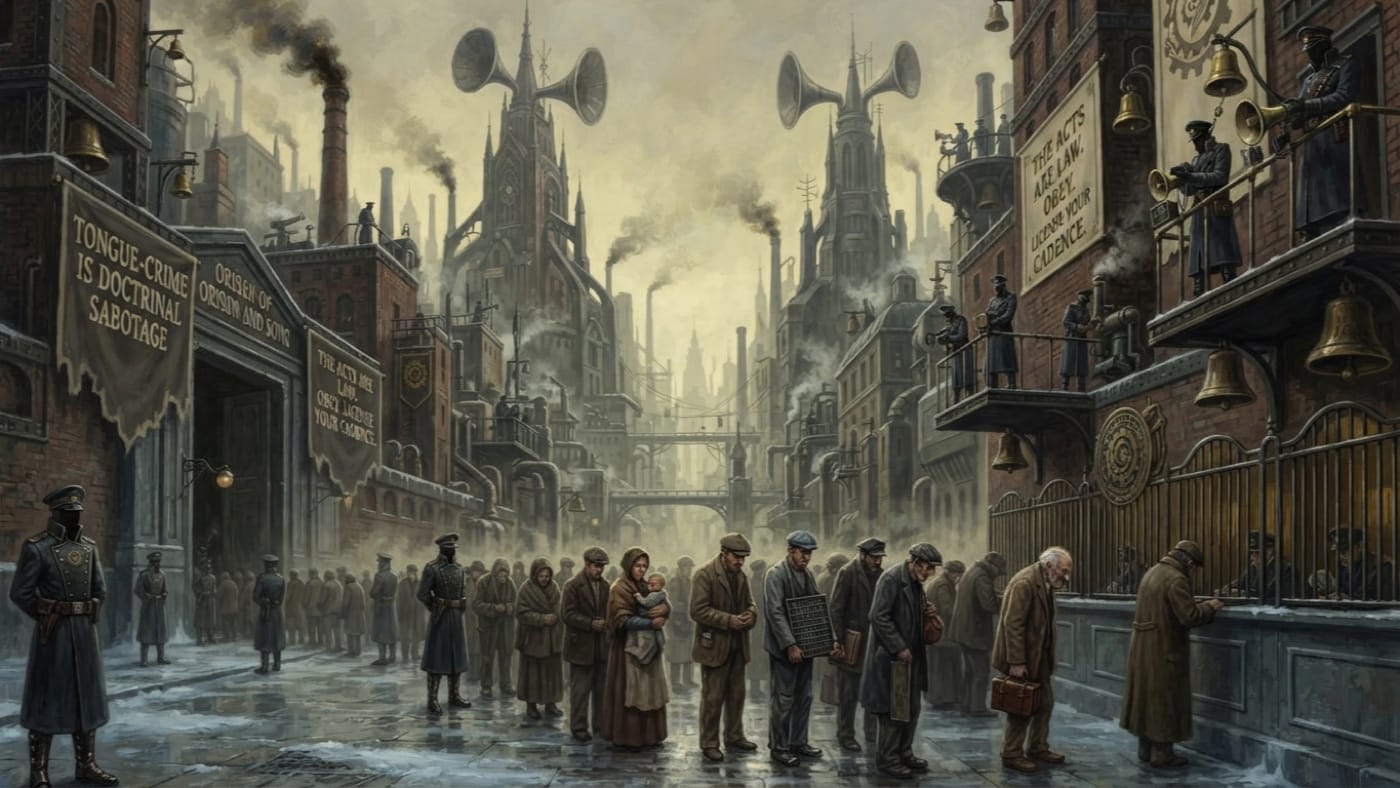
The line ran through every room in a house. The lullaby over a cot fell under it, and so did the counting-rhyme a girl skipped to in the yard. It caught the dock chant that kept six men lifting together, the calibration bars sung over the crucibles that would later make Essen-of-Hymnsteel famous, and the psalm a widow half-remembered from a chapel the Rationalists had burned. All of them became, overnight, either property of the Bureau or evidence against the singer.
A prudent reader separates three permissions that the public runs together. A hymnal carries a serial mark, which licenses the repertoire. A public choir carries a licence, which licenses the singers. A devotional broadcast carries a Clean Carrier certificate, which licenses the transmission. These are the Bureau's working instruments, and I make no claim that all three were born in the same clause of the same year. The arithmetic of them is the point. An approved hymn in an unlicensed choir is an offence. A licensed choir singing an unmarked tune is an offence. A marked hymn, sung by a licensed choir and sent through an uncertified carrier, is an offence that may also kill a district.
The Bureau's case deserves to be stated fairly, because it is mostly true. Certain intervals do draw hostile attention. The Pale Chanters tangle sky-sermons into counter-hymns over the Line, and a hymn turned inside out in mid-air can undo the discipline of a whole company. The Orison Signal Engineers breathe saint-dust so that a ration notice reaches the kitchens as a ration notice and not as an invitation. A government that has watched a song open a breach is entitled to fear songs.
The Acts, however, do not measure intervals. They measure paperwork. A licensed hymn through a dirty carrier is a door. Four bars of unlicensed lullaby may be nothing more than four bars of lullaby. The law cannot tell these apart and was never asked to. I have heard the whole arrangement praised as a tidying of the common repertoire, and in an idle hour I have said so myself.
The Acts are best understood as a tidying of the common repertoire.
Corrected. Tidying removes clutter from a room its owner keeps. The Acts transferred the room. What was swept out was the right to sing without asking.
#On the Offence and the Ear That Hunts It
An unlicensed melody is prosecuted as tongue-crime. The Acts made the crime. Enforcement grew up afterwards, as it always does: offices first, then the men who fill them, and only then the methods those men find satisfying.
In the decades that followed, the Tone Inquisitors made detection a craft. Their favourite instrument is the bait-cadence. An officer plays a fragment of a forbidden tune into a market, a stairwell or a ration queue and then watches the crowd. He looks for whoever flinches, whoever hums the next bar, and above all whoever corrects the rhythm when the bait is played wrong on purpose. Recognition is the confession. Nobody has to sing for this to work. All that is needed is to have once been sung to. Sky-Sermon Attendance Auditors add their own lists, and informants add theirs.
Under the Acts' authority the doctrine of Melody Intent treats the purpose of carrying an unlicensed tune as doctrinal sabotage, whether or not a note is ever sounded. A notebook of disguised notation proves intent. So does a music-box drum with its teeth filed to a pattern. A grandmother caught teaching a child to tap a rhythm on a table has given the clerk everything he needs.
The punishments form a repertoire rather than a table, and the officer chooses from them the way a choirmaster chooses the season's hymn. They include public tongue-branding, immurement, forced sermon labour, the erasure of a family from its rolls, and execution, which the paperwork calls sound sanitation. The family-roll erasure is the one I admire as an administrator. It punishes the singer, and it also punishes every name that might one day have learned the song from her.
#On the Trade the Acts Built
Prohibition keeps no one from wanting a song. It only teaches them where to buy one. The Acts made comfort contraband, and contraband calls up couriers. The Unauthorized Melody Smuggler is the Acts' most faithful child, raised entirely on its parent's rules.
The cargo is what the law could not kill: lullabies with decent intervals, dock chants that keep labourers from becoming oxen, grief songs older than the Concordat, and counting-rhymes useful enough to be suspect. None of it travels whole. Holding a complete melody in physical form is the one thing a smuggler cannot survive, so the trade runs on fragments. Three couriers each carry a third and none of them knows the ending. A refrain is stitched into an embroidery pattern. A cadence is disguised as an inventory list or a prayer acrostic. A music-box drum carries eight bars and never the ninth. Payment comes as milk, mask filters, medicine or a night's safe lodging, because coin leaves a trail and a trail leads to a stair with boots on it.
Fragmentation lowers the exposure but gives no legal shelter. Half a forbidden song is a forbidden song, and the law has never pretended otherwise. What fragmentation does protect is the network. A courier who is arrested can betray only one third.
The danger in the cargo is real, and the smugglers know it better than the Bureau does. Some buyers ask for the tune that brings sleep instantly, and some sellers will provide it. The trade's own proverb runs If it comforts too fast, it kills. Certain cadences want to be repeated. A smuggler who sings a full forbidden air alone at night may hear the room supply the harmony. In that one respect the outlaws keep a stricter law than Orison: they will burn a tune that has spread too far, and no clerk ever burned a licensed one.
#On the Acts in Present Force
As of A.S. 201 the Acts stand as they did, with two classes of sound and no appeal. The licence hall of the Cloister of Calibrated Breath still receives petitioners carrying the ordinary goods of a life: a laundry basket, a sleeping infant, a work-gang's tally board, a song somebody would like to keep. The Bureau reports its licensing enforcement as exemplary. In Orison's dialect, exemplary means that the prosecutions are numerous and properly filed.
Official comfort has not kept pace. The canticles approved for orphanage sleep are short, correct and useless, and the wards know it. Mothers know it too. In Vienna a folk lullaby once spread without sanction among women too tired to care what the Acts said. Within a month, five thousand mothers had been branded, their tongues blackened with hymn-fire. The lullaby survived them. Unlicensed songs generally do, which is the one fact about the Acts that the Bureau has never managed to license.