
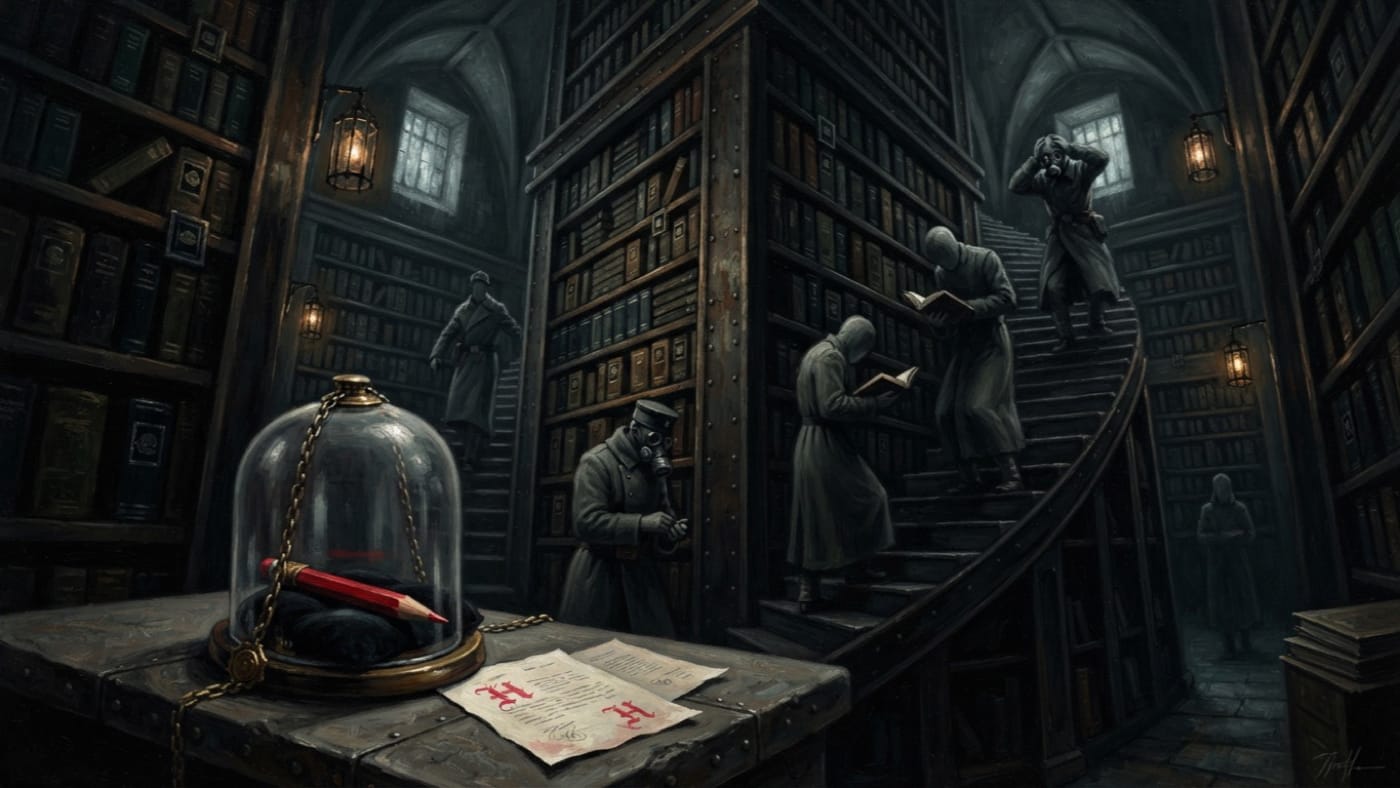
#On the Licensed Shelf
A parish shelf in a Rhineland village holds fourteen books of psalms and one stamp. The stamp is the part that matters. It bears the Seal of Approved Content, a closed book on a black field, and it certifies that the Bureau of Silence has examined the shelf, entered it in a licence register, and permitted it to go on standing. The psalms were always going to be psalms. The stamp is what makes them lawful furniture.
The authority behind that stamp is Ordinance 14-A, revised A.S. 187. I give the year of revision because the Bureau prints it on its own notice. I give no year of enactment because none is printed anywhere I am cleared to look, and I will not borrow one from a founding I admire. The ordinance descends in spirit from the second article of the Charter of A.S. 82, which the Elder Aldara Vess compressed into six words: no shelf shall stand without licence. Descent is not drafting. Whoever framed 14-A, and whoever revised it, kept their names off the notice, which in Silence counts as good manners.
The designation survives in two public places. One is the Bureau's licensing notice. The other is a single line beneath the verified hand sample of Aldara Vess the Younger, which warns that imitating her red pencil is punishable under the same ordinance. I have both citations. I have not been shown the text that joins them.
#On the Four Degrees
The notice names its subjects first: libraries, archives, scriptoria, reading rooms, and private collections exceeding seven volumes. Then it climbs.
The architecture deserves admiration. The fourth degree concerns paperwork. Its offender is a librarian who forgot to apply, or a widow whose late husband's devotional reading crept past seven volumes while she was praying for his soul. The third degree concerns objects. A man may possess a book without ever opening it, as most men possess their consciences. The second concerns the eye travelling along the line. The first concerns what happens behind the eye, and there the ordinance enters the skull with the confidence of a bailiff entering a debtor's kitchen.
These are classifications. The notice attaches no sentence to any degree, and I will supply none. A reader who wants a fine, a term of years or a scaffold must consult some other instrument. Ordinance 14-A tells a tribunal how grave the heresy is. What follows a grave heresy belongs to other offices and other paper.
The threshold grants no amnesty either. The Bureau's own text holds that every library and archive requires its licence, and the parish shelf of fourteen psalters was stamped long before anyone stopped to count its spines. Seven volumes is the point at which a private collection must apply. Modest households are not thereby issued a ration of permitted heresy, and the Index Damnatus does not suspend itself for anyone who owns only six books.
The notice then offers its own commentary, which I reproduce because I cannot improve it. The first degree, it says, has never been successfully prosecuted, since anyone who understood the text would know better than to admit it. That is the Bureau's testimony about its own record, and I enter it as testimony. It does not show that no one has ever been accused. It shows that the Bureau has written a crime whose only reliable confession is a lapse of intelligence.
#On the Hand That Authorises
The second citation hangs in the Censor-Prelate's office. It concerns a single pencil.
The sample has been verified, and the pencil it represents is authorised for Seal Amber corrections. Unauthorised imitation is punishable under 14-A. That is the entire notice, and it accomplishes more than most legislation manages in a page. It cites no clause and states no penalty. Nor does it bring every red pencil in the Synod, or every copied signature, within the ordinance. A forger of tithe receipts should look elsewhere for his sentence.
The Bureau has not published its reason for letting a licensing ordinance protect a hand, and I will not forge one. I can say what the hand does. According to the record of the Interdiction Squads, Aldara Vess can approve a raid with one initial in red pencil. That one letter sends men through false walls and turns cellars into inventories. Her licensing decisions come down in the same hand: APPROVED, WITHDRAWN, REDACT, HOLD. A competent imitation of that pencil could open a shelf, close one, or send boots out into the night. That is my own reading of the stakes. Any preamble that once accompanied the clause is withheld.
#On Inspection and Custody
A licence lets a shelf stand. It also gives the Bureau grounds to come back and inspect it. Silence directs its audits from the Cloister of Prescribed Silence in Strasbourg. Its Redactors enter a library with ink pot, brush, register and bell. They redact what a brush can save and confiscate what it cannot. The Bureau records four thousand two hundred and seven libraries audited in A.S. 200. That figure measures the Bureau's labour. It does not count prosecutions under 14-A, and anyone who quotes it as such should be audited himself.
These practices belong to Silence in general. From the two citations in front of me I cannot say which of them the ordinance itself commands. A licensed collection is permitted to exist. The licence does not let its owner read every page bound into it, and no Redactor will accept it as an excuse.
The surrounding jurisdiction is crowded. The Bureau of Doctrine defines heresy. The Bureau of Purity keeps the Index and condemns. The Bureau of Records holds documentary authority and does the indexing. Silence holds the physical word: the licence, the volume and the ink. The Censor-Prelate calls this Silence's sole authority over the word. Purity calls it something else, at length, in dispute files that Silence holds in custody.
The Forbidden Stacks beneath the city run on a separate procedure. Entry requires a Synodal licence, written authority from two Procurators, and the counter-seal of Silence. The Stacks sit in Silence's physical custody under a Records–Doctrine co-seal, and Purity keeps its right of inspection. No notice I have seen assigns any of this to 14-A. A parish licence will not get a curate down the stair.
The Ashen Circle reads all of the above as a market report. Its scholars buy charred diaries from burn-pits, lift marginalia from monastery walls, copy fragments into innocent bindings, and pass them through the gutters of the western provinces. A seven-volume threshold means little to a man whose library is forty loose leaves sewn into a coat lining. The four degrees mean a great deal to him. He has passed the fourth, the third and the second, and he stands at the first with his mouth shut, which is the only defence the notice acknowledges.
#On Present Application
As of A.S. 201 the ordinance is administered from a stone desk in the Cloister, in a chair built for a larger occupant. APPROVED restores the licence of a shelf that has grown past the threshold. WITHDRAWN shuts it, and the librarian learns by the next post that his vocation has slid into the fourth degree. REDACT sends out a Redactor. HOLD sends nothing. A held petition stays in the wing, neither granted nor refused, and no published rule tells the petitioner how long it will stay there. Aldara is fond of HOLD.
The red pencil has more work than usual this year, because the ink has grown careless about where it stops. Ink Batch 4,891-K, brewed at the Hollow-Script Scriptorium of Nemea, spreads one to three millimetres beyond its approved lines. The Bureau has found that the ink behaves as specified, after enlarging the specification to fit it. Margins on approved texts have been widened. Production continues under Seal Amber. Every licensed shelf now carries a little more white around its permitted words. Every correction made in the Censor-Prelate's verified hand has to allow for an ink that spreads past the end of the stroke.
Rumour states that the Censor-Prelate halted production of Ink Batch 4,891-K pending doctrinal review.
False, as her own dossier already records. Production continues under Seal Amber. The ordinance that protects her pencil makes no provision for her nerve, and it has never needed to.
The ordinance itself remains what the public record makes of it: one designation, one revision year, a ladder of four degrees and a pencil under guard. Silence has supplied no more. Silence considers that generous.