
#On Its Position
The Cloister of Prescribed Silence is the seat of the Bureau of Silence and the working chair of its Censor-Prelate, Aldara Vess the Younger. It occupies a wing of the Cathedral district of Strasbourg, inside the precinct of the Cathedral, among the Bureau houses that crowd the Sanctum Mile like creditors around a deathbed. This survey does not say which wing it is, or on which face of the precinct it stands. The Bureau has never published the matter, and I have not been invited to measure the place on foot.
Its origin is also unpublished. The Bureau dates its own constitution to A.S. 82, when the elder Aldara Vess gave her Charter Address inside the Church's growing administration. That was eight years before the Concordat of Strasbourg created a formal Synod in A.S. 90 and made a capital of the city. The year belongs to the institution. The building has kept its own records to itself. No register I have been shown names its builder or its consecrator. None gives the year its walls were deadened, or the morning the present Censor-Prelate first sat in her oversized chair. Clerks who want to fill these gaps with plausible years may apply to Silence for a licence to do so. The application will be refused.
What can be stated is the building's purpose. Libraries across the Synod's jurisdiction are licensed from this wing, and audits are directed from it. Access to the Forbidden Stacks is counter-sealed here. Ink brewed elsewhere is judged here. A seat of government is known by what leaves it on paper, and a great deal of paper leaves this one.
#On the Prescribed Quiet
The wing is soundproofed. That much is an engineering fact. The Bureau has not explained how it was done, and nobody has let me take a chisel to the walls. Visitors report a ringing in the ears when they enter and a pressure on the hearing, as if the building were leaning in to listen. My own ears report the same. Doctrine has offered no miracle to account for it, and I will not invent one. A thoroughly deadened room lets a man hear the blood in his own head. Some men have never heard their blood before, and they find the experience accusatory.
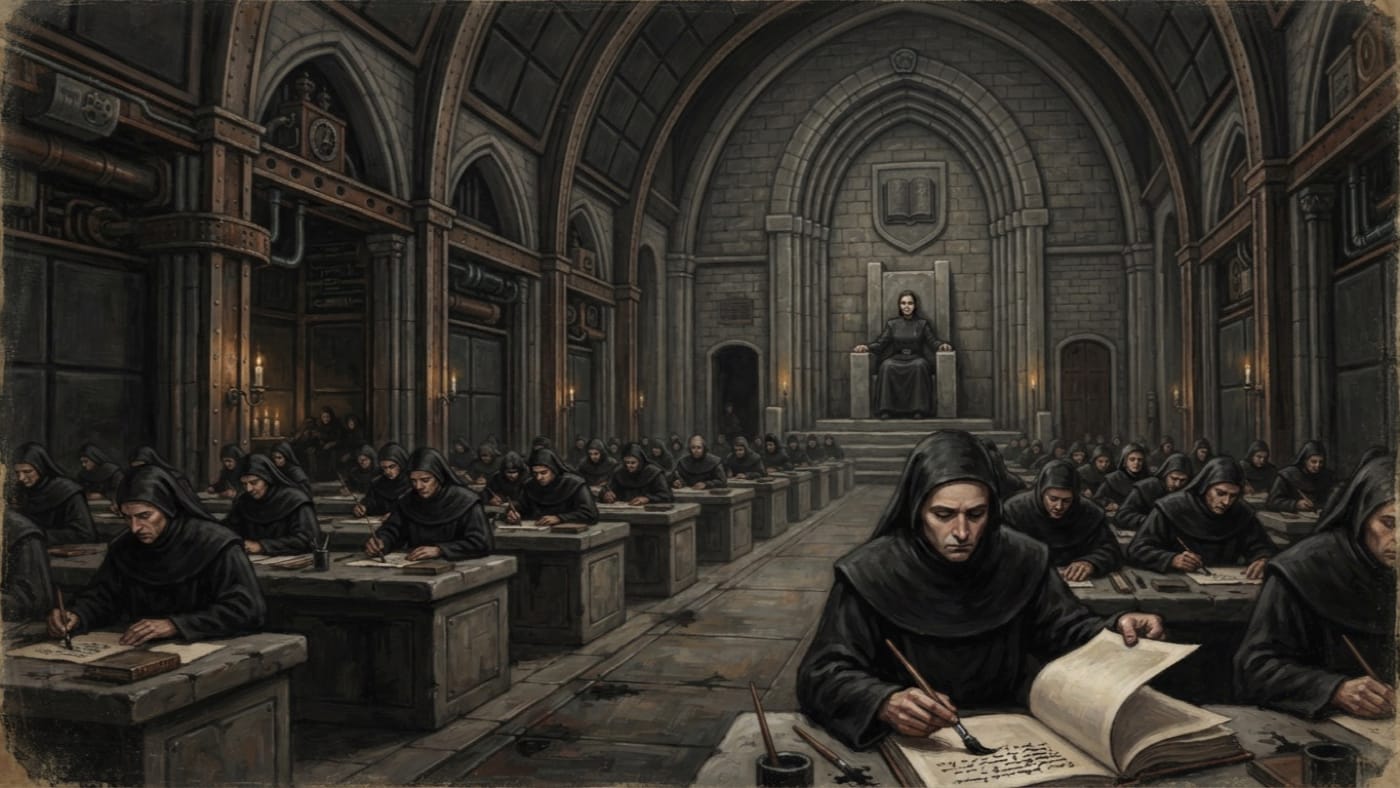
Inside, a vault rises over rows of ink-stained stone desks. Black-robed Redactors sit at them with vellum squared in front of them. The Bureau's seal, a closed book on a black field, is displayed where a lesser institution would hang a saint. Wax cools in its dishes. Wide-cut brushes lie in their trays, uncleaned, as regulation requires. The stone is cold enough to slow the hands, and the Bureau likes slow hands.
What a visitor notices is how people hold themselves. Nobody drags a stool. Pages are turned by the corner and laid down flat. A clerk carrying a folio walks as though it might wake. The rolls of this house record no vow of silence, and I have heard speech here, low and brief. The quiet is enforced by habit, by the stone, and by the example set at the far end of the room.
That example sits at a stone desk in a chair built for a larger occupant. The Censor-Prelate's office is plain. She wears no rings, so the desk has nothing to ring against.
#On the Work Conducted There
Aldara Vess does not govern by assembly. Her decisions arrive on paper, usually as one word: APPROVED, WITHDRAWN, REDACT or HOLD. Each one is a sentence passed on people outside the building, most of whom will never enter it.
APPROVED restores a licence to a parish shelf, a monastery library or a private collection that has grown past the threshold of Ordinance 14-A. WITHDRAWN shuts the same shelf, and the librarian learns that between one post and the next his vocation has become an offence. REDACT sends out a Redactor with ink, brush and bell. HOLD sends nothing at all. A held licence, petition or text stays in the wing's custody, neither condemned nor cleared. The scholar who asked for it goes grey on the far side of a word he never hears spoken.
Audits are directed from here. The Bureau's three hundred field Redactors, forty regional Audit-Cantors and six hundred clerks serve the whole institution across the Synod's reach. I will not pretend they all sit in this vault. To hold them, the wing would need to be a cathedral of its own. What the wing holds is the direction. An Audit-Cantor in a provincial see opens a library's cabinets because a paper signed in Strasbourg told her to. The four thousand two hundred and seven libraries audited in A.S. 200 were audited all over the Synod's territory, but every one of those audits was ordered from this one room.
Interdiction is authorized here as well. The squads that carry it out are drawn from the lower ranks of the Bureau of Purity and answer to Silence, and Purity has never enjoyed the arrangement. Their main business is the long campaign against the Ashen Circle. Those scholars sift ash for fragments, copy what they find into innocent-looking bindings, and pass it along the gutters of the western provinces. Each copy they make adds more paper to the wing's desks.
Then there are the Stacks. Nobody reaches the restricted texts beneath the city without three things: a Synodal licence, written authorization from two Procurators, and the counter-seal of Silence. Patience and patrons can secure the first two. The third is applied in this wing or nowhere.
#On Its Jurisdiction
The Cloister commands no other Bureau, and it would be insulted to hear anyone suggest it did. The Bureau of Doctrine decides what heresy is. The Bureau of Purity keeps the Index Damnatus and does the condemning. The Bureau of Records keeps its own archives under its own documentary authority, and it audited Nemea in A.S. 187 partly to prove the point. Silence governs the physical word: the licence on the shelf, the seized volume, the ink on the line. Where these claims overlap, which is everywhere, the Censor-Prelate prefers mutual and considered suspicion. The wing is furnished for exactly that.
The Forbidden Stacks are a separate, triple-sealed repository beneath Strasbourg. The Cloister controls their door by paper. If any passage runs between the wing and the vault, it appears in nothing I am cleared to read, and I will not draw a staircase to amuse the pamphleteers. Nor are the Stacks the Records vaults, or anybody else's cellar.
The ink comes from farther away. Redaction-grade ink is brewed at the Hollow-Script Scriptorium of Nemea, a different house in a different town. Nemea makes the ink. The Cloister judges what Nemea has made and decides whether Nemea may go on making it.
#On the Present Condition
The wing's current business is Ink Batch 4,891-K, brewed at Nemea in the 3rd Quartus of A.S. 200. When applied to a condemned line, it spreads one to three millimetres past the approved stroke and into words nobody condemned. The Bureau of Alchemical Standards tested it and found it within acceptable parameters. The Bureau of Engineering found it chemically identical to earlier batches, apart from an unexplained increase in how far it soaks into the substrate. Silence received both findings and classified them.
The decision that followed was in the house style. Production continues, and margins on approved texts are widened by three millimetres. According to the memorandum, the ink behaves as specified, and the specification has been enlarged to fit it. Every library licensed from this wing now has a little more blank space around its permitted words, and nobody outside the Bureau has been told why.
Rumour along the Mile holds that the Censor-Prelate halted production of Ink Batch 4,891-K pending doctrinal review.
Corrected. Production continues under Seal Amber, and the Cloister ordered no halt. The rumour comes from people who mistake a quiet room for an idle one.
Three Redactors have filed sealed depositions. They filed them with Purity, not with their own superiors, which says what they think of the room where their superiors sit. Each deposition states the same thing. If a fresh redaction in the new ink is tilted at a precise angle to candlelight, words appear in the black. The words were not in the original text and belong to no language Records catalogues. The Redactors call them the text the page was trying to write before the Bureau stopped it.
Purity has filed the three depositions under ████████████████. Doctrine returned the file with one annotation, which reads in full: "██████████████████████████." The Bureau of Silence has issued no reply.
No register I can reach records any answer from the wing. At the stone desks the Redactors keep working. They load the brush, lay the line and turn the page by its corner. If one of them tilts a sheet toward a candle, nobody in that room will hear it.