
#On the Castle and Its Present Offices
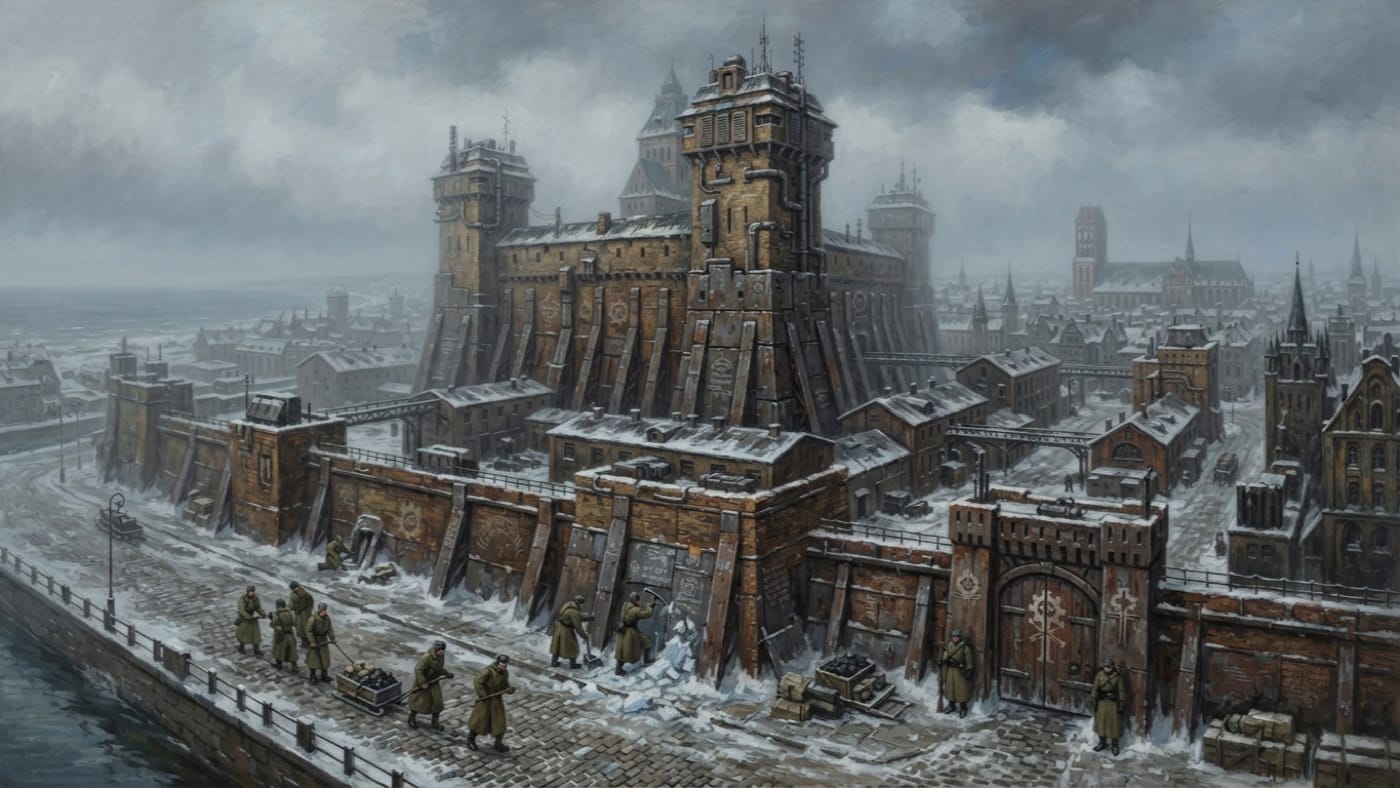
The grand master's apartments in the Ordensburg now hold filing cabinets. They stand along walls that once carried the hangings of a knightly order, in rooms where that order's highest officer slept, received petitioners, and confessed to a chaplain who presumably knew better than to ask follow-up questions. The cabinets are metal and the walls are brick. The cabinets will not outlast the walls, and nobody in the building has suggested they might.
The name does double duty. It belongs to the original Teutonic castle in the old city of Bastion-Königsberg, and it belongs to the district around that castle, one of the seven into which the bastion is divided. The Ordensburg sits within the fortified old-city complex. The Warrens lie between it and the Harbour Quarter, so the city's command and the city's poor are kept apart by a few streets and a great deal of paperwork.
Two offices share the castle. It is the garrison headquarters of the northern anchor of the Sagittal Line, and the walls are commanded from it. It is also the Northern Theater office of the Bureau of Doctrine, where a threat is described, assessed and left without a name. The first office has to decide what to do about the fog. The second has spent eleven years deciding what to call it. They work under one roof, and no regulation requires them to reach the same conclusion.
#On Requisition and Reinforcement
The castle is older than the Line, older than the Church's public emergence, and older than the Sundering by a margin the Codex does not presume to measure. This entry records no founding year and no name for whichever medieval patron paid for the brick. Antiquarians who wish to supply both may apply to the Bureau of Records, which will thank them, file the application and lose it.
The Ordensburg passed into the war's keeping around A.S. 67 (1777 CE). By then the retreating frontier had hardened into a Line that could be defended but was not yet finished, and the merchants, scholars and brewers of Königsberg learned that their city had acquired a new purpose. No surviving record gives the day the castle became a headquarters. I decline to manufacture one.
The Codex entry for Bastion-Königsberg states that "the Synod requisitioned" the city in approximately A.S. 67.
There was no Synod in A.S. 67. The requisition was carried out by the emerging Church's provisional frontier administration, an interim apparatus of councils and offices that governed out of necessity and sealed whatever it could. The formal Synod was constituted at the Concordat of Strasbourg in A.S. 90 (1800 CE). Calling the earlier authority "Synodal" is a courtesy applied afterwards by clerks who prefer their history to have been tidy from the start.
The bastion's broad rebuilding followed in A.S. 92–110 (1802–1820 CE). It began after both founders were already in the ground, and it remade the old city into the fortress the garrison now occupies. That span dates the rebuilding. It does not date each iron plate on the Ordensburg. Readers who need that precision may travel to Königsberg in January and count the rivets themselves.
The fabric itself can be described. It is medieval brickwork reinforced with iron plating. The buttresses carry inscribed prayers, and the Bureau of Bells maintains them on a rotating schedule. I record without endorsement the fact that an office devoted to bronze and frequency holds the upkeep of a castle's buttresses. What the inscriptions do, and by what means, is a question for the Bureau of Bells. The Bureau of Bells has not volunteered an answer. Neither have the buttresses, and I will be damned before I put the question to a wall.
#On Garrison Command
Castellan-Warden Ingrid Halvorsen has commanded Bastion-Königsberg since A.S. 191 (1901 CE). The command is hers, and the castle is where she exercises it. Across the whole bastion she answers for roughly twenty-two thousand military personnel, alongside some four thousand Bureau staff in their various offices. Those are figures for the city. The Ordensburg does not house twenty-six thousand souls, and a quartermaster who reads them as castle occupancy will earn the billeting disaster he creates.
The walls are run from the castle. The Sea Wall faces the Baltic and the northeastern approaches where the Grey has been reported. The Lake Gate faces the Masurian maze and has the thickest stone and the fewest incidents. Reports come in from both, and from every post in between, to brick that held a grand master's household before anyone on the Line was born. There they are read by the one person in Königsberg with the authority to act on them.
The bells are elsewhere. I have to say so because visitors keep picturing the Northern Carillon hanging in the castle like captured standards. Its forty-one bells hang in the cathedral, in the Cathedral Close, maintained by the Bureau of Bells under the spiritual direction of Rector-Chaplain Wendelin Grau. The Carillon rings over the city from the Close, and the Ordensburg hears it through its walls like every other building in Königsberg.
Halvorsen's difficulty is easy to state and has no form to go with it. She commands a threatened bastion, and the threat was classified as pending a year before she took command. Ammunition, masonry, rotations and bread can all be requisitioned, and they arrive when the ice allows. There is no requisition form for a theology.
#On the Northern Office
The Northern Office works on two disputes, and it treats both as filing problems.
The first is the Fractured North. Strasbourg claims jurisdiction across the Baltic and does not exercise it. The Scandinavian coast keeps its own councils, its own faith practices and its own bell schedules. The Northern Office writes to those communities from the grand master's apartments, and they write back when they feel like it. The exchange has kept the office occupied for the better part of four decades. In that time it has produced a great deal of paper and has not changed which bells ring at what hour in any fjord.
A clerk who refused to give his name told me, in a corridor of this castle, that the Bureau had asked three times for copies of the old Scandinavian bell-tunings and had been refused three times. With the third refusal came a demonstration, held at sea. The Bureau has not made a fourth request. What happened at sea sits in a file that the Bureau of Shadows holds and the Bureau of Doctrine will not discuss. I do not have that file. I have the corridor, which is all a corridor ever offers.
The second dispute is the Grey. In A.S. 190 the Bureau of War's Northern Theater assessment classified the contact reports from Königsberg as Unknown Forces, Extradoctrinal Classification Pending, and sent the matter to Doctrine for theological review. The review comes to rest in these rooms. Once a year the Northern Office issues an assessment. There have been eleven, from A.S. 190 through A.S. 200. The first ran to forty-seven pages and made fourteen recommendations for further investigation. The most recent ran to six pages and made one: "Continue current operational posture."
None of the assessments in between announces a conclusion, and none formally withdraws the earlier recommendations. They simply stop appearing, a few at a time, from one year to the next. The Grey's identity, nature, age, allegiance and intentions remain unresolved in every one of the eleven. The office records each question as open, and the record gets shorter every year.
A cabinet is an excellent device for keeping a question unanswered. Every drawer can be closed. A drawer that is closed and labelled Pending meets every standard of diligence the Bureau maintains. The building's own history also has a joke in it that nobody in Doctrine has noticed. The knights who raised this brick came to the Baltic with a doctrine and a sword, and they knew precisely what they meant to convert. Their successors in the same rooms have the cabinets, the brick, and fewer pages every year.
#On the Present Condition
As of A.S. 201 (1911 CE), Bastion-Königsberg is operational and unbreached, and the Ordensburg still serves as both headquarters and office. Halvorsen commands the walls from the brick. The Northern Office assesses the threat from the cabinets. The Bureau of Bells keeps the buttresses on its rotation.
There is no documented lethal assault by the Grey on the bastion. The garrison's reports of psychological casualties are also still on file, so anyone who reads the first fact as proof of a harmless enemy has not read the second. An unbreached wall does not show that any countermeasure has worked. It does not show what the Grey intends either. It shows that the wall is still standing, and the Castellan-Warden is paid to keep it so.
The reports come in from the Sea Wall and go to the Castellan-Warden. Copies go up to the apartments, where they are read, assessed, shortened and filed. In the morning the penitential crews chip the ice from the iron plates, and the old order's brick does what it has always done, which is to keep the weather out and the paperwork in.