
#On the Office Above the Gauze
The Omission Notary certifies a hole. The Bureau of Records files the certificate, the Bureau of Doctrine supplies an interpretation, and a parish clerk somewhere in the Warrens of Strasbourg corrects his roll by lamplight without once asking what, or whom, he is correcting.
The office belongs to the Custodians, the gauze-veiled apparatus of the Bureau of Shadows. That Bureau does not exist and holds fourteen decrees saying so. Inside the apparatus there is a ladder, or something that looks like one if you hold the candle at the right angle. Veil-Bearers stand at the bottom, running errands and learning silence. Above them, Corridor Runners and Wagon Hands manage doors, stairs and cargo. Above them, Custodians proper wear the full veil and carry the authority to decide. The Omission Notary is the specialist who stamps blank proof. The surveys put the Notary higher still, above the Custodian proper, but that placement comes from rumour. I repeat it because rumour is the only gazette the Bureau allows to circulate.
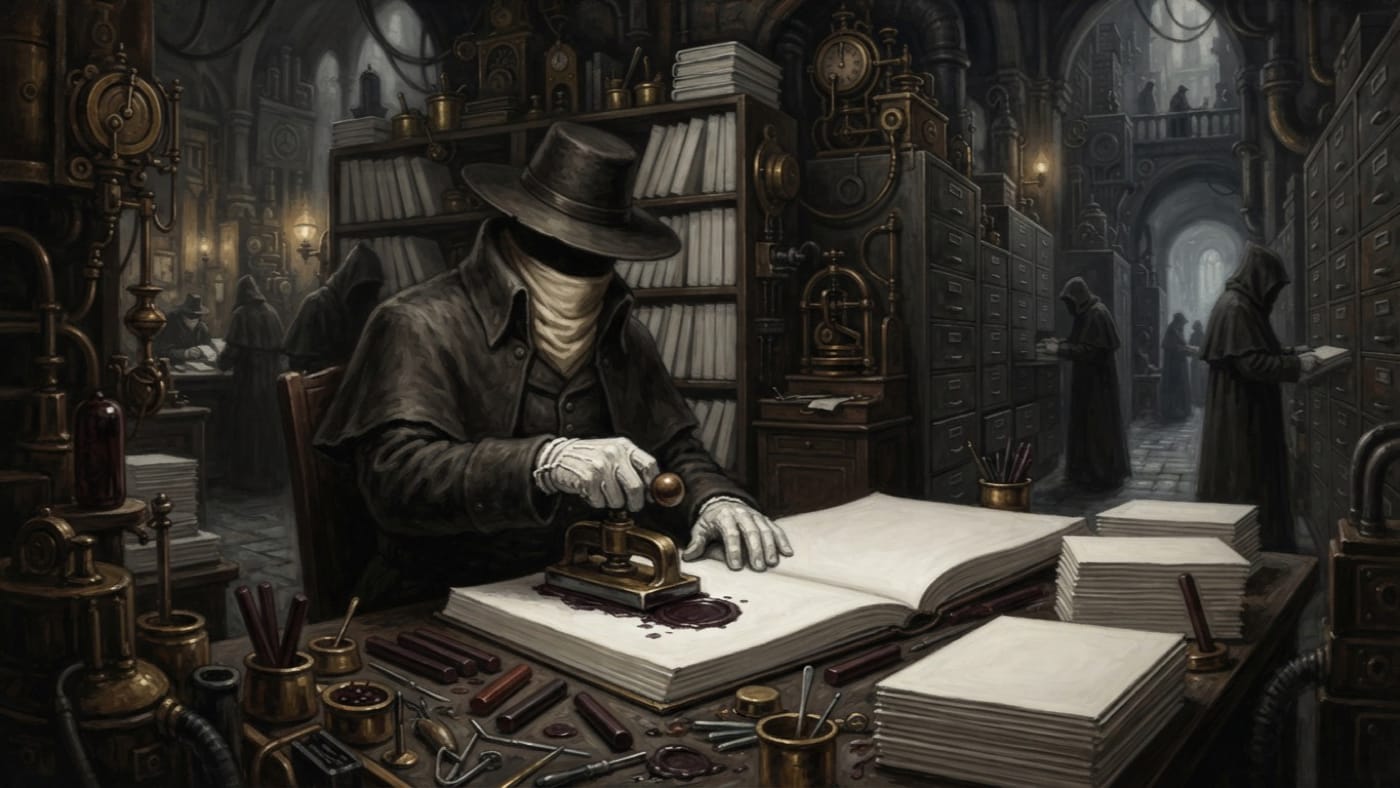
The Bureau acknowledges nothing. The street describes a figure at a desk with a white ledger and a press. The archives contribute only results: sealed blanks keep turning up where names used to be. Someone is doing the work.
#On Blank Proof
Unused vellum is only stock. Every chancery in the Church keeps quires of it, and the Bureau of Tithes counts them as an expense. A sheet becomes evidence when it enters the white ledger. That is the Custodian's book of blank folios, counted every morning, and the count must match. Each folio is accounted for while it is still empty. This is the sole department of the Synod where nothing is inventoried more carefully than something.
To become proof, the folio needs grave-dust wax and a Custodian's press. Keep those elements apart in your mind, because the auditors will. The wax is a material. It smells sweet and mineral, faintly animal, and an inspector sniffs it before he does anything else, since wax with the wrong scent means a forged omission. The press leaves a weight in the wax. It is an impression, never a device. There is no heraldic seal. There is no signature and no name of an author. The folio is authenticated physically and anonymously at once. A Records archivist finds this obscene. A Doctrine theologian finds it convenient. I have been both, sometimes in the same afternoon.
A confession records what happened. A charge sheet records what is alleged. The folio records the shape of the hole and swears it was always that size. It names no innocence, describes no crime and preserves no last words. It certifies the absence the administration needs, and the administration, having asked for exactly that, accepts it.
It is also not a death certificate. I correct junior clerks on this with the flat of a ruler. A collected subject might be in a quarry, an unlisted ward, a labour gang or a sealed archive, breathing and fed after a fashion. The folio expresses no opinion on breathing.
The household bears the consequences, and it bears them as ordinary paperwork. The man's name disappears from the parish roll. His debts are cleared, which is the cruellest courtesy in the service. A stranger sits in his chair, and every surviving document agrees the stranger has always lived in that house. His wife may be a widow, though the folio declines to say. She keeps her memory. The parish keeps a page. When they disagree, the parish wins.
#On the Work Before the Stamp
The Notary is the last pair of hands. By the time the press comes down, other hands have done the work. The Custodians' white-ledger practice runs roughly like this: sever the subject's anchors, collect the subject, reconcile the record, discourage memory, file the absence. The employer gets a visit. The priest is reminded about his pension. The neighbour gets bread, a warning about her son's registration, or both. Corridor Runners open the stair behind the magistrate's pantry. Wagon Hands load the Night Wagons after the final peal and record the weight, the weather and the wheel damage. They never record names. A Custodian proper decides whether the case calls for collection, reassignment, a warning, or the outcome the Bureau calls self-correction.
I cannot tell you who orders whom at each step. The Bureau would rather burn the staircase than draw it. The sources say only that the Notary's grade is the one that stamps the proof. Whether every blank in the service needs a Notary's hand, or whether senior Custodians sometimes press their own wax, is something nobody has explained to me. I have learned not to ask questions that are filed under my own name.
That leaves the stamp as both the last physical act of an operation and its first official one. Everything before it is rumour, bribery and wheel-ruts. Everything after it is record.
The procedure is clean. The gloves are kept so clean that their cleanliness gives them away. Sealed pockets, cord at the wrists, no stray ink. The cleanliness stops at the edge of the desk. Somewhere past the edge, a body that has not been certified dead is still taking up room.
#On Neighbouring Jurisdictions
There are four neighbours worth naming, and every one of them would like the Notary's chair.
Erasure Notaries also make people vanish from paper, and lazy pamphleteers treat the two offices as one. The Erasure Notary works in the open. He uses Black Seal strikes and signed chains of authority, and his corrected rolls go down to tithe, ration, gate and ossuary desks so that a struck household cannot eat, travel or be buried properly. He signs what he does. The Omission Notary signs nothing. The two produce similar results with opposite grammar, and it would take a reckless clerk to file one as a grade of the other.
Records clerks keep the rolls the folio corrects. The Custodians have a trick, which they call borrowed denial, of attaching a Shadows blank behind a Records denial so the denial looks official. That is cooperation. It does not make the people involved the same.
An A.S. 171 administrative glossary described Omission Notaries as "clerks of the Bureau of Records seconded to confidential work."
Withdrawn, and the withdrawal stands. Omission Notaries belong to the Custodian apparatus of the Bureau of Shadows. Records preserves what exists. The Notary certifies what does not. The two departments meet at the filing cabinet and at nowhere else.
The Penitential Shadows belong to the Bureau of Purity. The names are similar, and the Shadows are perhaps the most dangerous of these neighbours. They gather evidence so that Purity can pile it up: depositions, sins, a heresy you can show to a crowd. Purity hates a blank folio for the same reason a preacher hates an empty pulpit. You cannot give a sermon from it.
The Night Papers couriers carry authority that dies at dawn. Their slips give power for one night. A folio certifies a condition. I have seen confused garrison officers treat the two as the same kind of instrument, and I have also seen those officers' replacements.
#On the Auditor and the Blank
Custodians fear auditors more than they fear rebels. A rebel can be bribed with a cause. An auditor counts. He checks the folio count against the morning tally. He hunts for accidental ink, because a blank-book without a single stray mark is the status symbol of the service and one drop is a confession. He sniffs the wax. He watches for patterns: too many blanks in one district, the same hand turning up behind three different omissions. Custodian slang includes a practice called "double-blanking," in which two folios are filed so that the auditor puts the extra one down to clerical duplication. Every trick of this kind has a short life and ends with an auditor who has already heard of it. After that, the operative becomes the subject, and a different press comes down on a different folio.
The second danger has no audit, and it is the one the old Custodians talk about when they think the corridor is empty. They call it going blank. Friends forget a birthday, then a face, then that the man ever had a chair in the refectory. Written names blur. Spoken names start to feel improper. There are end-of-shift rituals: washing the gloves in salt, and saying one's own name aloud, quietly, once, to make sure it is still there. There is a superstition against writing one's full name even in private. The story behind it is about a Custodian who did, and by the next week the whole world agreed his name had always been misspelt.
The service has darker theories. Some say a blank page is a wound that draws lying things. Some say an unclean silence follows the worker home and nests in the gaps he files. The Custodians repeat this. Doctrine has not ruled on it. I offer no mechanism, because I have none, and Notaries keep no confessors who might tell me.
#On Present Certification
As of A.S. 201, blank proof is still being authenticated. I know because the archives in Strasbourg keep receiving it, and because the Synod keeps accepting it without reading a word, which is how the instrument is meant to be read. The office has no founding date I can certify, no incumbent I can name and no headcount I am willing to guess. The title is plural, and that proves only that the grammarians were consulted.
I have written elsewhere about the blank sheets that arrived under my door, sealed in grave-dust wax with a pressure mark in place of a seal. A heavy press, I decided, meant satisfaction. A light press meant continued attention. The last sheet had no press at all. That reading is mine. Nothing on any of those sheets tells me what grade of hand delivered it, and nothing ever will. That is the point of the sheets.