
#On the Requisition
Bastion-Przemyśl counts its bread. The Wire Orchard hands out ration tags at dawn under a blessing and closes each day with a count. Its proverb, no tag, no dawn, is the nearest thing the place has to poetry. On this stretch of the Sagittal Line, in the western Carpathians and facing the eastern highlands held by Atheron, a soldier judges privilege by his blankets and by whether anything floats in his soup. Officers eat at a table. In A.S. 191 / 1901 CE, that table acquired a silver tureen.
The tureen had been newly requisitioned from a seized estate. The file does not name the estate. It does not say who owned it, where it stood, when it was seized, or how many hands the silver passed through before it reached the officers' mess. I have asked the file these questions more than once, and it gives the same answer each time. It does fix three things: the order of one meal, what the people serving it did, and where the vessel went afterward. No day, month or season is recorded. I will not supply one to make the account look better dressed.
Nor will I supply a demon. No confirmed demonic sighting accompanies this incident, and that is why I count it among the most frightening entries in the Mirror-Lords dossier. At Switchbox Nine there was a voice nobody could identify. At the eastern salient a Lord stood among the shell-holes. In the officers' mess there was soup, silver, and a staff of officers.
#On the Courses
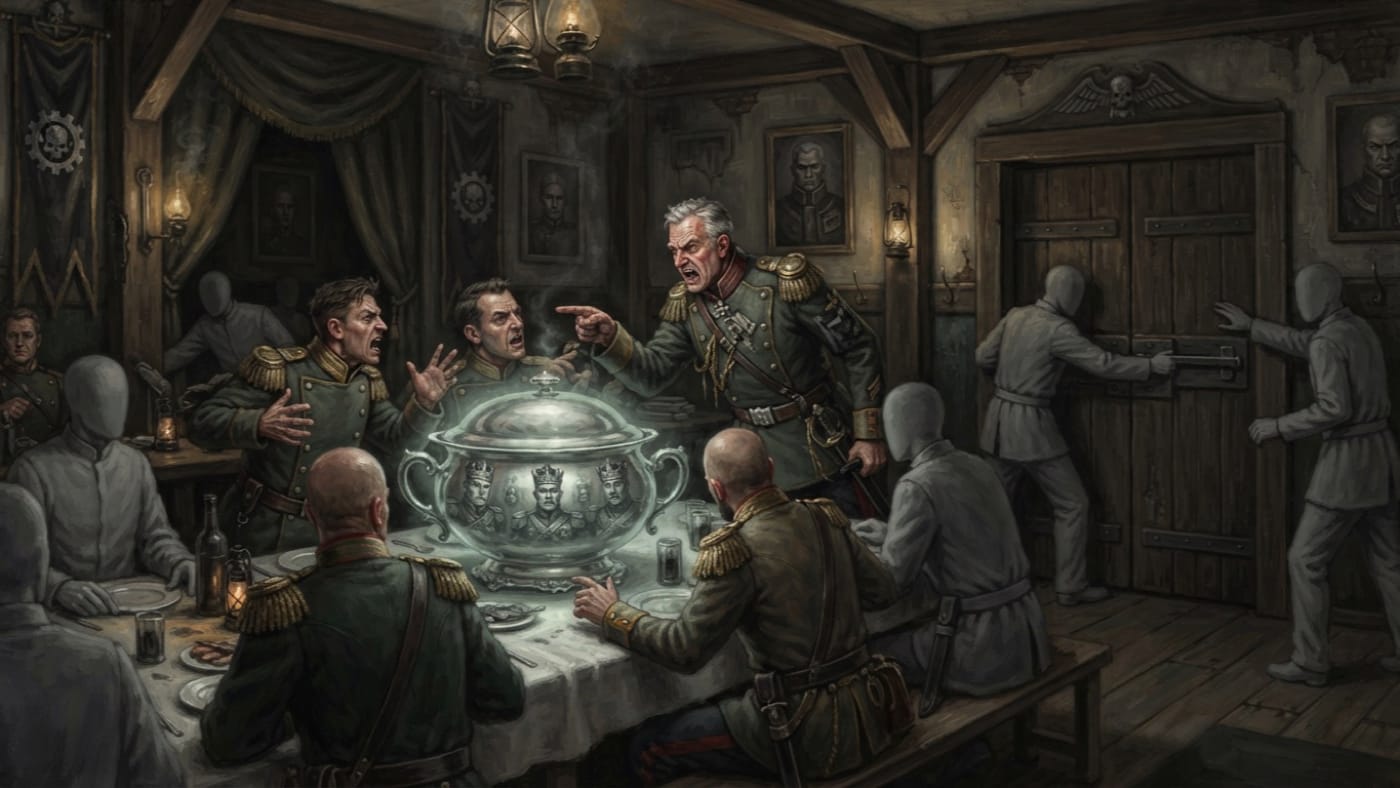
The silver showed the assembled staff as a council of crowned strategists. It showed the servants as featureless grey attendants. Both images existed only in the curve of the metal. No officer stood up from that table wearing a crown, and no servant left the room without a face. The file is careful on this point and so am I. A reader who confuses the reflection with the room has already taken his seat.
Look at what the officers were shown. Each man saw himself crowned, and he saw his colleagues crowned beside him. The record calls it a council, not a court with one throne. That detail deserves more attention than it has had. A council of kings contradicts itself, and the contradiction needed only one dinner to work itself out. Every man at the table was told he was sovereign. The same silver told him that the man across the salt cellar was sovereign too. Somebody would have to give way, and kings do not give way. They make declarations.
By the soup course, the colonel had announced a unilateral offensive.
Unilateral is where the damage lies. A staff exists so that one officer's certainty cannot reach the guns without being questioned. The maps get argued over and the supplies get counted. A major says the ground is mud, and he is believed because he has stood in it. The colonel did away with all of that before the second course arrived. The record does not say the offensive ever left the room, and it records no consequence on the field. I claim none. The danger was the announcement itself: the senior officer present had stopped consulting anyone.
By the fish course, two majors had accused each other of treason against genius.
That charge names an odd sovereign. A man in Przemyśl can commit treason against the Synod or against the Line and hang for it in Orchard Ring at any dawn. These two charged each other with treason against genius, a sovereign that existed only in a soup tureen. The file names neither man. It does not say who made the accusation first. Where genius is concerned, precedence is always disputed.
As Doctrine reads Atheron's method, Pride ruins a man by taking away his ability to recognise an equal. The officers in that mess had equals on every side of them. Within two courses they could see none. For the accuracy of the Ledger and the comfort of their families, I record that nothing in the file shows any of them was compelled. The silver flattered them, and the officers agreed with it.
#On the Servants' Intervention
By dessert, the servants had locked the officers inside and sent for the Bureau of Purity.
The record does not say whether dessert was served. It says what the servants did, and they did it in the right order. First they shut the door. A staff in rank fever is most dangerous when it can give orders to people outside the room, and a locked mess cannot send a runner to a battery. Then they sent the summons. They left the colonel's offensive and the majors' rival geniuses where they lay and called for the office whose business this was. Both acts were ordinary, and both were carried out by people the silver had shown without faces.
I will not make saints of them on thin evidence. The file does not say whether any servant looked into the tureen, or what that servant would have seen. Nothing here proves that servants resist Mirror influence. The Glass Rain of A.S. 194 shows corporals and privates promoting themselves as eagerly as any colonel. Their intervention changed nothing lasting in the chain of command either, and the officers went back to being officers. What the servants had that evening was a door, a key, and the sense to use both before anyone forbade it.
The servants received medals. The officers received treatment.
#On the Soup Report
The first account of the disturbance blamed the soup. An institution reaches for that kind of explanation when the alternative is admitting that its staff lost their wits over a piece of seized silver. Blame something in the kitchen, something below stairs, something that lets a cook be moved. The cook was moved, to latrine administration.
The disturbance in the officers' mess at Bastion-Przemyśl, A.S. 191, is attributed to contaminated soup.
The soup is exonerated. It was thin and over-salted, and its offences end there. The cook's transfer to latrine administration is reversed. The apologies owed are waiting on the procedure by which the Bureau apologises, which is waiting on the procedure by which such procedures are drafted.
The correction is on record, as are the thinness and the salt. The apology machinery is recorded as unfinished, and I do not say that any apology has been delivered. The rest is mine. The silver crowned the officers and erased the servants. The first report then did the same thing in ink, sending the blame downstairs to the one person in the building whose work had no reflective surface. The Synod corrected the ink. The silver needed a cupboard.
#On Custody and Classification
The tureen is kept in a lead cupboard beneath the Chapel of Counting, in the bastion's western old core, where incense hangs over damp confession paper. The file gives no reason for choosing lead, and I offer none. When I call the vessel faintly smug, that is my opinion of a piece of silver and nothing more. No record shows that it is conscious. No record shows anything inside it.
It lies in the Mirror-Lords file because the evening follows their pattern too closely to be filed anywhere else. A reflective surface raised one class of person and erased another. Rank fever then took hold, and a staff that should have held council fell apart within two courses. Doctrine filed the incident on that resemblance. The filing records a suspected association. It names no particular entity, and it proves nothing about how silver from a seized estate came to behave as it did. The record cannot say whether a Lord stood behind the tureen, passed through the estate, or never came near either.
The dates should be kept separate, because the Bureau likes to blend them into one story with itself as the hero. The Chapel Glass Incident came first, in A.S. 188 / 1898 CE. The mess disturbance followed in A.S. 191 / 1901 CE. In A.S. 192 / 1902 CE came Switchbox Nine, and after it Circular 192-M, which ordered unnecessary reflective surfaces dulled. The Glass Rain over Orchard Ring followed in A.S. 194 / 1904 CE. The Atheron engagement at the eastern salient in A.S. 199 / 1909 CE produced the present field doctrine of Przemyśl. None of that existed on the evening of the soup. The servants had no circular to cite and no paired witnesses or inventory drill to fall back on. In the margins of the later doctrine, the tureen is still listed among the silver that ought to have been dulled.