
#On the Missing Grain Return
Niš is in the Codex because of missing paperwork. In A.S. 38 a parish in that city failed to send its grain report. The parent record of the Eastern Silence lists that failure next to a magistrate in Skopje who sent no quarterly arrest tally and a rail office south of Belgrade whose destination columns came in blank. That is all the local evidence there is. The Bureau has no name for the parish and no name for its clerk or priest. It has no figure for the granaries, no day when the report fell due, and no surviving sheet.
A grain return is the humblest document any administration keeps. It counts sacks. It records what was sown, what was carted, what was kept back for seed and what was owed. Nobody reads it for pleasure. It is filed so that some later clerk can compare it against the next one and catch a man in a lie of four bushels. Its whole value is that it comes back every season. A return arrives, is stamped and shelved, and the office forgets it until the next one is due.
Niš broke that habit. The column stayed open.
#On the Eastern Correspondence
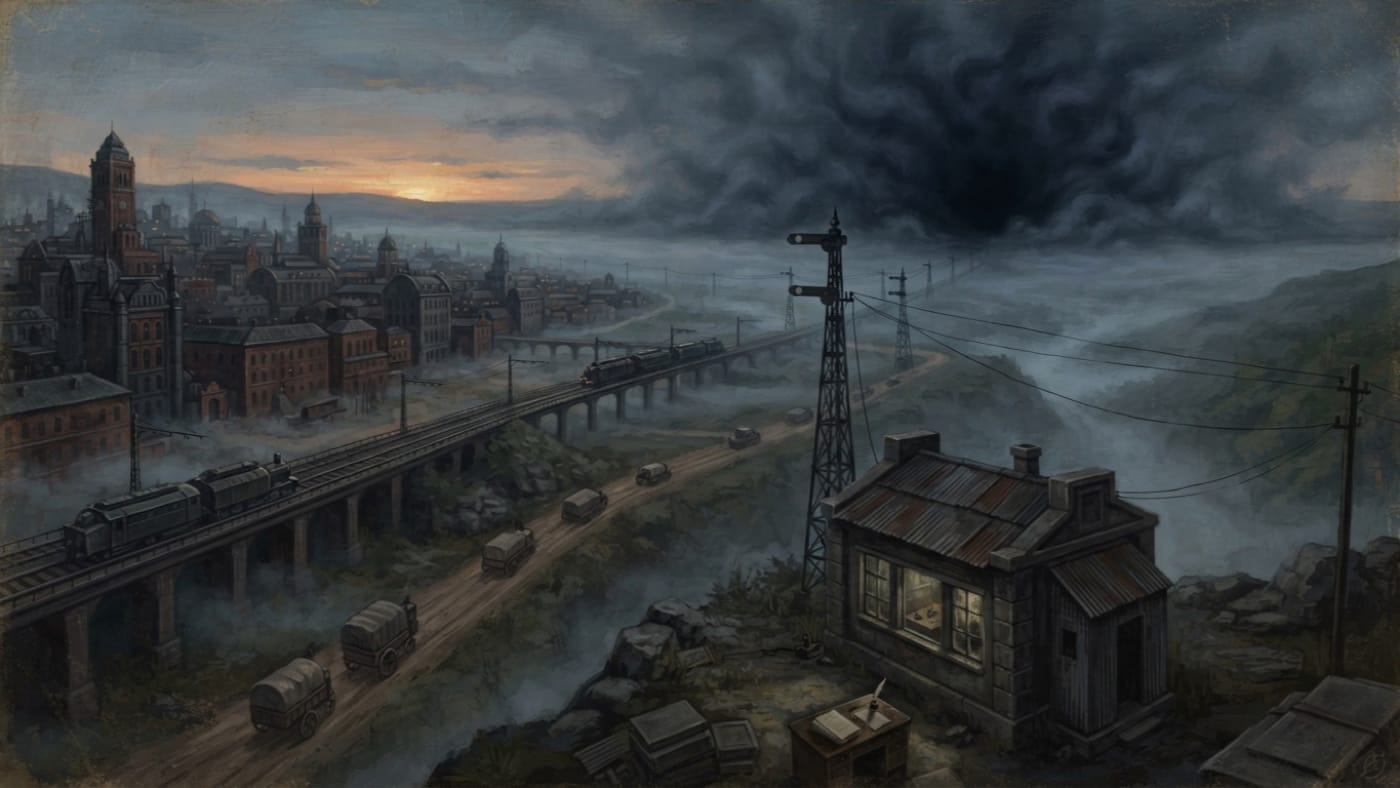
In A.S. 38 Serbia reported to the Rationalist Republic. Eight years earlier the Treaty of Regensburg had made that Republic formal, along with its preference for counting things over praying for them. The parent record describes how Vienna kept hold of its provinces: relay riders, courier trains, Danube packet boats and semaphore towers on the hill crests. The Bureau does not give Niš a station, a junction or a tower in that system. The record says only that a report expected from the city did not come.
One missing return is a delinquency. A provincial office expects a handful each season and has a form for chasing them: a reminder, then a second reminder, then a fine, then a visit from a man with a satchel and a grievance. Had the Niš omission stood alone, it would have earned the first reminder and nothing more.
It did not stand alone. Across Serbia, Thrace, the Wallachian marches and the western Balkan passes, letters began to fail before the couriers carrying them did. A bridge washed out near the Morava. Bandits took a convoy south of Novi Sad, or so the report claimed. Every failure had a plausible cause and a plausible clerk ready to state it. Laid side by side on one desk, they were no longer delinquencies. The open column in the Niš grain account became one entry in a pattern the Republic had no form for.
#On the Explanations Sent West
Vienna's clerks blamed spoiled ink, courier theft, local disorder, old superstition, bad roads, and the sloth of provincial men with mud on their boots. These are excellent explanations. They explain anything. A Rationalist office in A.S. 38 could account for a missing parish return without once lifting its eyes from the blotter, and it did.
Then accounts began arriving that no blotter could absorb. Refugees came west along the Danube roads. They spoke of forests that moved without wind, churches blackened from the inside overnight, and fog that swallowed whole valleys and gave them back rearranged. A patrol near Skopje was said to have marched into such a fog and come out in reverse order. Scouts sent east to verify these stories never came back to verify anything.
The Bureau records this testimony as regional. No surviving deposition puts a witness inside Niš, and I will not supply one to help the story along. Every refugee who describes a black church describes a church in their own village. The grain report from Niš testifies only to its own absence.
The Council of Rational Governance answered with quarantine. Travel into the eastern districts was forbidden and travel out was regulated. Reports of monsters and divine wrath were prosecuted as sedition under the Regensburg articles. The official finding was that the East suffered a plague of panic made worse by obsolete religion, and the official term survives in the chronicles: superstitious hysteria. By that reckoning, a parish that failed to report its grain belonged in the same sanitary category as a village that reported its dead walking. Both were noise. Both were sealed behind the cordon, to be counted later.
Nobody came back to count them.
#On the Warning Before the Sundering
The Bureau of Doctrine holds the Eastern Silence to be the fourth Providential Warning. The Cold Fires of Vienna came in A.S. 30, the Year Without Dawn in A.S. 32, and the Red Flood of the Danube in A.S. 34. The Silence followed in A.S. 38. Seven years later, on 1 November A.S. 45, the Sundering arrived and the East delivered its report in fire.
Doctrine classifies the Silence as a hostile preparatory absence. In that reading, roads, seals, maps and correspondence were loosened before the Great Deceiver broke in openly. This is the Bureau's holding, and it was set down long after the fact, once the Synod had a Bureau to hold anything with. In A.S. 38 the faithful who read the signs did so in cellars, among the Cellar Saints and the hidden Church. They had no seals, no offices and no right to publish what they believed. The Codex stamps the year after the fact and says so.
What the Codex will not do is march Niš into the war. The first open hosts struck Skopje and Novi Sad and broke their garrisons within hours. Those cities have their own records and their own ruins. Niš does not appear in the chronicle's account of those first blows. Serbian ground is linked in broad terms with Maldrake's slag valleys and Syrion's fog kingdoms. Those links do not tell us which power took the city, whether any did, or when. The Bureau has no garrison roll for Niš, no siege and no fall. On the regional calendar, 38 to 45 is seven years. That interval is no evidence that one parish clerk sat silent at his table for every one of them.
Eastern Silence Confirmed. A.S. 149.
Corrected for doctrinal sequence. Certain Bureau educational chronologies date the Eastern Silence to A.S. 149, after the war had already reached the Sagittal Line (Unregistered) and long after the Synod was constituted. The Silence began in A.S. 38, before the Sundering of A.S. 45, which is the only order in which a warning can usefully be ignored. A portent that arrives a century after the catastrophe is just the minutes of the meeting.
#On the Limits of the Entry
An absent report proves that a report is absent, and the Bureau will take that finding no further than its ink allows. The grain return from Niš does not prove that the harvest failed, that the parish emptied, that the church burned, or that every road out of the city closed on the same morning. The word parish survives in the record. The Bureau does not certify what that word still meant under a Republic that had made public prayer a crime.
Men who have never filed anything tell me that so small an entry dishonours a city. The truth runs the other way. Cities enter the Codex by the thousand through sieges, saints and sermons. Niš entered through the cheapest instrument the Republic owned. It was one of the earliest eastern documents to tell the truth, and it told it by saying nothing. Vienna had a column for the grain and no column for whatever stopped the grain. So it waited, and drafted reminders addressed to a table that nobody could confirm was still occupied.
The column remains open in the Bureau's copy. Conjecture will not close it.