
#On the Closing Peal
"The day ends when it is told to."
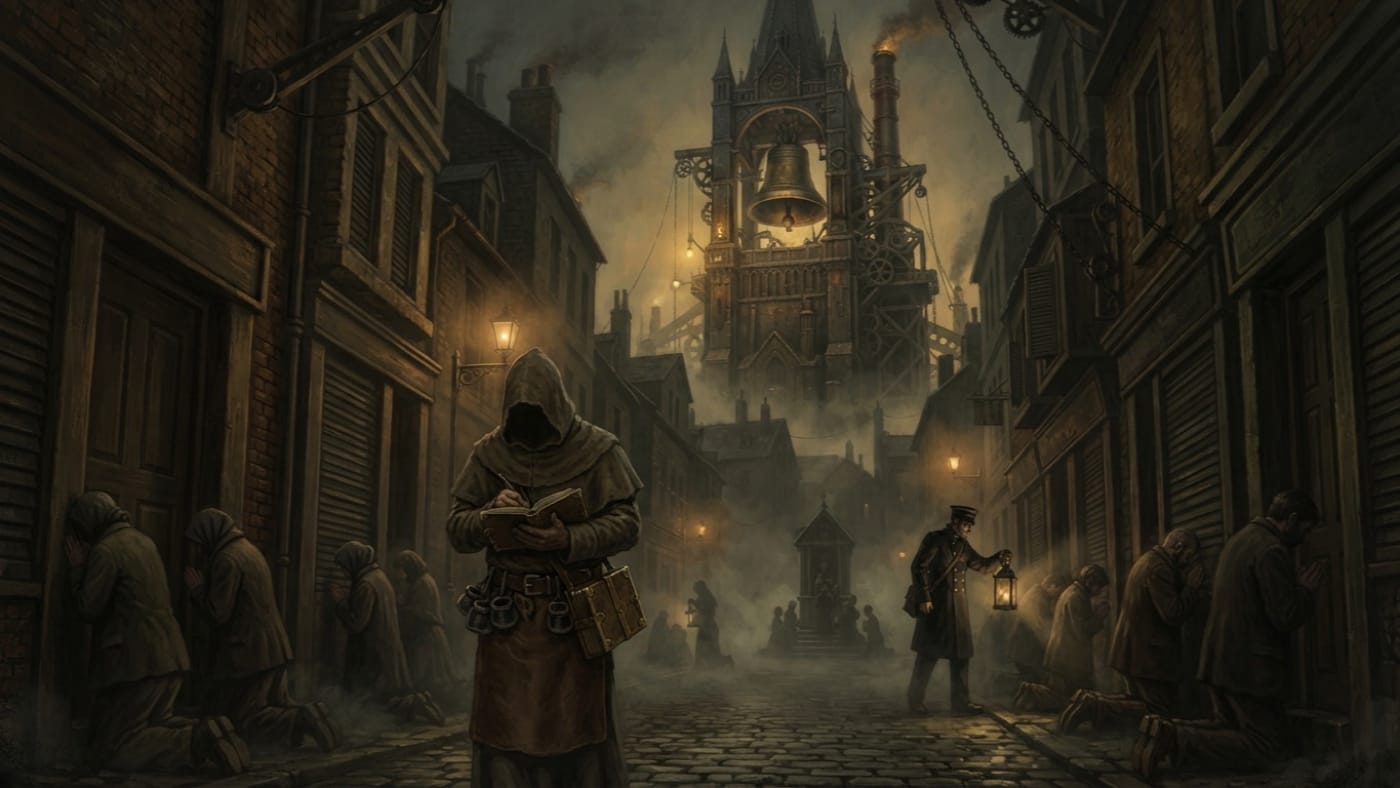
At the Ninth, the city puts itself away. Kitchens bank their fires and ladles go back on their hooks. Shutters come down along every lane in the ward, one after another, like a ledger being closed a page at a time. A man who was halfway through a sentence finishes it on his knees, or he does not finish it.
The Ninth is the last of the Ninefold Peals, the daily order by which the Bell Lattice of Strasbourg and the cities that copy it measure work, bread, debt and prayer. Foreigners ask what hour it strikes. The question tells you where they were born. The Ninth strikes at dusk, as the Bureau of Bells defines dusk, and the Bureau has never agreed to let the sun overrule it. It is not nine o'clock. It is not nine strokes. Provincial almanacs that print a clock-time for it have been confiscated, and the paper sent to better uses.
Its age is harder to state, and I state only what the file supports. The Office of Bells was constituted in A.S. 52 under the provisional council, though towns were ringing their own customs long before any office asked to inspect the rope. The proclamation roll of the Concordat of Strasbourg records three days and three nights of ringing in A.S. 91. The Bell Codex that governs present standards was ratified in A.S. 115. None of these documents records the first Ninth. Readers who want a birthday for it may petition the Bureau of Records, which will receive the petition promptly and file it at the Ninth.
#On the Duties of the Threshold
The bell starts the evening's duties. It does not finish them.
When the Ninth sounds, households kneel at their thresholds and confess loudly enough for the neighbours to hear. Fathers confess doubts about quotas. Mothers confess wasted bread. Children confess the jokes they whispered during catechism, usually ones about the catechist. Clerks in hooded mantles walk the lanes with inkpots slung at their belts and record each admission in the Ledger of Grace. Doctrine's public catechism calls this a freedom, "a cleansing of the soul, so that none may carry the day's shadows into the new dawn." I accept that description. The day's shadows are carried to Records instead, where they are better stored.
Once a household has confessed, it may close its shutters, but it may not stand. The family stays on its knees until it hears the Hymn of Closure from the shrine at the end of the lane, sung by conscript choirs of the infirm. Anyone who fails to hear the hymn, whether through deafness, drink or despair, is entered in the book as absent. Records later corrected the word to pending, and printed a note explaining that the change was purely about wording. A deaf widow kneeling on her own step is now pending instead of absent. Her knees have not been told.
Another account in the Lore Book describes inspectors carrying ledger-lanterns down the street at the Ninth and noting which doors echo with confession. Doors that stay silent are marked in red ash. The same account says that during a plague-year a whole street in Lyon failed to kneel and was gone by morning, paved over and given a holier name. I report it as the account gives it. The pavement does not argue.
The military form is harsher, and it belongs to the military. Along the Line, the evening rite ends the day's prescribed cycle with curfew fog and kneeling at the doorframe. Each soldier confesses his fear into the wood, then cuts his palm and works the blood into the grain. After years of this, a barracks becomes planking soaked in confession. Some soldiers claim the timber murmurs at night. The Bureau classifies the murmuring as "pious illusion," which is also how it classifies most reports from barracks. No civilian ordinance requires a housewife to bleed into her lintel, and I record that so that no zealous vicar decides it ought to.
#On Licensed Silence
The Ninth is called the hour of silence. Listen to it. A bell rings. Families confess in loud voices. Clerks' boots go up and down the lane. A choir sings. Inspectors take their own time over their rounds. The silence the Synod imposes at the Ninth is the loudest event of the day. The only sound forbidden is the sound nobody licensed.
The Censorium of Taverns holds the strictest view. In its own words, to laugh past the Ninth is sedition and to drink past it is treason. Its Fog Clerks carry incense vents to put out singing, and in the principal cities fog is pumped from the Orison vents until the streets go quiet. Tavern-keepers describe other fogs: coal-smoke, municipal fume, and whatever a cellar bellows can produce when an inspector is late. I have heard a man try to sing with a throat full of curfew fog. The sound was like a crow being strangled with paperwork.
What the Censorium writes and what the street permits are different documents. The Curfew-Fog Tavern Runner earns a living in the space between them. Runners hang muffled shutters and quiet-cloth, play approved music, seat drinkers so they cannot form a crowd, and keep a bribe tin they call paying the saint. The Synod tolerates them because a city under curfew needs somewhere to let off pressure, and a well-placed tavern tells the Lanterns more than a dozen informers. Treason is a fixed charge. Whether anyone brings it depends on who is drinking and what they let slip.
The working classes have adjusted. Brand-Smiths finish a shift and drink whatever the runner can pour before the Ninth, then speak their trade's superstitions quietly into the cup. The timing is the only piety the drink requires.
The Bellwarden stands behind all of it, with a toll-key chained to the wrist, tension gauges, and a log of every deviation. Emergency peals override the schedule. People beg the warden to hold the Ninth back by one peal because a child is still on the far side of the ward. Some wardens sell the extra minutes, a crime the profession calls a passage window. Once the bell has struck, the Curfew Ordinance of Quiet Hours takes over, and every step must be accounted for with a lamp, a pass, a route and a witness.
#On the Peal That Failed
The Bureau of Records keeps an account that the Bureau of Records denies.
According to its annals, the Cloister of Concord once suspended the Ninth for a single evening so the city could celebrate the Triune Hearth Compact. The bells were silent. The people were not. Without the bell they were used to, they did not know when to stop. Queues dissolved without anyone dismissing them. Kitchens left their pots on the fire until the food spoiled. The taverns kept singing, then kept drinking, and by the account's end they were rioting. The experiment was ended. The record was then amended to say that the bells had never faltered at all.
The Cloister of Concord once suspended the Ninth Peal for a single evening, and disorder followed.
Records has corrected this entry by stamp: "The rumor of a missed Ninth Peal is an invention of Rationalist agitators." The annals that preserve the suspension and the stamp that denies it are held by the same Bureau, on the same shelf, under neighbouring numbers. Neither gives a year. Neither names an officer. Both are authentic documents of Records, and Records is the authority on what counts as authentic.
The Bureaus give different reasons why the Ninth matters. Purity holds that the bells are Heaven's voice and that each tone drives out a demon. War holds that the bells are logistics: without them regiments go hungry and nobody marches. Doctrine says the bell keeps the Great Deceiver from walking abroad after dusk. Doctrine is entitled to say so, and I am entitled to quote it. The suspended evening shows only what the people did without their bell. It does not show what came for them.
#On the Ninth at Calais
Inland clerks sometimes mix up the Ninth with The Ninth, and the mistake has cost at least one requisition.
The Fog Bell Tower of Calais holds nine authorised bells. The ninth of them is unnamed in the public tables and is known locally as The Ninth. It is rung only when a name appears below the safe surf-line on the Script Wall. The ringing order requires readers to kneel when it sounds. The tower's main fog sequence, three short, one long, three short, belongs to Olivane and the fog summons. It does not belong to The Ninth, and it is not a model for the strokes of any curfew.
So the inland Ninth is a time of day, and the Calais Ninth is a single bell. One closes the city every dusk. The other warns that a name is sinking, and it rings when that happens, not on a schedule. Both make people kneel, and that resemblance is the whole source of the confusion. Calais has troubles of its own with its fog, and it does not need Strasbourg's curfew added to them.
#On Present Observance
As of A.S. 201, the apparatus is maintained, staffed and audited. Bellwardens oil the pulleys and check their pitch marks against the Timing House clerk's readings. The toll-keys stay chained. The hooded clerks go out at dusk with full inkpots and come back with empty ones, and every morning the Ledger of Grace is a night's confessions thicker. Ration kitchens, tavern licences, gate passes and the Brand-Smiths' cups all run to the same schedule, because people would sooner obey a bell than decide for themselves when the day is over.
I hear it from my own window. I kneel when it rings. My confession is short, as befits my office, and the clerk writes it down without looking up.