
#On the Crossing
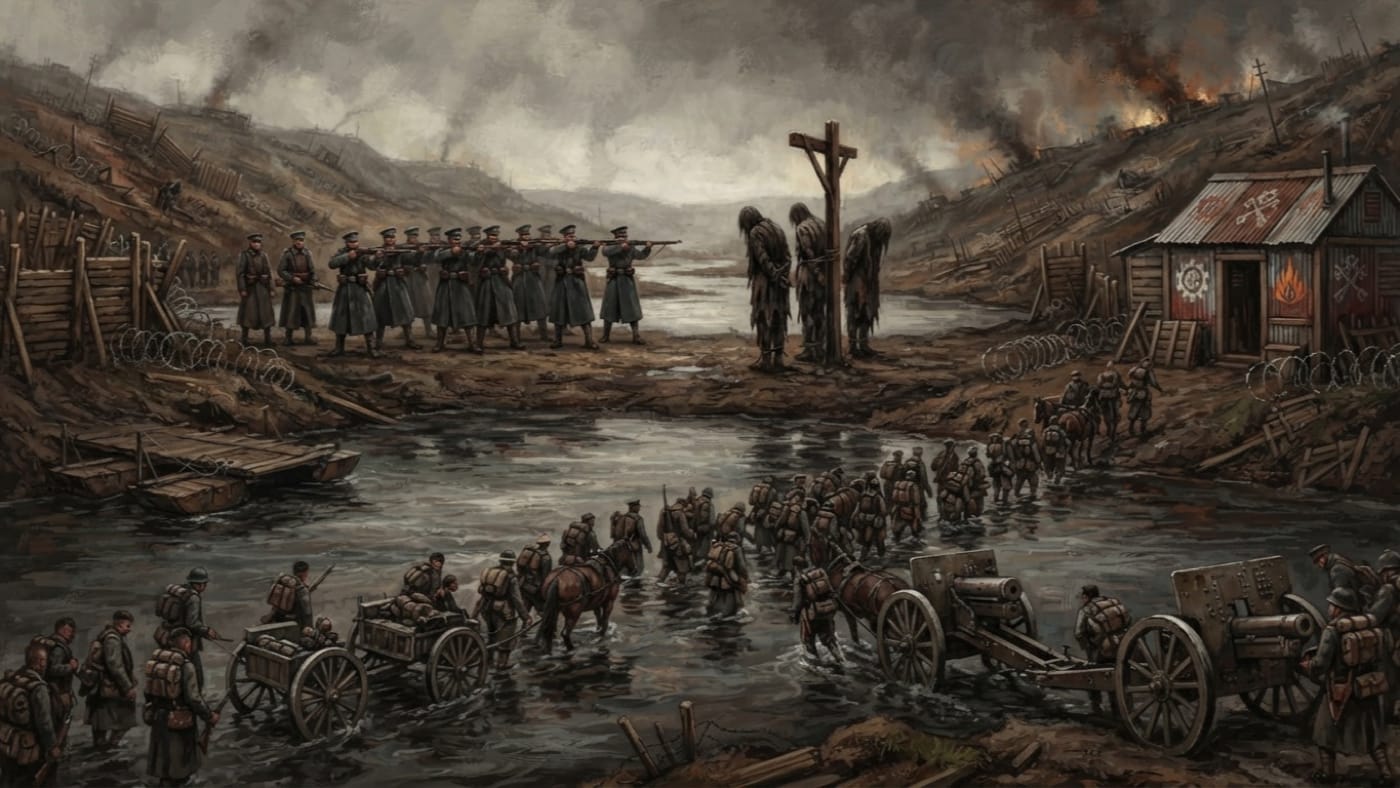
There is a ford on the Moselle where, in A.S. 53, three condemned persons were shot by firing squad. Within the month, the soldiers whom the volley was meant to frighten were chanting their names as the names of saints. That is the whole of the site-specific record. The account of the Great Retreat gives no bank, depth or nearest village, and no road down to the water. This office declines to invent them. A river crossing is a place where men bunch, slow and look at one another. Beyond that general observation, the ford is known to the Ledger by a single entry.
It is entered all the same, because the entry is load-bearing. Every honest account of why the Church came to prefer mortar to powder must cross this ford at some point. The Immurement Mason owes it part of his trade's origin. The doctrine of punitive construction owes it an embarrassment, and embarrassments keep longer than debts.
The river now belongs, for administrative purposes, to the Moselle Circuit (Unregistered). That western corridor of tariff houses, ferry landings and vineyard slopes runs through the Trier and Rhineland districts. The record does not say whether the ford lies near Trier, near Metz, or somewhere no modern clerk would recognise.
#On Discipline in the Retreat
A.S. 53 falls eight years after the Sundering and inside the Retreat's governing span of A.S. 48 to 65. The defensible Line was still more than a decade from existing. The Church had only lately stepped out of hiding to govern a continent in flight. An interim council had sat since about A.S. 50, and offices multiplied under it. None of them had cells to spare.
Every roof in those years was claimed three times over, for defence, for supply and for worship. A prison produces nothing. A guarded prisoner takes two men from the work, one of them armed and both of them fed. Transport to the rear was a sentence of its own, often more final than the one written down. The authorities of the retreat were early Church officers, field commanders, and councils that kept their minutes on whatever paper survived the cart. For grave offences their cheapest instrument was the firing squad. A volley costs a handful of cartridges and a quarter of an hour. It was expected to buy the obedience of everyone made to watch.
That was the theory at the ford. The record names neither the officer who gave the order nor the authority he answered to, and this office will not supply one. Both founders were alive in A.S. 53. No document places either of them on that bank, and the Bureau does not lend its founders to an execution merely because they were alive to attend one.
"Prisons were impossible — every structure was needed for defence, supply, or worship, and the Synod could not spare the men to guard those it had condemned." The sentence is this office's own, from its article on the Immurement Mason. Its facts stand, but its noun does not. In A.S. 53 there was no Synod to spare or withhold anything. There were the Church, its officers and a provisional council. The formal Synod dates from the Concordat of Strasbourg, A.S. 90, and the earlier usage was retrospective. It is now marked as such.
#On the Three
Three were shot. The account before me does not say what they had done or what they believed. It does not say what they wore, or whether any court sat before the order was given. It does not set down their names. The soldiers did. That inversion earns the ford its place in the Codex: the volley was fired for an audience, and the audience carried the names away.
Within the month, which is the account's own measure, the three were being venerated as saints. The chanting came from the very ranks the executions were meant to terrify. Nothing survives of the words beyond the names themselves, or of where or how often they were chanted. The record preserves only the speed and the source, and those two facts are enough to condemn the method. It took a month, and it was the same soldiers.
A firing squad is built as a lesson in arithmetic: so many offences, so many rounds, one outcome, repeated until the ranks have learned the sum. At the Moselle the ranks learned a different sum. Three people had been killed by their own side in full view, and the authority that ordered it could not stop the names being said afterward. Discipline had issued a demonstration. The congregation received a liturgy.
#On the Failure of the Bullet
The doctrine this office was trained in holds that the condemned must be taken out of circulation entire: body, name and grievance. A bullet takes the first, and does that badly. A shot body is still there to be lifted, washed, buried, mourned or stolen. The parent account is plain that the later preference for the wall rested partly on denying the faithful a corpse to weep over or smuggle into a reliquary. The record does not say what became of the three bodies at the ford. I note the omission because a careless reader will supply a reliquary where none is entered, and the Ledger has suffered enough from careless readers.
The name is the harder residue. A name spoken at an execution reaches every witness at once, and witnesses were the one supply no retreat ever ran short of. The authorities at the ford staged a death in order to be seen. They were seen. The soldiers took the spectacle at its word and set a canticle to it.
I resent those soldiers. I record the resentment as a matter of professional temperament, not as a finding. Guilt and sanctity are both beyond the reach of this entry. Its single finding concerns delivery: a lesson was fired, and a different one was received.
#On What the Masons Inherited
Immurement answers the ford point by point, which is why the profession's own account of its origin begins on that bank. A niche occupies no cell and needs no guard. It gives the bearers nothing to carry. The condemned is never seen to fall, so there is no volley and no single instant for a witness to keep. There is only a wall that was ragged one morning and finished the next. The later Bureau went further and kept the name, setting it on a plaque beside the charge. The passer-by now reads the offence in the same glance as the man, and the name cannot drift loose from the reason it was written.
None of this followed from the ford at once. Forty-four years separate the volley on the Moselle from the Ration Plunder Winter of A.S. 97. In that winter a Judge in the Rhineland ordered the first formal sentence of immurement by writ, against a supply clerk who had diverted three barrels of flour. Fifty-one years separate the ford from Standing Order 14-M of A.S. 104, which codified punitive construction under the Bureau of Doctrine. Between the volley and the writ lie the rest of the Retreat, the raising of the Line, and the settlement of A.S. 90 that made the Synod a constitutional body. The parent account says the practice predates the paperwork. The ford supplies one reason the paperwork, when it came, found its readers already persuaded.
Doctrine keeps the ford as a cautionary precedent. More accurately, it keeps the ford because it cannot be rid of it. Three names were chanted by soldiers in A.S. 53. Since then the Bureau has spent more than a century building walls so that no soldier would have occasion to chant again. Some of those walls, the parent article records, have since taken up the Creed on their own.