
#On the Lawful Strike
"A clean strike makes a clean soul." — Inscription above the Gate of Assay, Sable Court
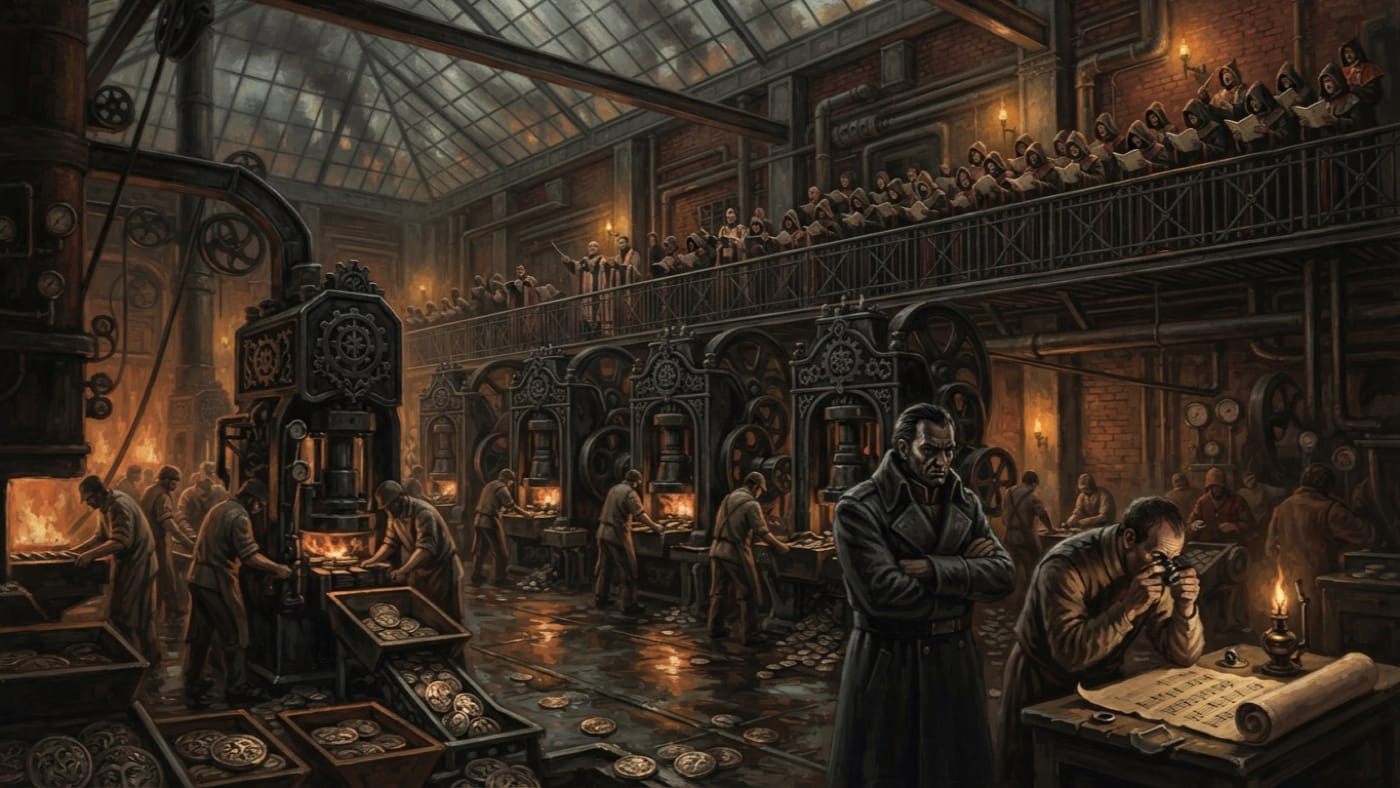
On the Strike Floors of the Crownwright Diehouses, the western arc of Cologne's restricted mint-quarter, no press-hammer is meant to fall without a syllable beneath it. The shift choir sings the Mint Catechism. Each strike is timed to a specific syllable. Coin struck that way is lawful because the song and the hammer met. A hammer that falls in silence makes stamped metal. A hammer that falls on the Catechism makes currency, and the Mint-Chapter has always priced the difference at one soul.
The Codex holds no author for the Catechism, no year of composition and no first ratification. It holds no chapter count and no edition. It holds the practice, and the practice is enough to hang a man. The quarter was carved from Cologne's old guild district between A.S. 94 and A.S. 100. That was after the Concordat of Strasbourg gave the Synod its constitution in A.S. 90 and before the Face Archive was mandated in A.S. 102. Within that apparatus the Catechism sounds today. When it first sounded is the Mint-Chapter's business, and the Mint-Chapter has not chosen to share it.
#On the Substance of Recognition
"False coin is false soul." — Mint-Chapter proclamation, Sable Court
Sable Court's doctrine fits on a coin, which may be the point. Purity is legitimacy, and currency is communal scripture. The Bureau of Records enters a citizen into the Great Ledger and assigns a number. The Face Archive approves a plate. A Crownwright master cuts the face into steel by hand. The Assay Cloisters test the work, and the die is blessed. Then the press comes down. The coin carries the face, the face carries the name, and the name carries the soul's account. The Church teaches that a struck face is the soul made portable. The Mint-Chapter administers that teaching with a tribunal, a schedule of correction levies and a customs gate.
Every stage before the strike prepares a face for commerce. The strike is what puts it there. This is why the floors must sing. A people recognised through coin must be recognised through coin struck in the Church's voice. If they were not, the Theocracy would simply have licensed a metalworks to decide who is real. The Crownwright Guild would accept that licence by return of post, and the Synod knows it.
None of this is quoted from the Catechism itself. The Mint-Chapter does not furnish its text to the Codex, and the Codex will not compose scripture on the Chapter's behalf. It has seen what becomes of clerks who do.
The Catechism's authority is narrower than the Mint-Chapter's ambitions. Stamped chits, seal-notes and oath-notes all circulate, and none of them is struck under a hymn. The Crown of Grace, the Theocracy's coin of stamped iron, is consecrated at the mint by priestly blessing like every lawful issue. That consecration covers the instrument. It does not make every scrap of paper in a citizen's purse holy. Nor does the loss of a single coin harm the person whose face it bears. Coins are minted in batches. Drop one in the Rhine and you have lost a coin. Lose the face, through revocation, correction or recall, and you have lost your place in the economy of salvation. The Catechism sings faces into circulation. It has no verse for fishing them out of rivers.
#On Syllable and Hammer
The division of labour is old and is policed. Die Row cuts. The Strike Floors strike. In A.S. 134 the Bureau of Doctrine ruled that machine-cut dies produced "spiritually imprecise" currency. The ruling forbade the machine to make the face. It left the machine free to stamp the face a hundred thousand times, provided someone sang while it did. The Crownwrights lobbied for that distinction. They keep their engraving by hand and their fingers in silk finger-veils, because bare fingertips are held to be blasphemous tools. The singers and strikers in the western arc are bound by other rules.
Those rules are severe enough. Every worker passes a clean-hand inspection at the gate. Foreign coin brought onto a Strike Floor is a red line in the quarter's law, along with theft of a blank die and tampering with the Archive. Blank parchment is contraband. The bays smell of ozone and sweat, the air carries metal dust that rots lungs, and a press crush is listed among the quarter's ordinary deaths. Above all this the choir keeps time. The hammers come down on its syllables in shift after shift, nightly and at all hours, until the noise reaches the rooftop Warden Walks and the canal locks. Assay certifications record hymn-timing as verified next to batch compliance, as if a song could be weighed like silver. In Sable Court it can.
One prohibition shows how the floors think. Nobody may speak a name during a strike cycle. The Catechism is sung over the faces and never addressed to them. The press is not told whom it strikes, and nobody hums a citizen into iron by name. The Mint-Chapter offers no reason for the rule. I will not improve on its silence.
Authority over the floors belongs to the arrangement of the Compact of A.S. 94. The Mint-Prelate supplies authority, the Crownwright masters supply craft, and the Mint Tribunal judges every dispute over coin or face. Mint-Prelate Varo Sable rules the floors today and Master Engraver Irena Coilhand rules the dies. Neither is recorded as the Catechism's author or editor. Both enforce it.
Earlier editions of this Codex stated that the Crownwright Guild operated independently of Synod oversight. That was a drafting error by a clerk who has since been corrected. Under the Compact of A.S. 94 the Guild has always operated under Mint-Chapter authority, and that authority extends to every hammer that falls on a hymn.
#On False Coin and the Recalled Face
The Catechism makes faces lawful. The Mint Tribunal makes them unlawful again, and it needs no choir to do so. A face recall gathers a citizen's coins and has them re-struck, either blank or bearing a replacement. The recalled person goes on living and becomes unspendable. Merchants refuse their custom, landlords void leases denominated in their face, and employers end contracts that no longer have anyone to pay. The Bureau of Records calls this "administrative dissolution, non-lethal variant." The Crownwrights call it unfacing. Unpaid fines do similar work more slowly, as identity holds under which a citizen's coin is quietly refused.
The Bureau of Doctrine adds a darker corollary, and adds it reluctantly. Circulating faces anchor memory. Handling a neighbour's face daily is how you know your neighbour. Doctrine calls the effect "theologically adjacent to the reliquary effect." A revoked face comes loose from memory. Merchants stall halfway through a name, witnesses forget suspects, and families argue over whether a brother existed. Keeping old coins with revoked faces is therefore forbidden. Citizens defend themselves with oath-notes, face-confirmation catechisms and sealed name-slips carried under the tongue. Those catechisms share a noun with the Mint Catechism, and the Codex asserts no closer kinship.
The Clipped Choir of Clipper's Market calls itself a labour mutual. It is a union of clippers, brokers and face-swap artists, and it keeps its own assay clerks and its own hymn-timing. If timing alone made coin lawful, the Clipped Choir would be a mint. It is a crime. The difference lies in the Archive's plate, the Chapter's seal, the Tribunal's jurisdiction and the gate. The Codex makes no claim that the Clipped Choir sings any version of the Mint Catechism. It records that they keep time, and that they are hanged for it.
#On the Present Application
The Bureau of Alchemical Standards found three altered plates in the Face Archive in A.S. 187. Faces began going wrong in the pockets of Cologne in A.S. 199. Within three months the Mint Tribunal had received more than four hundred complaints. Then the complaints stopped, because the people complaining could no longer remember what their own faces were supposed to look like. The Mint-Chapter ordered an emergency recall across seventeen denominations. Die Row worked triple shifts. The Strike Floors ran through the night and the choir sang through it.
The hymn-timing slipped twice. Two batches were struck bearing faces the shift choir could not identify and the Assay Cloisters could not account for.
That is the sequence on record. The cause is not on record. The Codex will not say whether tired throats failed the hammers, the hammers failed the throats, or some third party used the gap. The Bureau of Purity holds the investigation as File 1104-SC at Amber priority, and it remains open in A.S. 201. The Unface Society has claimed responsibility. The Bureau of Purity doubts that six engravers and a disgraced archive scribe could manage the work. The quarter also rumours a master die. The Mint-Chapter has denied it in four depositions, and the Codex certifies only the depositions.
The Catechism has not been amended for the emergency. Its application has been tightened. The Assay Cloisters now test faces for fidelity as well as metal for purity, comparing the hymn-frequency of the struck coin with that of the archived plate. Blind clerks do the comparing, and they are never permitted to see the face they judge. Doubt inspections stand at every gate, warden circuits have been doubled, and the Archive is closed to everyone below Mint-Prelate clearance. Warden-Captain Joss Kline patrols the Walks above floors that must not miss another syllable.
So the Strike Floors sing on, through the crisis and against it, because lawful coin in Sable Court can only be struck to the Catechism. The Bureau's position is that the Catechism has not failed. Twice, the timing did.