
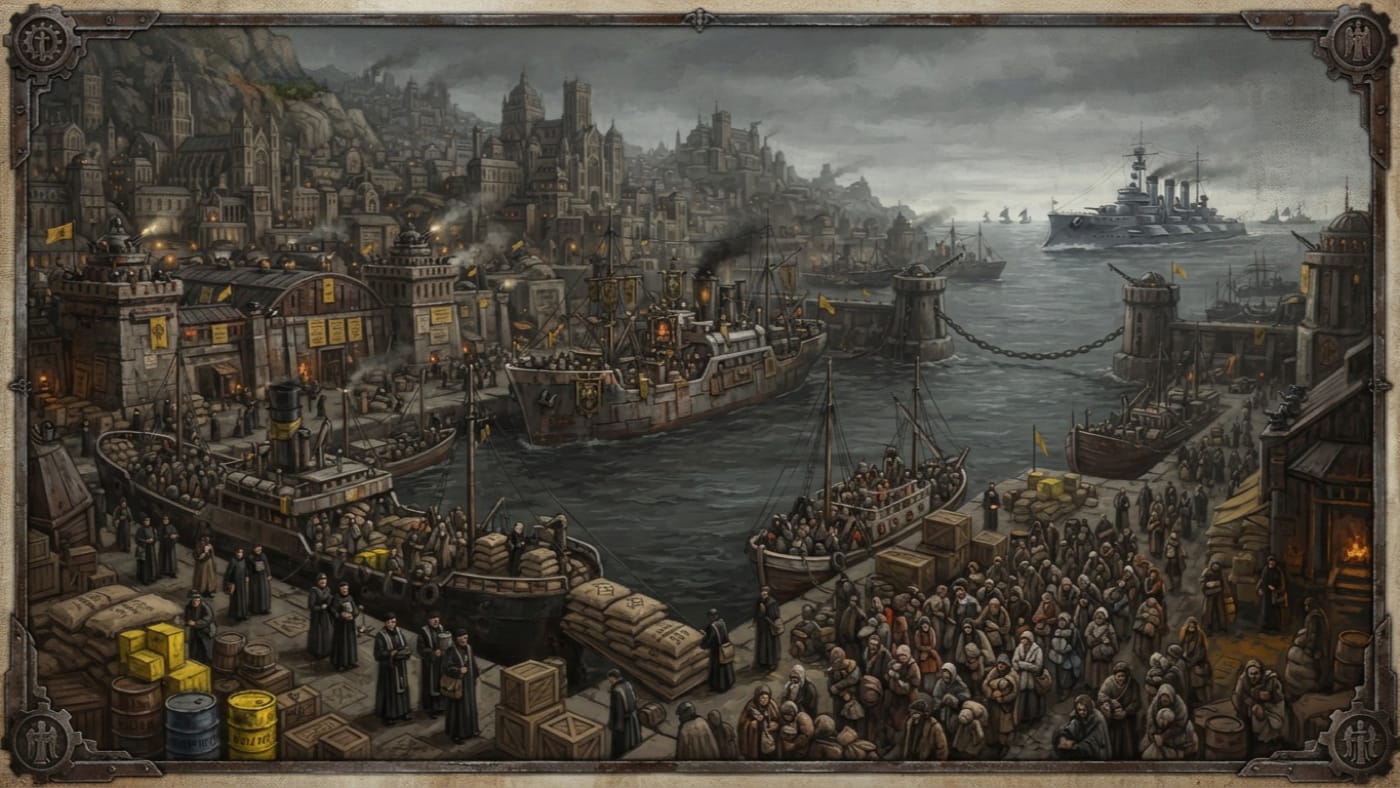
#On the Sea's Geography
The Mediterranean is the oldest road the Church holds, and the only one it has never been able to pave. It runs from the Iberian shoals to the Levantine shore, a long basin of salt water with bad tempers at both ends. Two arms reach north out of it. The Adriatic lies between the Italian boot and the Dalmatian limestone. The Aegean breaks into islands on its way toward Thessaloniki and the Thracian littoral. A ship can sail the whole of it without a single wall in sight. That is its first offence against good administration.
The Registry files the basin under Zone Seven, the Southern Coast, with its supply lanes and pilgrim routes (Zones 5 through 7). The ports refuse to keep to one zone. Marseille is entered as Zone One and Zone Seven. Genoa and Venice are entered as Zone Two and Zone Seven. Each faces the safe heartland with its customs house and the open water with its quays, and each charges both directions for the privilege.
East of the Bosphorus lies the Black Sea, which is a different water with a different purpose. It is an attack lane against Constantinople. The Mediterranean is a ration line. One brings the enemy to the southern anchor of the Line, and the other brings biscuit, shot and confessors to the men who meet him. Clerks who confuse the two on a requisition form are sent south to learn the difference by ship.
#On the Southern Passage
There is no single route. Ports compete, convoys divert, and a cargo's itinerary depends on the weather, the war and the size of the bribe. The pattern holds anyway.
Marseille handles the bulk and boards the pilgrims. Its quays take in the western basin's goods, and its eastern basin sends pilgrim ships toward Thessaloniki. Genoa holds the money. Its banking houses finance the war, and its yards hold the Bureau of War's principal naval contracts. It fights Marseille for every Synodal charter with the composure of a cardinal and the manners of a fishwife. Venice holds the Adriatic lane between Italy and Dalmatia, and it keeps a lagoon temperament that no Bureau has fully dried out.
Farther down the Dalmatian coast, near Ragusa, sits Saffron Bastion: a deep harbour, cliff batteries facing open water, and yellow quarantine flags on the moles. Past it, ships round into the Aegean and wait at Thessaloniki's chains. From these coasts the Southern Corridor carries goods inland to Bastion-Irongate, Bastion-Shipka and Constantinople, the lower spine of the Sagittal Line.
The arrangement is older than its paperwork. During the Atheist Wars, the southern faithful front ran down from Lyon to this coast. Severin of Avignon held the Avignon corridors with the sea at his back. He never put to sea, and his hagiographers regret it. His quartermasters understood the coast better. A shore behind a front is a way out for relics, priests and archives, and Severin kept that way open long enough to use it.
Western waters carry one further courtesy. British Crown frigates patrol them against pirates and sail alongside Synodal convoys without obeying a single Bureau. The arrangement saves ships, and Doctrine forgives it annually and resents it constantly.
#On Cargo and Pilgrims
Marseille's ledgers list Iberian grain, North African phosphite, Sardinian iron and Sicilian sulphur. These are what one great port receives, and the Bureau of Tithes would be grateful if readers did not mistake them for a census of the sea. The grain comes in sacks stacked by hand. The phosphite comes in drums that gnaw holes in the quay. The iron arrives as pig and scrap and leaves as a debt owed by a foundry. The sulphur stains everything it touches a jaundiced yellow, including the stevedores, who are paid by the tonne and coughed at by the clergy.
Steamers burn coal, and sailing coasters still burn nothing but patience. Both need ballast, pilots, caulking, salted provisions, fresh water and crews who can be sober at the right hour. The Synod issues prayers for the voyage. The sea is moved by men with hooks.
Pilgrims travel on the same water in a separate class of misery. A pilgrim vessel out of Marseille is a converted merchantman with a shipboard chapel, an inspector from the Bureau of Pilgrimage, and a manifest checked against the Great Ledger before the anchor comes up. The Bureau of Records owns the names and does not like to lose them. Relic crates in the hold carry the seal of the Bureau of Relics, whose clerks authenticate bone, cloth and phials with great speed when the tide is turning.
The pilgrims sleep on deck when the hold is full and in the hold when the deck is wet. They bring vows, children, debts and coughs. They wait days for a permit, hours for a boat, and weeks for a wind that the Bureau will not be held responsible for. At the far end they reach shrines, quarantine sheds, or the sea's own accounting. A smaller number are refugees travelling on a dead cousin's token, and the manifest counts them as pious.
#On Harbour Authority
There is no admiral of the Mediterranean and no single customs code. No one quarantine prefect governs every mole from Gibraltar to the Bosphorus. Each port is its own court of competing seals, and a shipmaster learns them the way a sinner learns confessors.
In Marseille the Bureau of Pilgrimage takes the passengers, the Bureau of Tithes assesses the cargo, and War claims military freight. The harbour-master answers to all three and obeys whichever is closest. On top of every lading sit the Salt Dues, a surcharge on coastal trade laid down in A.S. 92 for the Iberian campaigns and described ever since as temporary. At A.S. 201 they have been temporary for one hundred and nine years. The levy is a Marseille matter. Other ports have invented their own, with comparable piety.
Saffron does its sorting at the waterline. Ships under a yellow flag anchor in the roads until clerks have examined tongues, lungs and papers. Cargo is sealed in wax and stamped at the sealhouse. Pilgrims are processed, certified clean, and charged for the certificate. The bastion's Insurance Courts sell writs against wreck and fever, and these writs trade like coin. As a result, a disaster at Saffron always has at least one beneficiary with a seal.
At Thessaloniki the twin sea towers raise and lower reliquary chains across the harbour mouth at fixed windows. A ship that misses its window waits beyond the boom, burning coal, losing provisions and paying demurrage, while the manifest clerk finishes lunch. Purity officers walk the quays at both ports and choose which crates to open, and the choice is itself a market.
All of this delay keeps the ports alive. Every fee, inspection and lowered chain is a hand held out for payment, and it is also the reason the southern harbours are still open and not dead of plague.
#On Unlisted Cargo
Every manifest has a margin, and the margin has a price. Smugglers on this sea use saint-bone crates, fish barrels, coffin seals and pilgrim hems. They also rely on the old maritime law that no inspector opens the worst-smelling barrel twice.
Demon glass is the best example. Scavengers take shards from places the Bureau says no one goes. The shards travel to the coast wrapped in oiled cloth under religious cargo labels. In back-room workshops, Demon-Glass Polishers grind and mount them in lead. A finished optic goes out to an officer's field mask or a widow's parlour, and the price is the same either way. Purity announces the seizure, shattering and lime-burial of every shard. War buys the optics. Both claims are entered as true.
Most of the dead were killed by the sea in the ordinary way. Men are crushed between hull and quay, and men fall drunk off gangways at the turn of the night watch. Squalls arrive out of a clear afternoon. Biscuit goes green after nine days at sea, and water casks take on a taste of their previous use. Fever rides in steerage, and brine-fever haunts Saffron's lower docks. The Bureau of Medicine catalogues these deaths without poetry, and so shall I.
Some deaths are less ordinary. At Saffron, dock hands report voices from exposed water after dark. These voices call men by name, or by a name close enough. The bastion keeps approved lantern patterns after curfew. Speaking sea-names near open water at night is forbidden, and tampering with lantern patterns is one of the few offences the port punishes with no appeal. At Thessaloniki, sailors describe a hum in the chains and a drowned choir under the harbour mouth. Doctrine attributes these reports to the Great Deceiver's interest in human hearing. Harbour physicians attribute some of them to rum. Neither explanation has been able to dismiss the other.
These are local rules. Marseille does not chain its harbour at Thessaloniki's hours, and Venice does not light its lamps in Saffron's patterns. A captain who carries one port's superstitions into another is laughed at, and in one port he will be fined.
#On the Present Condition
At A.S. 201 the Mediterranean is open, busy and compromised. The southern corridor is moving grain, metal, powder, pilgrims and confessors toward the lower Line at rates no inland road could sustain. Inspections take place, and they leak. Quarantine holds, except when the money cannot wait. The Bureaus fight over every quay, and none of them would survive a season without the stevedores, pilots, ropemakers, nurses and sealers who keep the harbours working through their bickering. Genoese credit and British frigates also contribute, neither of them obedient.
Harbour catechisms teach that the southern sea lies "behind the Line, at the Synod's back, where the war is only freight."
Withdrawn. Freight is war that has not yet arrived. Remove this sea, and Constantinople would hold for exactly as long as its biscuit lasted. The catechism has been reprinted. The old copies remain in use at Marseille, where nobody reads the catechism and everybody reads the freight rates.
The Church blesses the convoys before they sail. War counts them when they arrive. Tithes charges them in both directions. The sea takes its share as it always has, and nobody has ever sent it an invoice.