
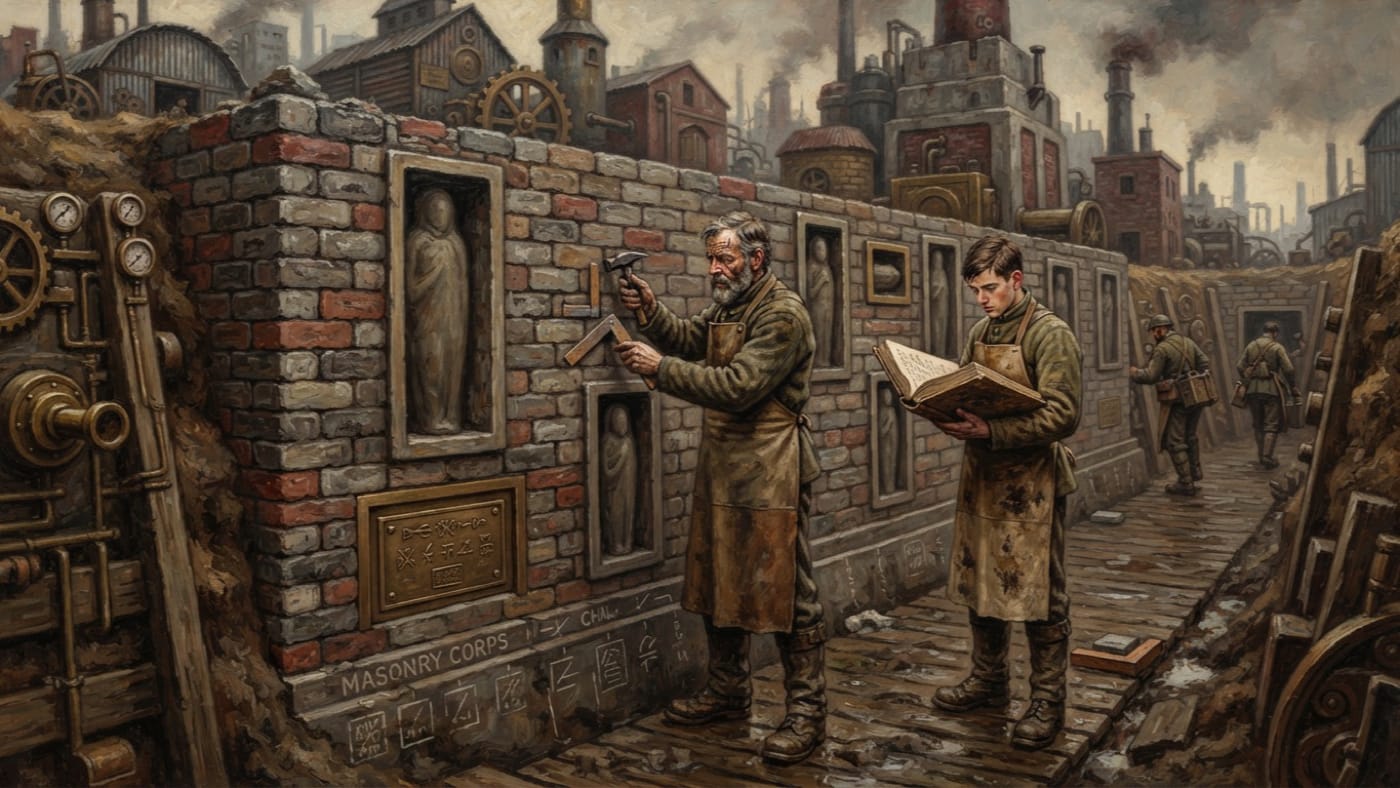
#On the Authority of the Code
A.S. 201 — a current survey; the Code's original promulgation is undated.
"Measure the sin, not the man." — masons' saying, provenance unrecorded
A sentence of immurement has two parents. The Judge supplies the verdict and the writ. Standing Order 14-M supplies the sanction, naming the offences for which a living body may be entered into a wall: Spiritual Sabotage, Resource Betrayal, Identity Fraud, and Doctrinal Contamination of the Second Degree or above. Neither instrument tells a man how deep to cut. That is the business of the Masonry Code. It is the professional specification by which the Punitive Construction Auxiliary turns a judicial category into a niche of known dimensions, a mortar of approved grade, and a plaque that can be read from the duckboards.
The Order says the condemned shall be sealed according to the specifications of the Masonry Corps. The Code is those specifications. Its relation to the Order is that of the trowel to the pulpit. I decline to rank them further, since nobody has shown me a document that does.
On its origin this office holds nothing worth sealing. No promulgating instrument survives in the files consulted, and neither does an author, an edition list or a complete text. We know the Code the way the Corps knows it. We know it through practice and through inspection, and through the roughly two thousand four hundred licensed operatives in Zones 1 through 5 who answer to the Bureau of Doctrine for every brick. We also know it through Appendix VII, the only portion anyone outside the trade ever asks about.
The Code exists because a wall has two masters. Doctrine wants the condemned kept. The Bureau of Engineering wants the curtain wall to stand when the shelling starts. A niche cut carelessly into a load-bearing course punishes the garrison along with the thief.
#On Specification and Accountability
The work begins on paper. The writ arrives, usually damp, carried by a Judge's bailiff or passed through the custody of a Trench-Court Clerk. Before he so much as wets his lime, the mason checks its seal imprint against the Judge's stamp. He confirms the condemned's name and charge against the plaque slip. A wall built on a forged writ is a wall that has lied, and the Corps has learned that the lie is charged to the man holding the trowel.
Then comes the niche. It is cut fresh or, if already cut, inspected for soundness, and its shape follows the charge. A thief stands, in a cavity sixty-eight inches by twenty by sixteen. A deserter kneels, in something shorter. A heretic sits in what the masons call the box. The trade knows the dimensions of the last two and my files do not. I have resisted the temptation to supply them from imagination, which is more restraint than the Bureau of Doctrine usually asks of me.
Three locking bricks follow, bottom, left and right, each laid to measurement. "Three bricks is forever," the masons say. The plaque is set after the second course: name, charge, hymn-line and seal imprint. The closing bricks go in, every seam is lime-washed and the inspection mark is chalked on the face. The log then takes three entries: time of completion, mix grade and mason's stamp.
What the Code produces, therefore, is a thing an inspector can test. He taps the seams and listens for a hollow. He measures where the plaque sits. He tests the lime. He reads the stress lines in the surrounding course for any sign that the punishment has weakened the defence. He also compares the log against the wall. Under the Code, a missing completion entry or a mismatched plaque stamp is as serious a defect as a hairline crack.
A niche that compromises the trench wall counts as sabotage. Sabotage, under the Order the mason serves, qualifies him for the next vacancy. The Code is the only manual I know whose readers can be filed inside it.
#On Appendix VII
"Sin seeks escape. Stone is faithful." — attributed to Saint Karron the Trowel-Hand, date of attribution classified
Appendix VII holds the binding mix, and the binding mix holds the Corps's theology together.
The Bureau's hagiography does not fix the saint's years. It credits Karron with sealing a heretic whose screams were drawing demonic attention. The screams stopped, and the demons, according to the same hagiography, withdrew. Karron was canonised and his mortar entered the Code as an appendix. The text of record lists its ingredients as lime, ash, relic dust, and a compound the Bureau of Engineering classifies as "doctrinally sufficient calcium silicate." No proportions are on file. Nor is the date the formula was first entered, or the name of whoever first copied it from a saint's bucket onto a page.
The mix has been revised four times, and only one revision has a date this office may print. In A.S. 158, three niches at Bastion-Przemyśl in the western Carpathians began tapping in the cadence of the trench bells. Within the month, Appendix VII gained additives that the Bureau of Engineering calls "doctrinally specified mineral additives" and the masons call hush-powder. The revised specification is classified under Seal Obsidian. I have seen the classification. I have not seen the specification. These are separate privileges, and the Bureau has good reason to grant them separately.
On the trench, a revision means something simpler than it does in the archive. Every wall laid before the change was laid to an outdated grade. Every log entry recording the old grade became, overnight, proof of conformity to a standard that no longer existed. Such a wall was compliant on the day it was sealed and obsolete by the next requisition.
#On Air and Its Discretions
The Code governs the wall. It does not govern the breath inside it. Air provision belongs to the presiding Judge, who may order none, a slit the width of a reed, or something more theatrical. The Order says only that the Bureau recommends none. An opening the writ authorises is part of the specification. An opening the writ does not mention is an alteration, and alteration is an offence against the Code however kindly it was meant.
Here the trade divides. The Pure Sealers read the specification as complete. If the writ grants air, they cut what is granted, to measurement and not a hair wider. If it grants none, they leave none, and they will not discuss what they hear afterward.
The Breath-Givers read the same pages and find room. They route a breath-thread through the masonry at an angle that cannot be seen from the face, so the condemned lasts days instead of hours. They call this mercy. A longer dying also makes a longer lesson, the district hears more of it, and I note that the Breath-Givers seldom refuse the fee. A thread is paid for in salt, fuel chits or morphine. In the forward bastions it is paid for with a forged mercy clause attached to the writ, which takes a clerk, a seal and more than a month's rations. The forgery makes the alteration look authorised, and on inspection the wall looks compliant. Both appearances are filed.
Neither faction is acknowledged. The Bureau acknowledges that all niches meet specification.
#On the Wall After Completion
The Code once assumed that a sealed niche was finished. Experience has amended the assumption without denting the confidence.
At the Silence of Târgu in A.S. 128, thirty-one men were put into one wall in nine hours of masonry. Soldiers nearby reported hearing the Creed spoken in unison from inside it. The Bureau classed the matter a Category Two Spiritual Anomaly and ordered quarterly inspection. That wall is still the Murmur Line.
An earlier compilation of trench-court procedure enters the Silence of Târgu under A.S. 228. The year is A.S. 128. A.S. 228 has not yet occurred. This office regrets having nearly inspected it.
Przemyśl followed in A.S. 158. Three niches sealed six to fourteen months earlier tapped First, Third and Fifth Peal, with what the Bureau of Bells confirmed was metrical exactitude. The assessor's report is sealed, and the assessor was sent to the Paper Mines of Ulm. The file does not say what the tapping was.
In A.S. 163 at Bastion-Irongate, above the Danube gorge, a mason who had worked alone was found the next morning sealed in his own niche. The plaque bore his name in a hand that was not his. Doctrine classified it as administrative error, and the Code gained a rule.
The A.S. 199 classification of acoustic phenomena completed the apparatus, with three categories: Residual Devotional Emanation, Demonic Interference and Administrative Noise. A mason who hears any of them files Form 14-M(c), applies hush-powder to the seam and refrains from speculating in writing. The classifications tell him which form to use. They do not tell him what is answering.
#On the Present Application
In A.S. 197 I walked the inner curtain wall at Bastion-Brest on the Bug and counted fourteen plaques. The oldest was dated A.S. 102. Its mortar had held for ninety-five years, the stamp was unbroken and the log matched the wall. That is what the Code looks like when lime is plentiful.
Lime is no longer plentiful. In Zones 4 and 5 the masons substitute mud-calcium compounds that crack within months and weep in wet weather. The soldiers say the condemned are crying. The Bureau says the weeping is chemical. The Code has not changed, and masons still fill in the mix-grade column of the completion log. A district may now hold walls that fail every tap test yet pass every paper audit. The mason who stamped them knows what was in the bucket, and only he stands fully exposed: to the inspector, to the next vacancy, and to whatever the seam is doing at night.
The Bureau assesses the Corps as "operationally adequate."