
#On the Appendix and Its Authority
"Measure twice. Seal once." — masonry-yard proverb, older than its first inspector and quoted by every one of them since.
Masonry Code Appendix VII is where a saint becomes a material. It holds the binding mix of Saint Karron the Trowel-Hand, and by holding it the Appendix turns a hagiographic recipe into something a quartermaster can requisition, an inspector can scrape out of a joint and a clerk can find wanting. Nobody prays to an appendix. Every man who lays a course in front of a condemned prisoner answers to this one.
Its authority is narrow, and that is where its power comes from. The Appendix does not sentence anyone. The writ does the sentencing. The Immurement Mason checks the writ's seal against the plaque slip before a single brick is wetted, and nothing in the mortar's specification may lengthen, shorten, soften or harden what a court has decreed. The Appendix governs the stuff between the bricks: what goes into the trough, what the weather is allowed to change, and what an inspector may demand to see when the wall is tapped. A judge may make a man into a niche. The Appendix decides whether that niche is lawful mortar or wet dirt with a plaque on it.
The text's pedigree is shorter than its reputation. The mixture passed through Engineering memoranda, Doctrine catechism and masonry-yard song before it reached the Code. The surviving record does not say who first copied it into the Appendix, or in what year. I have looked. The record has a long memory for fees and a short one for authors.
#On the Binding Mix
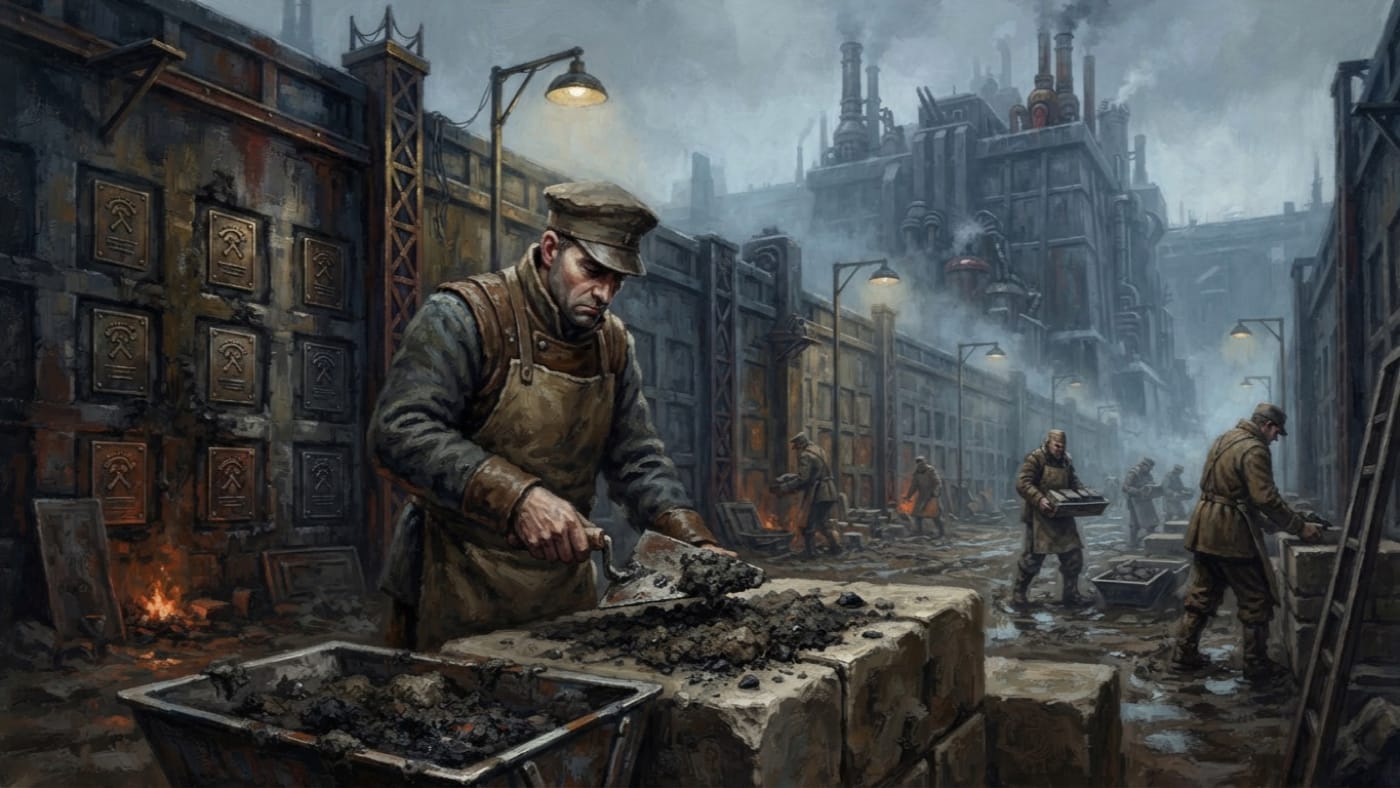
There are five ingredients, and a Lime Boy can recite them before he can spell them: lime, ash, bone or relic dust, silicate grit and water. The catechism gives each one a duty. Lime for bite. Ash for witness. Bone or relic dust for sanction. Grit for grip. Water has no duty, only a master, and the master is the weather. It is measured by hand and corrected for rain, frost and the damp rising from the trench floor, because no wet wall has ever consulted the clerk who wrote the batch slip in a dry office.
Engineering reads the same list and sees chemistry with a priest attached. Its memoranda accept the grit as doctrinally sufficient calcium silicate, a phrase I admire the way one admires a well-forged seal: it is false in no particular and true in none. Doctrine reads the list and sees a sacramental, in which the ash testifies, the relic dust sanctions, and the whole mixture carries the saint's intention into the joint. The mason at the trough sees a batch that will either cure or crack, and he calls it Karron's spit.
When these readings collide, the inspection sides with the wall. If relic dust spoils a set, no inspector will sign for its sanction. Ash that weakens a course bears witness mainly against the man who mixed it.
Karron's sainthood rests on the claim that this mixture once did more than hold bricks together. The vita reports that he sealed a condemned heretic whose screaming carried along the trench stone and drew answering movement out of the fog. It reports that the scream stopped at the final course and that the things beyond the wire withdrew. The trade's own lore calls this a claim, and so do I. The Appendix certifies a mortar. Nobody has ever asked it to certify a miracle, and the men who wrote its revisions took care that it never volunteered to.
Yard catechism formerly taught that Appendix VII preserves the very mixture by which Saint Karron silenced a host of demons through faith alone.
Corrected. The Appendix preserves a mortar. The vita reports that one condemned man was sealed and that a withdrawal followed. The Appendix answers for the set and for nothing after it.
#On the Four Revisions
The formula has been revised four times. Each revision is a confession dressed as an improvement, and the Code wears all four in order.
The first followed cracking in winter niches. Frost got into the joints, the joints opened, and a seam meant to last forever began weeping lime down the curtain wall in full view of the garrison it was supposed to instruct. A weeping wall invites rumour. The yard idiom says it invites worse: if it weeps, it speaks. This revision answered the cold. If it recorded its year, that page has not reached me.
The second followed complaints from Records that plaques were coming loose before the lesson had matured. Records does not care what the mortar means. It cares that the name, the charge and the seal imprint stay fixed to the wall long enough for a passing thief to read them and an auditor to check them against the registry. A plaque lying in the mud is a sentence without a citation, and Records considers that the more serious crime.
The third followed the Demon-Listening Incidents at Bastion-Przemyśl, where sealed niches in the Carpathian fortress were reported tapping back in trench-bell cadence. Doctrine demanded binding against whispers from sealed mouths, and hush-powder entered the mix under an institutional name that no mason says in daylight. The incidents prompted the revision. They say nothing about where Karron himself worked, and anyone who places the saint at Przemyśl because his mortar was amended there has mistaken the hospital for the patient's birthplace.
The fourth revision, in A.S. 199, standardised additives across Zones 4 and 5. It is the only revision whose year the Code admits in print. It came after three seasons in which mud-calcium substitutions had already been made, and it did not mention them.
These four revisions belong to the binding mix alone. The edition history of the Masonry Code is longer and duller. Standing Order 14-M keeps its own sequence of amendments, and it cites Karron in its commentary, never as an authority. The Bureaus dislike sharing jurisdiction with the dead. They tolerate sharing it with an appendix because an appendix cannot attend a hearing.
#On the Test and the Record
The Appendix promises that the same mortar goes into every wall. Consistency is its entire virtue. A mason who mixes beautifully on Tuesday and differently on Thursday has not made two good walls. He has made an audit.
The test starts where the rumour points. Inspectors tap the seams and listen for the dead note of a hollow course. They take lime from the joint and test it against the declared grade. They follow the stress lines that spread from the niche into the surrounding wall, because a sentence that cracks a curtain wall punishes the garrison along with the thief. Then they compare all of it with the paper. The completion entry records the time, the mix grade and the mason's stamp. The stamp is what matters. It turns a batch into a signature, and a signature into a man who can be found.
Approved hush-powder is declared on the entry and tested for. The yard's contraband quick-set hush is a different substance with a similar nickname and the opposite purpose: it hurries the cure until the additives can no longer be tested at all. Inspectors who honestly confuse the two are rare. Inspectors paid to confuse them are less rare.
Failure has a price. A cracked seal can cost a mason his stamp or send him down to breach repair. A wall that compromises the trench costs considerably more, and the man who mixed it may be offered the chance to study the Appendix from the inside.
#On the Two Readings of the Seam
The Pure Sealers read Appendix VII as the saint's argument made solid. Karron sealed, the scream stopped, the seam closed. A mortar specified to the grain leaves no room for pity, and a mason who keeps to the grade leaves no room for bribes. Some of them say this with the calm of the devout. Others say it because a fully shut seam is the easiest one to defend at an audit.
The Breath-Givers read the same text and notice what it leaves out. The Appendix governs mortar and says nothing about air. Air belongs to the writ: when a writ authorises an air slit, the mason cuts it and the inspector measures it. When the writ is silent, a breath-thread run to a hairline crack becomes a matter of craft, discretion and the price of salt. Some Breath-Givers call this mercy, and some call it a trade. The honest ones admit that every vent becomes a debt, and that the creditor is usually the inspector.
Neither faction has a clause of its own. Both have trowels, and both call on the same saint before the closing course.
#On the Present Application
In A.S. 201 the Appendix applies wherever the Church makes a wall out of a man. It applies most harshly in Zones 4 and 5, where the fourth revision was written and where it is now failing. Zone 4 is the Line itself, the north–south chain of bastions and trenchworks from the Baltic to the Bosphorus. Zone 5 is the contested ground east of it, where forward works are cut into earth that changes hands with the seasons. Lime travels the same supply corridors as shells, bread and wounded men, and lime travels last.
The trade has a word for what reaches the trough instead: mud-calcium. It is whatever the quartermaster can dig up, burn or declare. The fourth revision standardised additives. It could not standardise supply. A batch slip may record the approved grade while the trough holds something the slip has never seen. The completion entry is correct. The wall is not.
Inspectors know this. Some test properly and halt the sealing. Then the docket backs up, the bailiff complains, and a judge asks why his sentence is waiting on a shipment. Others tap, nod and chalk their mark. The chalk on the wall says compliant. The mortar behind it tells the truth at the first frost.
Above the troughs, the yards still paint Karron's maxim: Sin seeks escape. Stone is faithful. The maxim predates mud-calcium. Stone is faithful to its recipe, and the recipe has lately become a matter of opinion.