
Sources checked; drafting the tract now.
#On the Credit and Its Bearer
A martyr-credit is a favour backed by the Relic Registry. Clerks and traders on the Reliquary Switchbacks also call it a devotion token. It certifies that its bearer has contributed enough to the martyrological record of that corridor and may therefore be spared certain scrutinies. The Registry has never published which scrutinies those are. Ask a turn clerk to list them and he will smile at you, and the smile is part of the fee.
What the credit buys is time. The corridor is four miles of shale and two thousand feet of climb, and the turns are close together. Every halt at a booth costs body heat and every lost hour costs coin. Each fresh inspection is also a fresh chance for someone to decide that the last one was wrong. The credit spares the bearer some of those questions. It does not spare him the mountain.
Martyr-credits can be purchased. The Relic Registry Office says they cannot. Both statements have been filed, and both are in order.
#On the Record Behind the Favour
The record came before the credit, and it was built from corpses.
The goat-track was widened in A.S. 74. The work followed the Sixth Carpathian Route Audit and was done by the wartime Church offices that would later answer to the formal Synod. In A.S. 76 an avalanche killed forty-seven porters on the Third Turn. The clerks declared the dead martyrs of supply, a title that needed no miracle, only a notary. Seventeen femurs were recovered and nailed into the shale where the men had fallen. By A.S. 82 every turn carried a name, a bone and a toll. In A.S. 92 the Registry formalised passage licensing: a Turn License for the traveller, a Relic Handling Certificate for the cargo, and a confession at each shrine station, written on slate and copied to paper.
The ledger kept growing, and anything that grows on a mountain eventually gets a price. A credit records that its bearer has given something to that ledger. The Registry is careful never to say what was given. It records the gift and leaves out the giver's motive.
The first credit was issued by no ruling I can cite and in no year I can certify. If the issue was written down, it went into the sub-archive beneath the Turn of Saint Odrin, which nobody has inventoried since A.S. 140. I decline to describe what a credit looks like, and I advise the reader not to ask.
A martyr-credit is a separate thing from a relic. It is also separate from a Turn License and from a Relic Handling Certificate. A pilgrim may carry all four and still kneel at the Summit Gate for the master seal, which no favour replaces. The Bureau of Records supplies the ledger the credit refers to. The Bureau of Tithes supplies the reason anyone bothers.
#On the Fine at the Lower Marker
The credit proves its worth between the fourth and fifth turns.
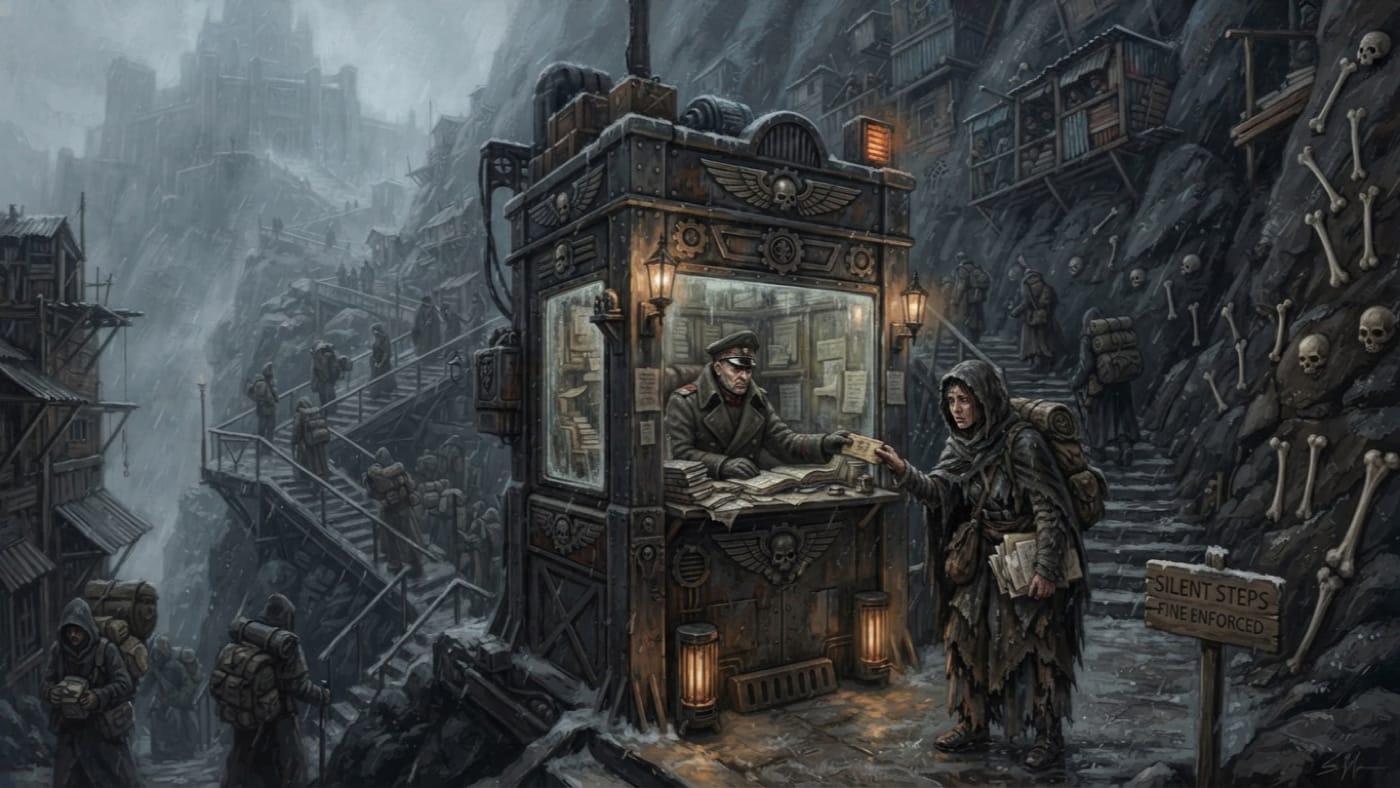
That stretch of path runs from the Shrine-Court of Seven Nails up to the Switchback Inns, and it is one of the Silent Steps. Speech there is fined. Warden-Captain Bronn's men listen from vents cut into bone-lime mortar and carry nail-batons that bruise through wet wool. On this segment the speech fine is bound to the altitude toll. A pilgrim fined at the lower marker may not go on until the fine is paid or secured against a martyr-credit.
I keep the Court's word secured because it was chosen with care. Payment ends a debt. Security only pledges something against it. The published rules do not say whether a secured fine is ever discharged, or whether the credit pledged against it comes back to its owner. I did not ask aloud, since I was standing on the Steps at the time.
Picture the pilgrim without a credit. He has been fined for a cough. He stands below the marker in sleet, holding papers he may not read out. He cannot climb until he pays. If he protests, that is speech. If he appeals, that is speech too, and the wardens enter it as proof that he understood the boundary he broke. Each word he spends adds to the fine he cannot pay. The inns above auction their bunks by body heat and by weather. Every minute he waits makes him poorer, colder, and more likely to confess to whatever the slate is prepared to receive.
The pilgrim who holds a credit pledges it and climbs on without a word. The fine stays on the ledger, and Bronn keeps his file. The bearer has bought what the Steps are really selling, which is the right to stay silent without being ruined by it.
The credit gives no relief from the Court's jurisdiction. Since A.S. 178, the Shrine-Court has held a special dispensation to punish "relic-adjacent" offences without Registry appeal. Bronn reads that phrase as widely as he likes. A credit can soften the arithmetic of a fine. The seven nail-keys on his iron ring stay where they are.
#On Genuine Favours and False Ones
There are three kinds of paper on this mountain, and they lead to three kinds of damnation.
The first is the genuine credit, bought. It is a Registry favour issued for money, which the Registry says never happens. The Registry stamp on it is real and so is the coin paid for it. Only the devotion it certifies is invented, and that does not trouble the clerk who signed it.
The second is the false credit, sold by the Quiet Turn smugglers who work the underside of the Hanging Mile and the cellars beneath the inns. Their methods are recorded: they keep caches, they bribe wardens, and they sell fake martyr-credits. A fake works only as long as the warden who accepts it has been paid not to look closely, and on the Switchbacks that is often long enough.
The third is the forged shrine mark, or turn-mark, used to skip a turn altogether. It is a different instrument, sold on the same black market behind Cairnfield Terrace. The Bureau of Records counts turn-skipping as a separate sin. A smuggler might carry both kinds of forgery, but they never become one thing.
I record no test for telling the three apart. If the Registry has one, it has not shared it with the Bureau of Purity, and Purity has not asked.
Registry position: martyr-credits are conferred upon demonstrated devotion and are not available for purchase.
Corrected. They are available for purchase. The purchase is the devotion demonstrated. The Registry's position is kept in the file as the Registry's position.
#On Names Entered After the Storm
The lower turns have a phrase for acquiring a credit: buying a name. No dead man's identity changes hands, and the buyer does not become a saint. What he buys is the Registry's good opinion of his own name, which is worth more on that mountain than his own good opinion of himself.
The list he has "contributed" to keeps getting longer. During whiteouts the wind on the Switchbacks carries syllables, and some of them are martyr-names that appear nowhere in the Registry. Clerks hear them, and ink bleeds on slate. When the storm passes, the Registry adds the name to its record, with a ledger entry, a femur marker and a toll. This was classified, or acknowledged, as Name-Drift in A.S. 199. When it actually began is a question the Bureau of Alchemical Standards has been asked to stop investigating.
Every new name is one more entry in the record a credit claims to serve. When the record grows, so does the market in standing within it.
The Blank Saints, a heretic cell operating from the crawlspaces under the inns and the backs of the cairns, say the Registry makes the names up. They say the martyr list is manufactured and that new turns are created so new tolls can be charged. They have forged Registry slates and swapped turn-names to make their case, and the case is theirs. I record it as an accusation, as Doctrine requires. Whether the Registry exploits the storms or produces them, nobody can tell from the slate.
In A.S. 200 the Registry certified the integrity of its martyrology, and the Bureau of Records countersigned. A certificate establishes that someone has certified something. I have filed it under that heading.
#On Present Acceptance
In A.S. 201 the Bureau of War classes the corridor as Amber. The relic traffic moves, and the deaths stay within what the Bureau calls acceptable. Martyr-credits are accepted at the turns, presented at the lower marker, pledged against fines, sold in the booths and faked beneath the inns.
Who gets one depends on money. The rich arrive with silence guides and credits and climb past the Steps without stopping. The poor learn the rules at their first fine. Porter-Master Jaro "Knot" Ilwyn controls who carries, what is carried and which mule lives through the Hanging Mile, and he keeps his debt lists carved into the underside of a rail. A porter's winter debt can be turned into conscription or shrine service. A pilgrim who has a credit is one debt further away from that.
The Bureau of Pilgrimage calls the credit a devotional instrument, and the Bureau of Tithes calls it receipts. The Bureau of Doctrine has been asked to rule on whether the Creator recognises a favour that the Registry says was never sold. Doctrine has received the question and stamped it for review.
A sleet closure has sealed the Summit Gate again. Below the lower marker of the Silent Steps, a woman in wet wool has been fined for saying her son's name. She is holding out something to the warden. The warden is reading it.