
#On What the Word Is For
The Church calls a battlefield manifestation of the Creator's favour a Martial Miracle. A relic lights on a ridge. A river changes its mind beneath a hostile ford. A gun fires after its crew is dead. That is the working meaning of this survey: the cited records supply cases rather than an exhaustive definition. The category is known by its uses. It appears in canonization files, in War's campaign histories, in the headers of casualty annexes, and on the permit a pilgrim buys before she may weep at a plinth.
Every case involves three separate matters, and a clerk who mixes them up is soon reassigned. First comes the occurrence: light, water, mud, bodies. Second comes the testimony: what gunners, confessors and porters said they saw, written down by men with cold fingers. Third comes the recognition: what the Bureaus agree, afterward, the occurrence was and what it may be used for. The first belongs to the Creator, or to the Great Deceiver, or to the river. The second belongs to the witness until Records takes custody of it. The third belongs to us.
The division of labour is old and jealously kept. The Bureau of Doctrine interprets, and it alone decides whether a light was grace or trespass. The Bureau of Records holds the depositions and the seals. The Bureau of War writes the campaign history, in which every victory is a devotion and every retreat a vigil. If an object is involved, the Bureau of Relics examines it. If a road is involved, the Bureau of Pilgrimage charges for it.
#On Kalnik, Read Backward
The earliest manifestation the category now claims took place at the Last Stand of Kalnik Ridge in A.S. 48 / 1758 CE, three years after the Sundering. There was no Synod. There was no Bureau of War. There were priests and conscripts on a limestone spine above the eastern plains, with Maldrake's vanguard coming up the slope. A half-blind Franciscan custodian named Brother Tomislav lifted the Reliquary of Saint Isidore above a cairn at the seventh hour.
Seventeen relics ignited at once. The vanguard recoiled. The light was fierce enough to print the shadows of kneeling men into the rock, where they stay even when the stone is chipped away, and the ground where Wrath struck was fused to glass. Kalnik bought time and nothing more. The Great Retreat went on, Maldrake endured, and the plain stayed lost. It was a rearguard miracle, and the men who survived it kept retreating.
The formal ratifications cited here came later. I apply the label retrospectively; it does not put a Synodal office on the ridge. The clearest instance I can find is the canonization file of Saint Ignatius the Carrier, ratified by the Fourth Doctrinal Congress in A.S. 104. It certifies no personal miracles and attributes one martial miracle to the relics at Kalnik Ridge. Ignatius was a parish clerk who once carried three finger-bones through Rationalist checkpoints in a breadbasket. The miracle was credited to the relics, and the sainthood to the man who carried them. Porters have never accepted the distinction. I am no longer certain Doctrine expected them to.
#On Belgrade and the First Offensive Ratification
For seventy-five years after the Sundering, the Church's battlefield wonders were wonders of delay. Belgrade, in A.S. 120 / 1830 CE, was the first that could be filed as an advance.
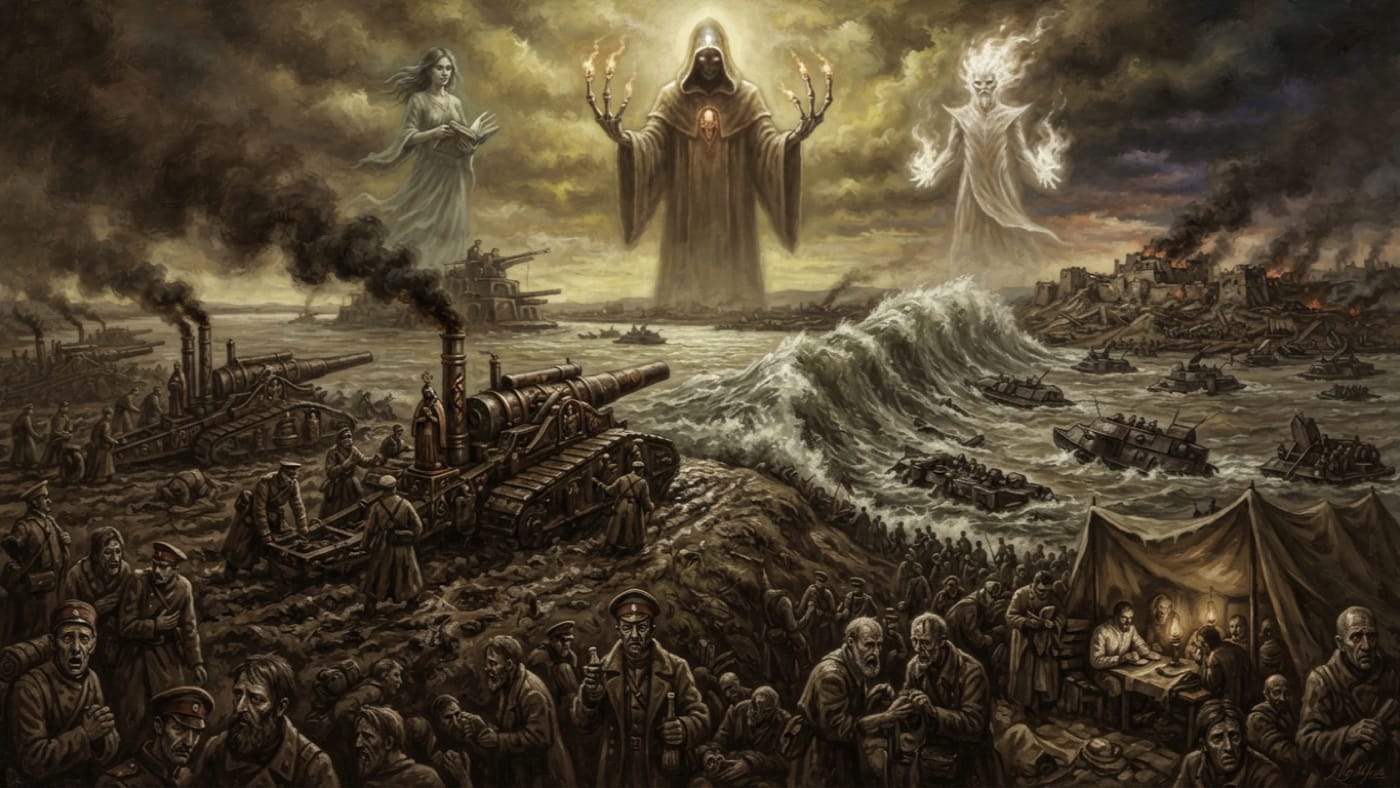
Maldrake's Wrath-host came west against Continental Levy formations, relic artillery, river batteries and confessor detachments. War had judged the flats firm after nine dry days, and the flats disagreed. Gun-teams sank to the axles. Caissons were unloaded by hand. Three captains asked leave to withdraw and were told to maintain devotional position. Through the heat-haze the iron hides of the hostile engines glowed the colour of a forge mouth.
Three figures were reported above the line. Over Battery Saint-Margaux there was a woman holding a psalter whose pages turned against the wind. Over Battery Veyl there was a figure with no face, behind a visor of white fire. Over the river there was a robed bearer holding three burning phalanges. No official document names any of them. The porters name the third Ignatius, for the obvious reason, and Doctrine declines to ratify the obvious reason. A man who once carried bones does not thereby become their general.
The relic guns fired in sequence. The Danube rose in a long diagonal ridge and bent back on itself. Barges downstream tore free and were driven east with their chains still attached. Wrath-forged infantry in the ford found the water running uphill into their faces. A pyre-engine stuck in the Flesh-Mud burned hotter, cracked the crust and was swallowed whole. By the eighth hour the hostile centre had broken, and its flanks were burning backward into their own smoke.
Early campaign sermons held that the Danube "parted" at Belgrade.
Corrected. The Danube turned. A parted river opens a road for the faithful, while a turned river strikes the Enemy in the teeth. Only the second happened, and only the second may be preached.
War, Doctrine and Records accepted the action jointly as a Martial Miracle and as the First Offensive Ratification. They verified the apparitions by sight-line convergence: separate batteries, separate bearings, one sky. That was the method at Belgrade, and it is no statute. No canon requires three saints, three witnesses or a surveyor's triangle before grace may count. Nor was Belgrade the first miracle of any kind. It was the first major offensive triumph the military record could canonize without disguising it as a delay.
#On Witness, Custody and the Bill
The testimony was taken on the bank, on deposition sheets stiff with river-damp. Confessors added annexes in pencil. Gunners signed with crosses, and some signed with prints because their hands no longer closed. Records took custody within the week, copied the sheets, sealed the originals and assigned each bundle a number. From that day on, what a man saw at Belgrade was whatever his folio said he saw.
One Battery Veyl deposition was copied twice and its original sealed. The public account leaves out a phrase from it. I have read the copy. I will not complete it for you.
The Bureau of Relics has its eight stations for a doubtful bone: intake and quarantine, provenance, physical examination, doctrine fit, response testing, verdict, notarization, disposition. A battle has no bone to set under the lamp. Belgrade's ratifiers borrowed the vocabulary anyway. Provenance became the custody of sheets, examination became the comparison of bearings, and doctrine fit was never in doubt.
Now the bill. The Church teaches, and I pronounce it without reservation, that a miracle draws its price from the faithful body: hunger, sleep, memory, years. Sorcery takes its price from Creation itself. It sours soil, unbinds kinship, and makes the word river stop meaning a river. That is the line between grace and trespass, and Doctrine alone draws it.
Belgrade's casualty annexes record forty thousand Synod dead. Artillery crews bled from the ears. Surgeons took limbs by lamplight on the rise. Men drowned, men went missing, and men were entered under categories that lower the public total without returning anyone to his mother. No ledger I have seen says which of these losses, if any, paid for the river. Doctrine has its teaching and Records has its annexes. The two documents have never been formally introduced.
The mud raises a separate problem. The Flesh-Mud swallowed a hostile engine, and it has swallowed our own men before and since. Taking the Enemy's side for an afternoon does not enlist it. Its allegiance is not on file, and neither is the mechanism by which the current bent. The Church ratified the outcome and attributes the cause to the Creator. Records keeps the remainder under seal.
#On the Uses of a Turned River
Chaplains read the Belgrade account aloud before advances. War cites it in every season of thinning morale, because a soldier who has heard that rivers can change sides fights better beside one. That is the first use, and the honest one.
The second use began within weeks. Widows, veterans, invalids, relic-hunters and merchants started walking toward Belgrade without permits, route seals or the courtesy of being taxable. The Bureau of Pilgrimage was formally constituted in A.S. 123 / 1833 CE, three years after the victory. Its Harmonized Routes decree absorbed or crushed eight rival guilds. Devotion became a road, the road acquired gates, and the gates acquired fees.
The third use is the present one. In A.S. 201 Belgrade is ruined and contested, perfumed in districts no patrol enters, and holy by decision. Pilgrims arrive under armed escort. They may stand on the approved rise. They may look at the artillery plinths, at the chained marker where Battery Saint-Margaux stood, and at three basalt sighting posts that fix the apparitions with all the confidence geometry can lend to theology. They may not descend to the lower flats. The lower flats still breathe after rain.
A victory, then, was ratified. The ground was never reclaimed, the city was never made safe, and the river's motive was never deposed. Boatmen say the current below the old battery line hesitates on certain mornings. Clerks enter it as optical disturbance.