
#On the Citation
"Enforcement: immediate." — Standing Order 14-K (Revised), final line of the smoke clause
Martial Code 22-A reaches me the way most law reaches most men: secondhand, in capitals, and attached to something they have already done. The offence carries the label Spiritual Contamination, Voluntary. I hold that label on two documents. Both are copies of one Bureau of Purity instrument, Standing Order 14-K, first issued in A.S. 134 (1844 CE) and revised in A.S. 172 (1882 CE). The Code appears in the revision. I date its invocation there because that is the earliest point at which I can see it. The documents in my keeping do not record when the Code was first written, who wrote it or what seal it carried. I do not forge preambles to make a shelf look tidy.
The revised order gives the Code two applications. One concerns smoke that writes. The other concerns glass that whispers. Each is tied to 22-A by a single sentence, and each sentence deserves a slow reading. The smoke gets no such courtesy.
#On the Reading of Smoke
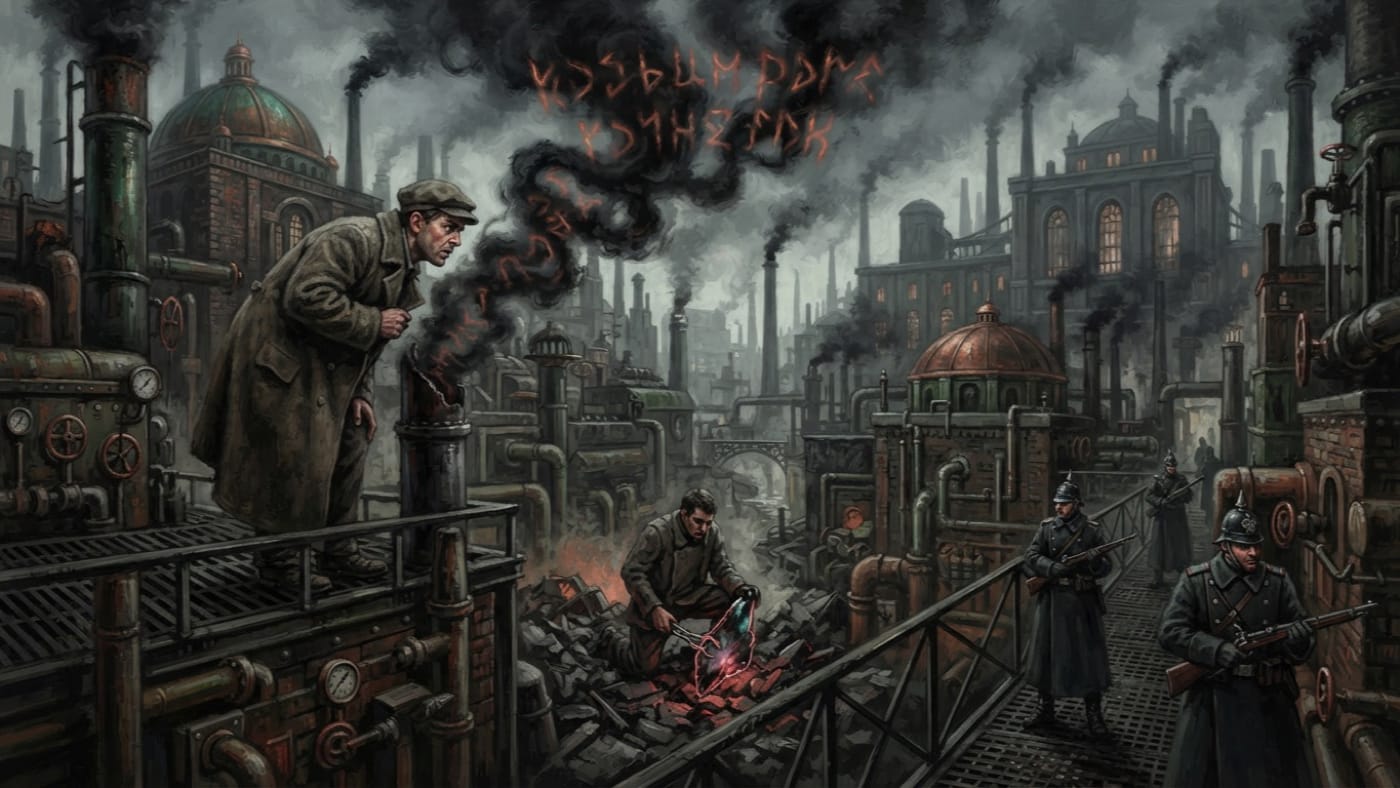
Black diesel is Anatolian pit-sludge, boiled in cellar stills by the distillers and pumped through clay and lead beneath the Warrens. It reaches every lamp, stove and engine that the official allocation does not, and that is most of them. Under conditions nobody has catalogued to the Bureau's satisfaction, its fumes arrange themselves into letters. The revised Standing Order says two things about this. Every report of scripture-smoke shall be filed as "atmospheric condensation, non-doctrinal." Reading, transcribing or interpreting smoke-text is punishable under 22-A.
Note where the line falls. A clerk who writes condensation is obeying the order. A man who writes down what the condensation said is breaking it. The first act is required description, and the second is engagement, which is the offence. The order does not make seeing the smoke a crime, and it could hardly try. The smoke hangs over the chimneys in plain view, and half of Bastion-Constantinople would be in custody by vespers.
The danger is real. No entry in my Codex will say that the Bureau suppresses phantoms. In A.S. 136 (1846 CE) a quarter of Constantinople was found burning black diesel in its furnaces. The smoke wrote, and a crowd gathered underneath it. Soldiers fired to disperse the crowd, and the smoke coiled into human shapes. Seventeen soldiers died. The quarter was sealed for nine months.
Between November and March, the Bureau of Purity's own field offices run on the same fuel.
#On Recovery for Approved Purposes
The second application comes from the same revised order, as reproduced in the scavengers' entry. Demon glass is pried from the slag-plains of Wrath and the mirrored corridors of Lust's shattered courts. The shards are warm. They whisper and show visions. They hold the eye, and in the courts they wear away the memory of anyone who lingers. The order forbids all personnel, civilian or military, to come within two hundred metres of a confirmed deposit. In a separate sentence, it makes the recovery of specimens for "research," "intelligence" or "devotional study" punishable under 22-A.
That is two sentences, and I keep them as two. The proximity rule sets the distance. The recovery clause names the purposes that bring a man under the Code. Nothing in the text says that every pace inside two hundred metres is itself Spiritual Contamination, Voluntary. A Warden who merged the clauses would be writing law in the margin. I write a great deal in the margin, but never law.
The quotation marks around the three purposes belong to the order. They are the Bureau's sneer, issued in advance, at every scholar, spymaster and pious widow who believed that a good reason would make the glass safe to hold.
The order ends by superseding every earlier permission, naming Bureau of War Field Dispensation 7-C as "retroactively annulled." War had once licensed what Purity now forbade, so Purity amended the past. The glass is classed as Category One Spiritual Contraband, under a policy of absolute seizure, immediate destruction and no appeal, and it has kept reaching War's optics division through channels that appear in no ledger. Those deliveries show appetite. They do not show a surviving exemption, and War has never claimed one in writing. The no-appeal rule governs the shard. What happens to the hand that held it is a separate question, and my documents answer it with the word immediate and nothing more.
#On the Word "Voluntary"
The Bureau of Doctrine supplies the vocabulary of orthodoxy, and voluntary is the cheapest word it owns. Look at what it does in each application. The man who reads the smoke raised his eyes and kept them raised. The man who brings out a shard crawled past a marked distance and closed his tongs. Both acts can be called chosen, and the Code calls them so.
Then look at what the trades report. A Wick-Kid hauls canisters because without them the district goes dark, and a dark district along the Sagittal Line is a district where the dark has teeth. A Picker crawls into the slag because the trenches he deserted were worse. The glass of Lust's courts is attested to erode memory within the quarter-hour, and Hook-grade shards take their name from refusing to let a viewer go. Whether a man in that state still chooses is a question the Code leaves open, and so do I. The text in front of me defines no threshold of consent and no measure of capacity. I will not invent a jurisprudence to spare Doctrine an awkward afternoon.
What I can record is the effect. The word removes the Great Deceiver from the dock and leaves the scavenger standing there alone. Contamination by accident would be the Bureau's failure to protect its people, and contamination by choice is the subject's own sin. The first goes in the accounts as an expense. The second goes in a file.
#On Enforcement and Supply
"Contraband does not exist unless confiscated. Until then, it is loyalty-in-waiting." — Bureau Resolution, classification pending
Purity cites the Code and Purity enforces it. Purity also keeps its offices warm on unstamped canisters and gets its public victories from the brokers whose stock it is sworn to destroy. The fuel trade sets aside a visible tithe cut of twenty per cent for confiscation, and the remainder flows through pipes the Bureau has agreed not to find. The glass trade keeps different figures. The Bureau of Shadows estimates that eight to twelve per cent of the material is lost to seizure each year. These figures belong to two separate trades, and nobody who values his post should average them.
The Bureau of Tithes files the proceeds of the spectacle under "Contextual Revenue Assessment" and asks nothing further.
The arrangement needs bodies. A Whisper-Broker arranges a "donation seizure": some furnace-grade glass is left where Purity can find it, a crowd is gathered, and a Picker is taken. The Picker's name was written in pencil, and the file is stamped RESOLVED. In the fuel trade, canisters paraded through a market square have turned up back in storage four days later. The Wick-Kid paraded with them has not turned up anywhere.
None of this is an exception to 22-A. No clause shelters the patron who buys the shard, the trench captain who burns the fuel, or the clerk who reads both reports and files them as weather. The Code reaches them exactly as written. In practice it is enforced against the people closest to the smoke and the slag, who are also the people least able to pay for a seat at the theatre. The trades' own histories record the punishments that follow these seizures, immurement among them. The citation itself fixes no punishment. Enforcement: immediate tells the officer when to act and says nothing about how.
ERRATUM — BUREAU OF PURITY, INTERDICTION DIVISION The assessment that "demon-glass scavenging has been eradicated in the eastern theater" (Standing Report, A.S. 197) is revised. The practice has been reclassified as "residual opportunistic recovery by unaffiliated individuals." The distinction is jurisdictional, not factual. Warden's annotation: the recovery clause has no residual category. It applies to the residue exactly as it applied to the trade.
#On the Continuing Application
As of A.S. 201 (1911 CE), both cited applications stand as the revised order states them. Report the smoke as condensation, and do not read it. Stay two hundred metres from the glass, and do not bring any of it back for a purpose that needs quotation marks. Field Dispensation 7-C remains annulled, and that includes the years when it was in force.
The lamps in Purity's offices stay lit. War's optics stay sharp, and Tithes stays solvent. The Picker's name is still in pencil.
Polishers downstream of the scavengers have asked whether cutting a shard that is already recovered counts as recovery. The order as cited does not say. I have passed the question to the appropriate committee, and it remains there with every other question the committee has received.