
#On the Obligation of Service
A.S. 201 — a current survey; compilation and original ratification dates remain unknown.
The Martial Code begins the moment a recruit opens his mouth before a licensed witness. Before that he is a son, a debtor or a parish name on the levy list of the Bureau of War. Afterwards he is a sworn soldier, and the Code can reach him wherever the Line sends him.
I am asked where the Code came from, who compiled it and in which year it was sealed. I cannot tell you, and I distrust anyone who claims he can. The folios open to me give no compiler, no original edition and no ratifying council. Soldiers were swearing before witnesses and being punished for breaking faith long before the Concordat of Strasbourg gave the Holy Bureaus their present form. The Concordat settled offices, and settling offices is not the same as writing a law. Anyone who shows you a bound "Code, First Edition" is selling you either a forgery or a fable.
What survives is the practice, and the practice is consistent enough to describe. War demands the service. The Bureau of Oaths witnesses the promise and registers it. Field judges pronounce sentence when the promise breaks, clerks keep or dispose of what the sentence produces, and the Bureau of Doctrine explains afterwards why each of these was holy. No single office owns the whole. Each one insists another office is responsible for the worst parts.
#On the Witnessed Soldier
Every soldier swears the Oath of the Line before deployment, in the presence of an Oaths Witnesser. Its terms are short, which is how War likes its terms. The recruit binds himself to service, to obedience, to the bell-schedule, and to death if the Synod requires it. Nothing in it is ornamental. The fourth term in particular needs no gloss.
The Witnesser says nothing during the oath. He stands with the cord-sash at his hip and the lead tablet in his palm, and he listens. He records the exact words spoken, the conditions attached to them, the parties bound and the cadence of the voice. Cadence is the Bureau's peculiar contribution to jurisprudence. A trained ear is said to hear duress in a stumble and resistance in a pause. Whether that ear is a gift of the Creator or a credential the Bureau protects to keep its monopoly is not a question this entry needs to settle.
Then comes registration. The record goes from the field tablet into the Bureau's books, and copies of the binding are lodged in Strasbourg. The Bureau's position, stated in its catechism and enforced by its officers, is that the oath binds because it was heard. What the recruit intended is irrelevant. A recruit may swear with his fingers crossed in his greatcoat pocket. The Witnesser hears the words and not the fingers.
This process deserves the reader's attention, because it is the hinge of everything that follows. A soldier's obligation is exactly as sound as the record of his swearing. A missing name, a misheard condition or a cadence noted in the wrong column leaves a man whose duty rests on a defective entry. The Bureau treats such defects with the gravity other institutions reserve for arson.
#On Breach and Sentence
For soldiers who break their oaths, the Martial Code specifies the punishment. They are gagged and buried alive, and their silence is notarized as final testimony.
I have read that sentence many times, in the Bureau's own phrasing and in mine. Nobody has ever complained that it is unclear. I will add no clause number, no depth of grave and no list of the men who have filled one, because the folios I am permitted to cite contain none of these. The penalty is stated and its theology is plain enough. A man who used his voice to break a sworn bond loses his voice. His last testimony is the silence the gag forces on him, and a notary certifies that silence as he would certify a signature.
The Bureau of Oaths states that this penalty is "rarely applied in the present era." It does not say the penalty has never been applied in the present era, and I have learnt not to ask.
The burial of the soldier should not be confused with the burial of his oath. The Bureau holds Breach Rites for broken bonds of every category, and the military rite uses iron and ash. The broken oath is named aloud and the parties are identified. A Breach-Rite Witnesser speaks the Dissolution Formula, and the entry in the Ledger of Fidelity is struck through with a single red line. The words stay legible under the line. The rite deals with the bond and its record, and the Code's penalty deals with the man. Neither belongs to the jilted bride, the defaulting debtor or the guildsman who sold his apprentice's indenture twice. Their bonds are struck in red, and none of them is put in the ground for it.
A further claim follows the soldier even past the gag. In the aftermath of the Breach Plagues the Bureau formalized what it calls the Trench Last-Oath Doctrine. It holds that a soldier's vow remains binding beyond his death. Names have been reported reappearing on rosters at more than one station along the Line. The Bureau's position is that those names stay under its jurisdiction. It offers no account of how they come back, and I will not supply one for it.
#On Judgment in the Trenches
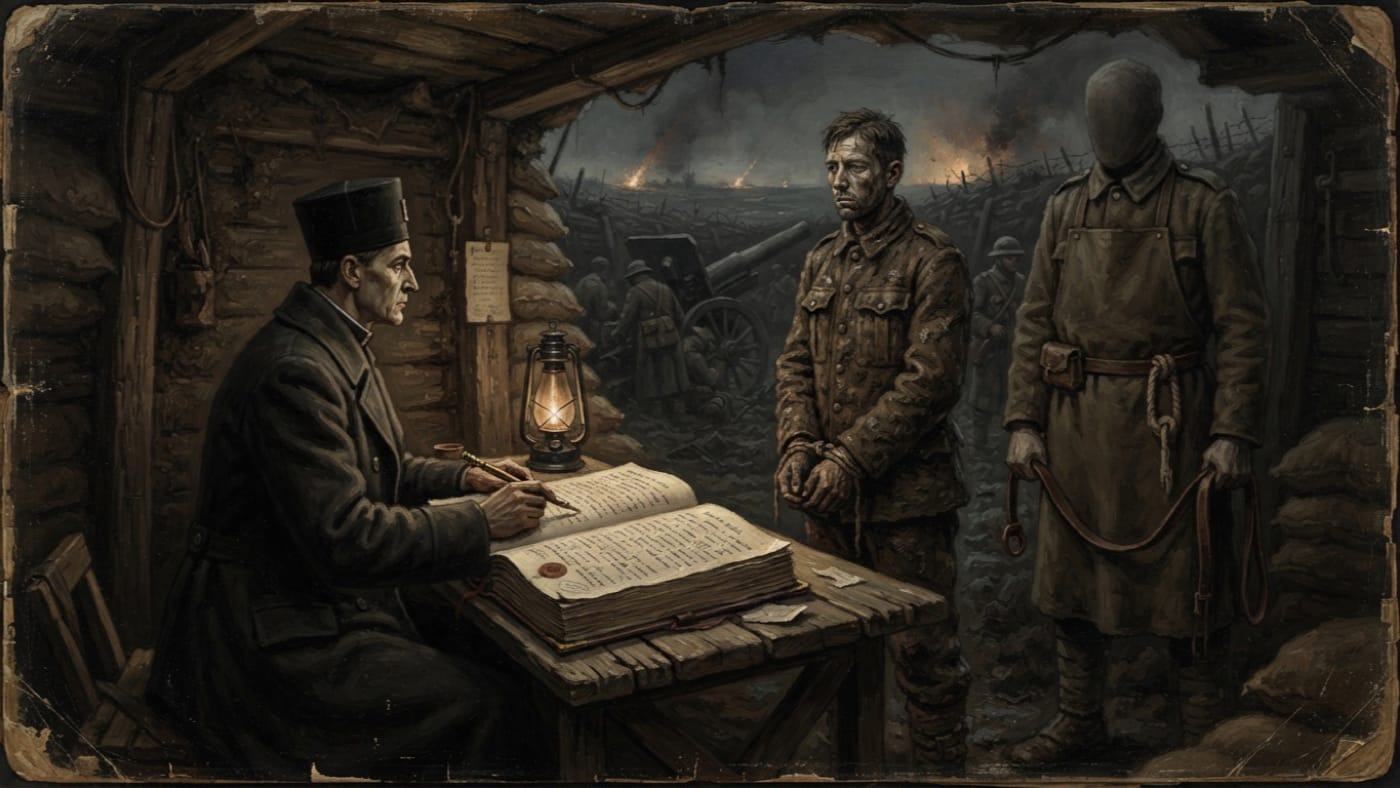
The Code is applied in dugouts and sandbag chapels along the Sagittal Line, from Königsberg on the Baltic down through Brest, Przemyśl, Sibiu, Irongate and Shipka to Constantinople. These tribunals have no walls worth mentioning. A plank table holds a lantern, a seal tin and a ledger that is never dry. The judge sits robed in black, with a rifle in place of a gavel and a relic for his seal. The accused stands in mud to his ankles while the next defendants wait in the trench outside.
Doctrine allows no hearing to last longer than a single hymn. When the hymn ends, deliberation ends with it. Sentence follows at once and appeals are forbidden. The condemned may shout a final confession if they have breath for it, and the clerk writes it down.
The documented field practice covers a range of offences. The mutineer goes to the firing squad, and the thief is given to the Immurement Mason to be sealed into the trench wall. The judge passes sentence and a separate trade carries it out, each under its own writ and its own plaque. An accused heretic is sent to the ossuary draft. He marches to the front carrying a relic and nothing else, and is expected to fall in the first charge. I set these practices beside the Code. I do not claim they all derive from one clause of it, because I have found no clause that says so, and inventing one would be a forger's work.
The courts are not consistent, and I will not pretend they are. One man has been shot for losing a ration stamp. Another has been spared after desertion because his hymn was judged pleasing. The written penalty is fixed. How it is applied depends on the judge, the hymn and whether the guns are firing. The Bureau describes this as "the inevitable texture of field conditions." The men waiting outside the dugout pray for short hymns.
#On the Record After Judgment
The Trench-Court Clerk sits at the end of the plank, and the clerk's work does the most lasting harm.
The clerk confirms who the man is from three sources: his identity tag, a witness and the unit roll. Then the clerk takes his confession, either in full or compressed to the rubric card, and assigns it a category. After that comes the wax and the field stamp, and then the outputs the families actually receive: a death attestation, a burial clearance token and a bequest slip naming who gets the letters, the ring and the coin. Desertion claims are logged as well, often with the deserter absent.
If one tag does not match the roll, the attestation stalls. Without the attestation there is no burial clearance. A widow in the western parishes cannot then prove she is a widow, cannot inherit, and cannot stop the arrears that begin to treat her household as a debtor. No firing squad is involved in any of this. The clerk's pen manages it alone.
Two kinds of record come out of all this, and they are treated very differently. The soldier's oath entry is permanent. If it is ever voided it is struck in red and left legible in the Ledger for good. The field confession is disposable. Final words that contradict the sanctioned account go into a contradiction bundle and a sealed pouch, and when a courier brings the order the bundle goes into the furnace. Some clerks burn willingly. Others delay and hide their bundles, and auditors watch both kinds.
Soldiers who break their oaths are gagged and buried alive, their silence notarized as final testimony.
I gave this sentence in my survey of the Oaths Bureau without qualification. The Bureau of Oaths asks that it be read together with its own published wording: the penalty is "rarely applied in the present era." The Bureau confirms that the penalty stands. It declines to say what "rarely" means. The Bureau of War did not reply to the inquiry.
#On Present Application
The present difficulty is a matter of numbers. The war front has grown faster than the Witnesser corps, and recruits are now sworn to the Oath of the Line in batches of fifty. A single Witnesser records cadence for the batch as a whole. Fifty voices are entered as one rhythm, and fifty men are bound on one stroke of the pen.
The Bureau of Oaths calls this "suboptimal." It also admits that a soldier whose oath was improperly witnessed may not be bound to service at all. If the swearing was defective, the obligation may be defective too, and the Code's reach over that soldier is uncertain. The Bureau of War has told everyone to ignore the problem. The Bureau of Oaths has recorded its objection in seven memoranda, and all seven are filed in Strasbourg, where the Bureau of War does not read.
No recruit should treat this as an escape. No tribunal has ruled that batch swearing frees anyone. No Witnesser has struck a batch entry for defect, and no judge in a sandbag chapel will wait a hymn's length while a deserter recites the Bureau of Oaths' memoranda to him. The uncertainty is real, and it is recorded on paper. It has not been applied to any man. Until it is, the Code governs every man in the batch, along with whatever the Witnesser failed to hear.
The memoranda remain open. The batches continue.