
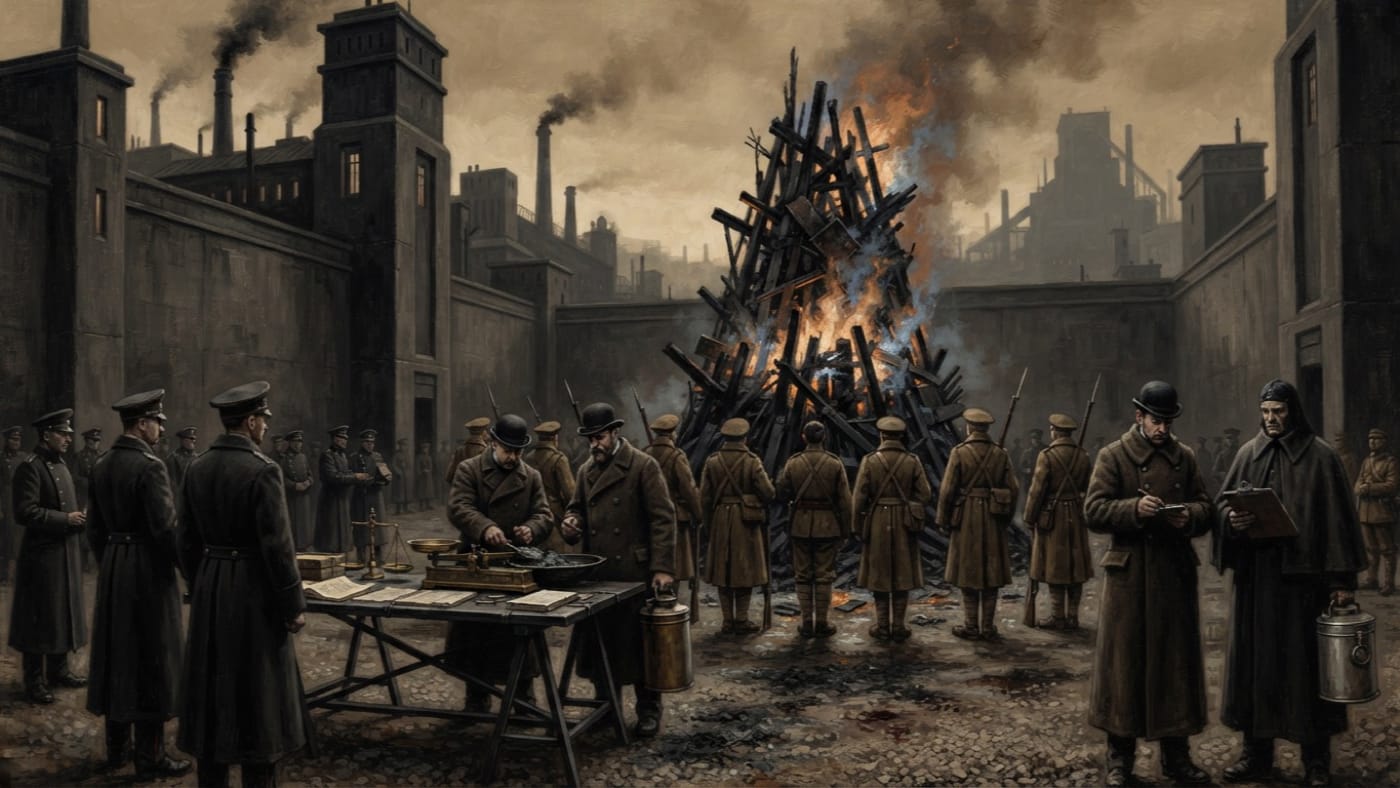
#On the Offence
"Do not eat from the Enemy's hand. Do not eat from the Enemy's field. Do not eat." — Martial Code 14-D, Spiritual Contamination (Voluntary), Subsection 3
Martial Code 14-D has a title of two words and a parenthesis, and the parenthesis does the killing. Spiritual Contamination names the injury. Voluntary names the man who must answer for it. Between the two words the Bureau of War has found room for a pyre.
Subsection 3 is the only part of the Code this office has been given to quote. I quote it above in full because it is short enough to be shouted across mud. Its third sentence is a small masterpiece of military drafting. It forbids the one act every soldier performs daily, and it leaves the officer at the crop-line to add the missing qualifier.
The Code's enactment year appears in none of the papers I hold. I can prove only that it existed by A.S. 163, because in that year it was already the penalty clause of Standing Order 119-F. Bastion-Constantinople Eastern Command issued that Order against Synod personnel approaching, harvesting, sampling or consuming produce from unregistered agricultural sources within ten miles of the Blightmarsh boundary. The Order says what may not be done. The Code says what becomes of the man who does it.
#On the Hunger Before the Charge
The danger is real. A reader who hopes I will call the Code a superstition may close the folio now. Produce from the Abundance Fields is physical food. The grain can be threshed and the apples can be weighed, and the Bureau of Alchemical Standards found in A.S. 178 that the grain carries more protein than any registered Synod strain. It feeds the body. Then the hunger returns, larger than before, and it grows with every mouthful taken to quiet it. The Harvest tend these fields for Kargath, and they tend them well.
The first community found dead among such plenty lay near Pécs in A.S. 147. Its ovens were full and its people were wasted to the bone. The second lay near Kaposvár in A.S. 159. The Order followed sixteen years after Pécs, and the Code's sentence came with it. Withdrawal is correct. I defend it, and I will go on defending it after this entry is sealed.
Now consider the soldier who meets the Field. He has eaten what the ration allowed. Rationing as discipline is meant to make him humble, and its reliable effect is to make him hungry. His convoy is late. The wind smells of bread. Blessing will not save him: the Bureau of Relics maintains that properly blessed food cannot carry the curse, and the field evidence maintains otherwise. Each condition that makes the apple dangerous also makes his reach for it less free than the parenthesis supposes. The Synod keeps its soldiers hungry for the protection of their souls, then charges them with appetite.
#On the Sentence and the Remains
The sentence is execution by burning. The ashes are weighed, sealed in a Bureau reliquary canister, and buried at a depth of no less than nine feet.
Each office keeps its station. War insists on the flame. The Bureau of Doctrine insists on the depth. Records insists on the weight. I insist on reading the weight aloud. I have yet to find an office willing to sign for the whole procedure. Each one owns a step, and none of them owns the man.
On paper the procedure is clean. Fire reduces the condemned. A balance records what is left. The canister is sealed, and the earth closes over it at nine feet or deeper. The Code does not say what the depth is meant to hold down. Doctrine reads it as containment. War reads the fire as the end of the matter. I read the balance, and more than once the number has come out lower than the body had any right to leave. That observation is mine. No bureau has adopted it as a finding, and Records prefers to call the shortfall pyre loss.
#On Corporal Mettler
Corporal Haas Mettler of Kestrel-7 was burned under 14-D in A.S. 196, thirty-three years after the Order made his offence possible. He was convicted under the consumption prohibition. The smell revision was still three years away.
The facts come from three sources, and I keep them in three columns.
The first column is the patrol's. On a routine boundary check the patrol came upon a Field, and Mettler ate three apples. His commanding officer reported that he wept while eating, first from pleasure and then because the pleasure kept rising when it should have settled. By the time the patrol restrained him he had eaten the cores, the stems and a quantity of soil.
The second column belongs to the Bureau of Medicine. Its field kit registered his hunger as catastrophic within the hour. At the pyre, Medicine's representative noted that the flames consumed him faster than baseline models predict for a body of his mass. Medicine recorded the speed and did not state a cause, and I do not supply one on its behalf.
The third column is mine. I attended the execution. Mettler was still hungry when they lit the pyre. I have entered that in the column because I saw it, and for no grander reason.
The charge asked a great deal of three apples. The food was real, the place was forbidden, and by the Code's arithmetic the act was therefore voluntary. I believe he chose the first apple, in the narrow way a hungry man chooses. I do not believe anyone chooses to eat soil. The sentence would have been the same if he had stopped at the first bite. That is the economy of the parenthesis: it settles the question of will at the first swallow and never reopens it.
#On Contact and Voluntary Conduct
The fourth revision of 119-F, in A.S. 199, classifies smell as contact. The amendment belongs to the Order. I cannot say whether it altered a single word of 14-D. The offices that could tell me have not been asked by anyone with the standing to compel an answer, and that list includes me.
A man does not choose to breathe. Sometimes he can choose where to stand while he does it, and the revision is built on that narrow ground. Sentries at Kestrel-4 report bread on the west wind. Officers withdraw them, Medicine assesses them, and quartermasters inspect what they carry. Contact, detention, assessment and conviction are four separate stages handled at four separate desks. I record the distinction because clerks forget it when the paperwork is heavy. The distances and duties belong to the Order's revised text, and I leave them there.
The trouble with the revision is grammatical. The more the Order extends contact into the senses, the worse the parenthesis fits. Smell is contact. Smell is also weather. The Code has not decided which of these sentences to believe, and every officer at the crop-line is left to decide it for himself.
Provisional Classification, A.S. 141: Abundance produce operates as "demonic illusion operating on the gustatory senses."
Withdrawn. The food is real. I enter one consequence of the withdrawal: under the illusion classification every eater would have been a dupe of the Enemy. Real food makes him a defendant.
#On the Open Entries
The ledger of Order 119-F records forty-three violations. Thirty-one ended in immediate execution. Nine ended in quarantine and then execution, after the quarantined men showed what Medicine classifies as progressive caloric void. Three violators disappeared into the Fields before they could be apprehended. That makes forty burnings and three open lines. The figures cover the Order only. They are not a census of every prosecution under 14-D in Synod territory, and I warn any clerk who tries to use them as one.
The ledger gives quarantine no fixed term. It records no cure, no clearance and no acquittal. On the evidence of these nine, quarantine postponed the pyre and never cancelled it.
The three missing men are what keeps Records awake. A burned man closes his column: the ash is weighed, the canister sealed, the depth certified. A man who walks into the wheat and is not seen again leaves the arithmetic open. Records has formally asked whether disappearance counts as desertion or death. The Bureau of War has formally declined to answer. I have no more information than either of them, and I will not pretend to know where the three went.