
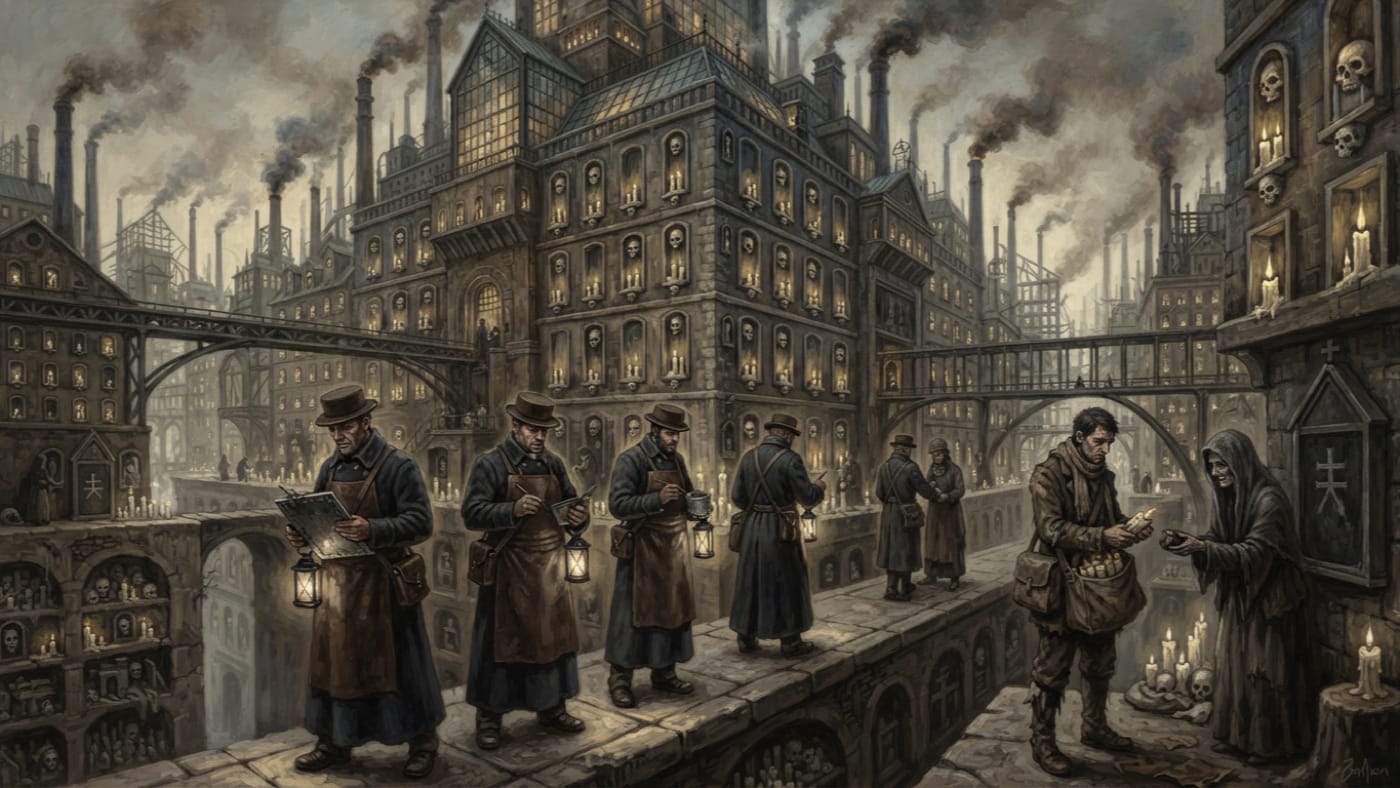
#On the Substance
Marrow-wax is vigil wax mixed with fat rendered from the marrow of the dead. The dead in question are sanctioned remains: bodies that entered the ossuary, received their tags, and passed into the Church's keeping by the proper door. The candles made from it burn in skulls at household windows, along trench walls and in the ossuary squares of Bastion-Constantinople. They burn wherever else the faithful have been told to show that they remember.
That is the whole of the documented recipe. A reader who expects proportions, vats, a guild of renderers or a patent of first manufacture will find none of them here. He will find none in the archive either. I have looked, and I do not enjoy searching the archive for things it declines to hold. Who first stirred a dead man's marrow into a candle is unrecorded, and the Codex will not invent him.
What the substance does is a matter for the Bureau of Doctrine, and Doctrine has been plain: "The light of loyalty must burn until marrow is spent." The Church teaches that the mixture carries a devotional potency beyond common tallow. It does not teach that a given candle holds a given soul, feeds it, frees it or carries messages to it, and I will not have that said in my Codex. The candle is an act of fidelity, performed with material the dead no longer require. Anyone who claims more for it is selling something. In the ossuary rings, that is usually literal.
#On the Household Flame
Every household keeps its vigil. The skull sits in the window, the candle sits in the skull, and the flame sits where the street, the neighbours and the Bureau can all see it. Each flame is tallied, and each extinguishing becomes a report. A dark window is punished as absence. A window crowded with too many flames is punished as arrogance. The family must therefore burn exactly enough grief to satisfy a clerk it has never met.
The smell is what people remember. Marrow-wax burns acrid and close, and citizens say their candles smell like their ancestors. Children are taught to tell by scent alone which candle belonged to which relative: a grandmother here, an uncle there, and in the skull by the stair a brother taken at the trench last winter. The Bureau of Purity calls this "training of loyalty by nose." Purity names its programmes the way a butcher names his pigs, affectionately and with a date in mind.
Whether a child's nose truly finds her grandmother in the smoke is a question the Codex leaves to the child. The instruction is documented. The recognition is family testimony. Neither is a certificate of provenance, and the Bureau of Records has never issued one.
When ash-storms come and the flames sputter, families stand at the window and relight with charred fingers until the skin peels. To leave a candle dark is to declare oneself kinless. Doctrine says a premature extinguishing is a test of resolve. Records says it indicates infiltration and calls for the neighbours to be investigated. The standing resolution holds that both are true: relight, report, punish.
Mourning has thus become a matter of consumption. A vigil that may never lapse requires wax that may never run out, and that wax must come from somewhere. The Church specifies where.
#On Measure and Receipt
Approved marrow-wax travels through certified channels. The Bureau of Tithes measures it, and the Bureau of Records receipts it. The whole meaning of the word "approved" lies between the measure and the receipt. Tithes vouches for the quantity of the wax, and Records has entered its passage. Its sanctity rests on both offices agreeing that it came from the right dead, lawfully kept.
I will not reproduce the forms. There are forms; there are always forms. Their numbering is beneath the dignity of a theological article and above the clearance of most readers.
Out in the ossuary rings, approval becomes a local matter. The Circle of Ashen Steps is the bone-lane Circle of the Lantern Brotherhood. It patrols the Ossuary Rings, the funeral routes, the cremation yards and the night-cart depots, and its doctrine runs: "A candle uncounted is a body unclaimed." At dusk the Circle inventories its hooks, its tags and its approved wax. After the curfew seal its patrols walk clockwise with lanterns fixed at the sternum. A Wicker carries the slate and a Lanternman carries the ash paste. They mark every lit window once and every dark one twice.
The tallies end up in Ossuary Office Seven, which everyone sensible calls the Counting Room. It is a stone chamber inside the ring. Its slates are scratched with candle counts, wax hangs down its walls in pale ridges, and it holds a trough of ash paste and a locked cabinet of body-tags. Nothing is rendered there. It is only the place where candles are counted and where someone decides whose candles ought to be fewer.
#On the Fine and the Private Sale
The Circle's favoured correction for a delinquent household is the Marrow Fine, which confiscates the family's ration of approved wax. It is collective punishment, dressed for chapel.
The family has to work through the arithmetic, so the reader may as well. The fine takes the wax but leaves the obligation. The skull remains in the window. The tally pass returns at dusk tomorrow, clockwise and on schedule. A household that cannot show a flame has declared itself kinless, and the next correction will be worse than the first.
The tolerated sin steps into that gap. Ashen Steps skims marrow-wax and sells approved stock on the side, privately, to households desperate to keep a name lit for another night. The distinction matters to me even if it does not matter to the widow who pays. The wax is genuine. Tithes measured it, Records receipted it, and it is as approved as it was in the depot. Only its sale is unauthorized. The material is lawful and the hand is not, and the flame passes the next tally perfectly.
The Codex holds three facts. The Circle confiscates wax. The Circle sells wax. The households that lose the first are the obvious buyers of the second. No document shows whether any particular ration travelled from one family's sill to the next family's purse, and the Codex will not assume that every seized candle was resold. Draw what line you like between those facts. The Circle draws it every night.
The Brotherhood roster names Wick-Sergeant Rulik "Sootmouth" among the sellers. He knows every ossuary tunnel, and he coughs a wax-sweet phlegm into a rag that he folds with clerical neatness. The roster says he sells marrow-wax to pay off a daughter's ration debt. Others say the daughter is dead. Two officials deny that Rulik exists at all. I record all three positions and endorse none of them. His tallies, I am told, are excellent.
#On the Second Book
Skimming wax is petty. The larger matter sits beside it in the same locked cabinet.
The Circle keeps a second ledger, which its few readers call the Two-Book Dead. It records bodies quietly diverted for patrons through corpse-sale, marrow-wax skimming and "lost" funerals. Officially, a body enters the ossuary, receives its tag, passes into sanctification and becomes countable. Unofficially, some bodies leave by way of the Counting Room, and Records receives whatever number satisfies the column.
The Codex keeps three things apart here, and so will the reader. The first is ordinary sanctioned marrow-wax, measured and receipted and made from the lawfully kept dead. The second is approved wax that the Circle diverts and sells. The third is diverted bodies. The second ledger shows that marrow has been taken where it should not have been. It does not show that every lawful candle in Bastion-Constantinople is cut with theft. I will not let a scandal in the cabinet become a slander against the vigil.
Previous Brotherhood filings describe all lost bodies as "route attrition under difficult funerary conditions."
Correction carried forward from the Codex entry on the Circle of Ashen Steps: several bodies were not lost. They were reassigned without the courtesy of a verb.
The family cannot sort any of this out. It has a tag it once kissed, a candle that smells of someone, and a Church that says the body was sanctified. If the family learns that the body was sold instead, the ossuary riots will burn the Circle alive, and they will not stop at the Circle. The Bureau of Records does not acknowledge the Two-Book Dead, and Records does not walk the rings after dark. Purity watches. The Wardens despise the Circle.
#On Continued Issuance
As of the A.S. 201 survey, the vigils remain compulsory and the tally passes continue. Tithes still measures approved marrow-wax, and Records still receipts it. The Circle of Ashen Steps remains provisionally tolerated while it waits for the quarterly reconciliation of candle tallies, body-tags, wax issuance and ossuary transfer receipts. That reconciliation has not been completed. The discrepancies remain below the riot threshold, which is the only threshold that matters.
The candles will be lit tonight. The fines will be levied, and the wax will be sold.