
#On the Confiscation
The Marrow Fine takes wax. Readers who came expecting a bone-saw may leave by the clockwise door.
When the Circle of Ashen Steps imposes it, a household gives up its ration of approved wax. That is the certified vigil stock kept for the skull-candles in its window. The wrapped blocks go first, then the stubs, then the half-burned taper still warm in its socket of bone. The charter under which the Lantern Brotherhood keeps this Circle lists the practice among its favoured punishments. It also calls it collective punishment, with a frankness I would have struck from any draft that reached my desk.
The punishment is collective because the window is collective. A vigil flame is counted against a threshold. Throats are Ash-Tongue's department. The candle burns for the family's dead and declares the family's loyalty, so when the slate finds a fault, it records the fault against the address. Everyone in the house loses the same wax on the same night: the grandmother who tends the wick, the child who can name a dead uncle by the smell of his candle, and the lodger who has never lit a wick at all.
Ash-Tongue, the Circle's other favoured correction, dusts one offender's lips with consecrated ash until speech hurts for days. It has a target, and it ends. The Marrow Fine has a household, and it ends whenever the household finds more wax.
#On the Tally
Every stronghold of the Church keeps its ash-candle vigil. Families set candles into skulls and place them in windows, trench-niches and ossuary squares. Each flame is tallied. A window without one is read as absence and punished as absence. Six rings of bone and masonry make up the Ossuary Rings of Bastion-Constantinople, where the southern anchor of the Line keeps its dead. There the tally belongs to Ashen Steps.
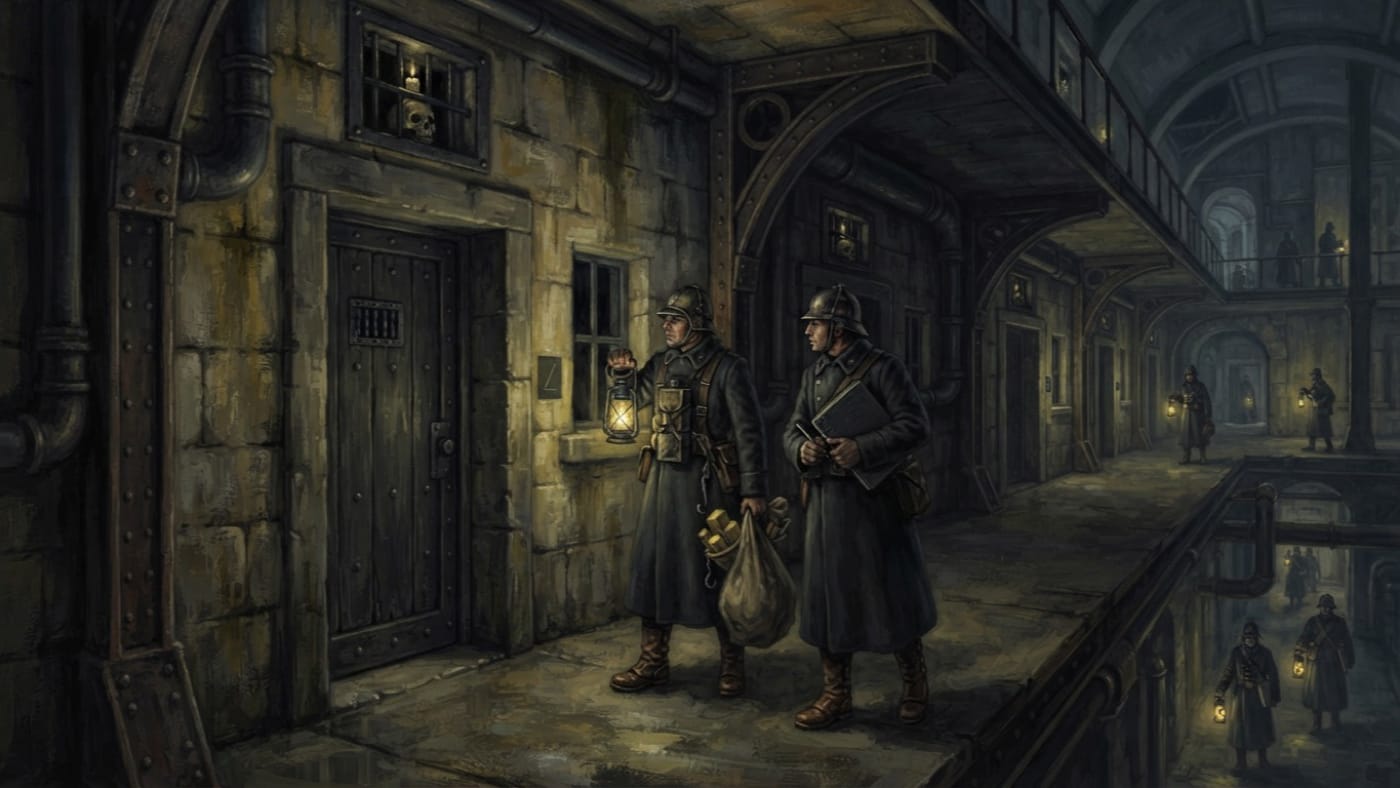
Their night runs in a fixed order. At dusk they wash in ash and inventory their hooks, their tags and their approved wax, so the Circle's own stock is counted before anyone else's. At the curfew seal, under the Ordinance of Quiet Hours, the ring-walk begins. It goes clockwise, with lanterns strapped at sternum height. Early in the night comes the candle-tally pass, which notes missing flames and does nothing about them yet. Midnight belongs to the body-routes. Late night belongs to corrections.
The Marrow Fine belongs to that late hour, alongside the warning and the taking-away. A dark window does not summon it automatically. The window earns a mark, and the mark waits.
What the mark means is another question, and the Circle does not ask it gently. A sill without a flame may belong to an empty house. It may belong to a family that could not afford its wax. It may belong to mourners keeping a body one unsanctioned night longer than the route allows, or to someone who has stopped praying. On the slate all four look the same: one scratch beside one door.
Initiates learn this in the Candle-Tally, the rite in which a novice keeps a ledger of household flames through a full night. If the novice's tally proves wrong, the Circle leaves the slate alone and corrects the street instead, by supplying a reason for a candle to have gone out. A slate in error is a disgrace. A household in error is merely Tuesday.
#On the Household Without Wax
The morning after a Fine, the skull is still on the sill and the wick is still in the skull. The household's dead are exactly as dead as they were. The household still owes a display of its grief, in full, and the early-night pass will inspect it again tomorrow. Only the fuel is gone.
The family now has several choices, and none of them is approved. It can borrow from neighbours, but their rations are counted on the same slate, and they have every reason to fear a split-candle glyph chalked on their own threshold. It can burn something other than approved wax and invite the Wicker with the slate to ask what that something is. It can sit behind a dark sill and wait for the early-night pass to note the absence again. Or it can buy.
The Fine relieves a household of its wax ration.
Corrected. Nothing was relieved. The household held wax at one dusk, and by the next it owed the window a flame it could not light.
I do not claim a rule that a fined household must be fined again. The charter contains no such rule, and I have looked. I report only the two things the charter does contain. The Circle takes the wax, and the Circle counts the windows. A family that has lost the wax is still counted. Any reader who cannot carry that sum across a single line of the Ledger has no business in the Rings after the curfew seal.
Grief does not wait for supply. The widow still whispers to the skull-lamp after curfew, because the Rings hold that secrets spoken while the candle burns will be forgiven by the dead. The night after a Fine, nothing is burning, and she has nothing to confess beside. The children have been schooled in what Purity calls loyalty by nose, so they know each relative by the scent of that relative's wax. Now they sit in a room that smells of wet stone.
#On Approved Supply
The tally recognises only approved wax, and approved wax is dear. Marrow-wax is rendered from sanctioned remains and mixed into vigil candles for its devotional potency. It is supposed to pass through certified channels under Tithes measure and Records receipt: one weight in, one receipt out. Ashen Steps skims it. The Circle trims the shortage, keeps the excess and sells the difference to households desperate to keep a name lit one more night. This is the Circle's tolerated sin, and I report it in the tone the Ledger reserves for weather.
The Marrow Fine sits beside it. One practice removes approved wax from households, and the other sells wax to households that lack it. I place both on the same desk and decline to staple them.
The Circle confiscates a family's wax and sells it back to the same family at a markup.
Corrected. The Circle confiscates wax from families, and the Circle sells wax to families. No receipt yet found shows where any confiscated ration went after the door shut, who was paid for it, or how much. The earlier sentence is withdrawn for want of a receipt, which is the only grounds on which this office withdraws anything.
The door belongs to Ossuary Office Seven, the Counting Room. It is a stone chamber inside the ossuary ring, with tallies scratched into slate and old wax hanging from the walls in pale ridges. A rack of bone hooks stands beside a trough of ash paste, next to a locked cabinet of body-tags. Wherever confiscated wax ends up, it first enters a room already lined with the stuff.
That cabinet holds the sin the Circle is not allowed to keep. The Two-Book Dead is its second ledger of bodies quietly diverted for patrons, corpse-sale, marrow extraction and lost funerals. The Bureau of Records does not acknowledge it. The Church can put a price on skimming. A father who was sold rather than sanctified is a discovery that ends in an ossuary riot. The Rings are built from the dead, and they would burn Ashen Steps with real local enthusiasm. Nothing in the record ties any particular Fine to that cabinet. The wax shelf and the locked drawer are a few paces apart on damp stone, and the Circle survives only as long as nobody measures that distance.
#On Toleration
Ashen Steps survives because it is useful. It hands bodies cleanly to sanctioned crews, keeps the funeral lanes moving and buries corpse-theft scandals before the corpse. Its licence is conditional and auxiliary. The published account of the Circle names the curfew toleration clauses of A.S. 94 as its defining precedent. That precedent covers the Circle's existence after curfew and nothing more specific. I have searched for a decree that authorises the Marrow Fine by name. I found the toleration instead, which is the better document because it says less.
The Wardens despise the Circle, and Purity watches it. Families curse its lanterns, then go looking for them when a night-cart axle snaps beside the cremation yard. None of these parties has asked the Circle to stop taking wax. The Fine delivers the one result every office at the southern anchor wants: windows that are either lit or explained.
In its provisional note of A.S. 201, the Bureau of Records keeps the Circle within tolerated auxiliary parameters, pending quarterly reconciliation of candle tallies, body-tags, wax issuance and ossuary transfer receipts. Wax issuance is on that list, and wax confiscation is not. It may fall under issuance, or under tallies, or under nobody.