
#On the Ash Placed at the Mouth
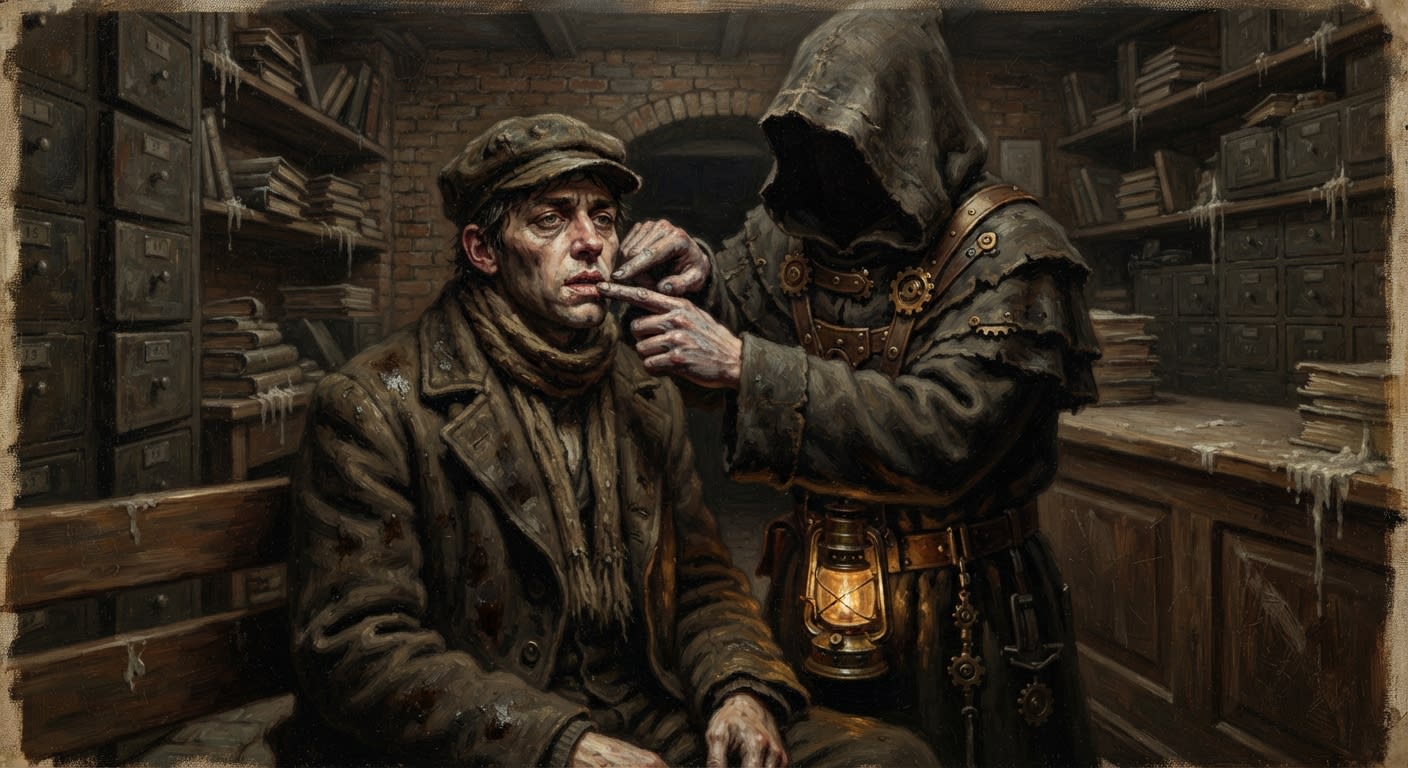
Ash-Tongue is the smallest punishment the Circle of Ashen Steps keeps in its trough, and the one it issues most often. A Lanternman takes consecrated ash paste on two fingers and holds the offender's jaw in the light of the sternum lantern. He works the ash into the lips until they are as pale as a chapel step. Within the hour the lips tighten. By morning they crack, and every word opens the cracks again. For three days, sometimes five, each sentence costs a pinhead of blood and a sermon's worth of pain.
Nothing is removed. The tongue remains. The voice remains. The offender can still sign a receipt, recite a confession, answer a Records hand and pay a Tithes mark. What goes is fluency. In the bone-lanes a night-cart driver's fluency is the most dangerous thing he owns.
The practice resembles three older instruments and must be kept apart from each of them. Execution ends testimony and produces a corpse, and in the Ossuary Rings a corpse produces forms. Torture theatre needs an audience, and audiences riot. Mutilation leaves a mark a widow can point at in front of a Warden-Captain. Ash-Tongue leaves a chapped mouth, and by the winter wax shortage half of Bastion-Constantinople has one.
#On Consecrated Ash and Corrected Speech
The paste comes from the trough in Ossuary Office Seven, the Counting Room, which stands beside the rack of bone hooks and beneath walls ridged with old wax. The Circle says the ash is swept from sanctioned cremation yards and blessed at the start of each month by a chaplain of the Bureau of Rites. When questioned, the chaplain remembered blessing "a trough." He did not remember what was in it.
The chemistry is humble. Dry ash on a dry mouth is only unpleasant. Once the offender talks, swallows or weeps, the ash mixes with spit and turns caustic. The Circle counts this as the offender's own contribution to the sentence. A driver who keeps silent suffers little. A driver who protests blisters. The punishment grows with the speech it is meant to correct. Canon lawyers have spent centuries trying to write a statute like that and never managed it.
The preserved witness is what makes Ash-Tongue useful to everyone above the Circle. The Bureau of Records needs its witnesses alive, because a dead witness leaves a hole in a column, and holes invite auditors. Rites needs them able to pray, since a confession unheard by a priest is still heard by the Creator, and Rites finds that arrangement satisfactory. The Lantern Brotherhood needs something plainer. Under the Triangle of Witness, the Echo writes the patrol's account while the Anchor holds the light and the Blade holds the man. Ash-Tongue makes sure the offender's own account arrives days behind the Echo's. By the time the driver can speak without bleeding, the report has been sealed, countersigned and filed. His version is late, and a late version in the Ledger is called a discrepancy.
#On Who Receives It
The recipients fall into categories the Circle recognises by habit rather than by statute.
Night-cart drivers come first and most often. They see everything that moves through the bone-lanes after curfew, and they drink at the depots. A driver who says the wrong number aloud at a depot bench will find a Lanternman waiting at his wheel before dawn.
Minor corpse-thieves come next. The serious ones get the hook behind the knee. The boys who pull a ring from a finger get the ash, a warning and a split-candle glyph chalked on their mother's threshold.
Clerks with loose mouths make up the third category. These are Fifth Ring allocation hands and tag copyists who complain in the wrong corridor about three femurs under one name. A clerk under Ash-Tongue still writes a perfect hand. He simply stops reading his memoranda aloud.
Candle-tally disputants make up the fourth: householders who insist their flame was lit when the Wicker's slate says it was dark. The dispute ends when arguing costs more than the fee.
Mourners are the most delicate category. A family that hides a body one extra night of unsanctioned farewell usually receives the Marrow Fine, the confiscation of approved wax rations from the whole household. Ash-Tongue is reserved for the one member of that family who tells the neighbours why. The Circle keeps the two punishments carefully apart. The Fine punishes a household, and Ash-Tongue punishes a mouth.
The best-known attested use is in a partially redacted field note from Ossuary Route 6. A patrol found a night-cart with three registered bodies and a fourth that the record will not describe. The driver insisted the fourth body had come aboard voluntarily. Wick-Sergeant Rulik, called "Sootmouth," ordered Ash-Tongue on the driver along with tag review on the bodies. The Circle's answer to an impossible statement was to make repeating it painful. Two Brothers vomited. The note does not say whether the driver kept insisting, and I have no intention of asking him.
#On the Counting Room Formula
In the Circle's daily order, the late-night hours belong to "corrections": the tallies are made true by warning, by fining or by taking someone. Ash-Tongue is the correction that needs no taking. It uses no cell, no cart, no body-tag and no transfer receipt. It uses two fingers and a trough the Circle already maintains for ritual washing.
Two Brotherhood roster fragments preserve the words spoken over the trough before the ash is lifted: Names are weight. The mouth is the scale. Let the scale be slow. The first line is the Circle's charter doctrine. The other two are later additions from the Counting Room, and nobody signed them.
The Circle's larger business explains why the scale must be slow. Its tolerated sin is marrow-wax skimming. Its locked sin is the Two-Book Dead, the second ledger in which certain bodies go where the first ledger says they did not. That traffic depends on time: time to soften a tag over lamp heat, time for a receipt to climb to a desk far above the lime, time for a widow to kiss the tag before anyone asks what lies behind it. A driver who talks at once brings an inquiry on the same night. A driver whose mouth has been corrected talks in three days, and three days is enough to reconcile almost anything.
I will not say that every Ash-Tongue guards a diverted corpse. Most guard nothing grander than a Wick-Sergeant's temper. Some of the others guard the cabinet.
ASH ISSUE SLIP — OSSUARY OFFICE SEVEN, A.S. ███ Recipient: copyist, Fifth Ring allocation desk Cause: ██████████████████ (spoken) Duration: five days Note: recipient submitted written complaint on day two. Complaint received, complaint reconciled. Recipient reassigned to ████████.
Earlier Brotherhood filings describe Ash-Tongue as "penitential anointing of the lips, voluntarily received as a sign of vigil humility."
Corrected. The humility is real and the anointing is real. "Voluntarily" appears to have referred to the Lanternman.
#On Denial and Aftertaste
No Bureau recognises Ash-Tongue as a punishment. Each has found its own way of recognising it as something else.
Records has no punitive category for it. When the chapped mouths show up in ration-clinic ledgers, Records files them as oral irritation, funerary exposure and sends the ledger back up the stairs. Rites treats ash on the lips as ordinary penitential grammar. It is one of the oldest signs the Church has, and Rites cannot condemn it without condemning its own processional. The Bureau of Tithes has no interest because no fee is collected. Five years ago a junior assessor proposed an ash surcharge, and he was promoted somewhere with no windows.
The Bureau of Purity watches. Purity has always admired a correction that leaves the confession intact. Purity officers have been seen at the Counting Room door taking notes. The practice belongs to the Circle, and the Circle guards it the way men guard a small inheritance. The Bureau of Shadows presumably keeps a register of every mouth that received ash, and would deny that mouths exist.
The Wardens despise it. That contempt matters, because the Brotherhood's authority is local and a Warden-Captain can revoke it. One Warden-Captain of the southern anchor is said to have called Ash-Tongue "a grave-rat's kiss" and then signed the quarterly toleration anyway. Contempt has never yet cost the Circle a signature.
The legal cover is thin. The Brotherhood's standing as tolerated auxiliary vigil personnel rests on a subordinate clause in the Curfew Ordinance of Quiet Hours of A.S. 94, drafted by Vicar-General Anselm Rihn. The clause does not mention ash. The Circle has read that silence for more than a century as permission, and no Bureau has read it any other way in writing.
Ash-Tongue survives because it stays below the threshold where grief turns into fire. It leaves no corpse to count, no scar to show and no absence to mourn, and it generates no fee to audit. The offender wakes on the fourth day and speaks normally. By then nobody who might have listened is still waiting.