
#On the Annex, and Where the Bureau Keeps Its Clocks
"In the matter of temporal governance, the Bureau does not speculate. The Bureau measures." — Internal charter, Article One, Bureau of the Hourglass
The Bureau of the Hourglass keeps its headquarters in Lyon. Set aside the letterhead and the headquarters is the Lyon Annex: a working hall of clocks, a row of comparison benches, an archive of graph sheets that has filled every cabinet issued to it, and below the great clock hall a restricted calibration floor the Bureau designates Sublevel Two. The Annex belongs to the Hourglass. It lives beside the Lyon Academy of Horological Sciences, whose own account places it beneath the Academy's west wing. The Academy supplies the Annex with trained hands. It also supplies, by way of the Academy's resident Doctrine observer, a pair of eyes the Annex never asked for.
The headquarters is modest. Readers who expect a palace of the hours will be disappointed. Readers who have seen the Bureau's budget will not.
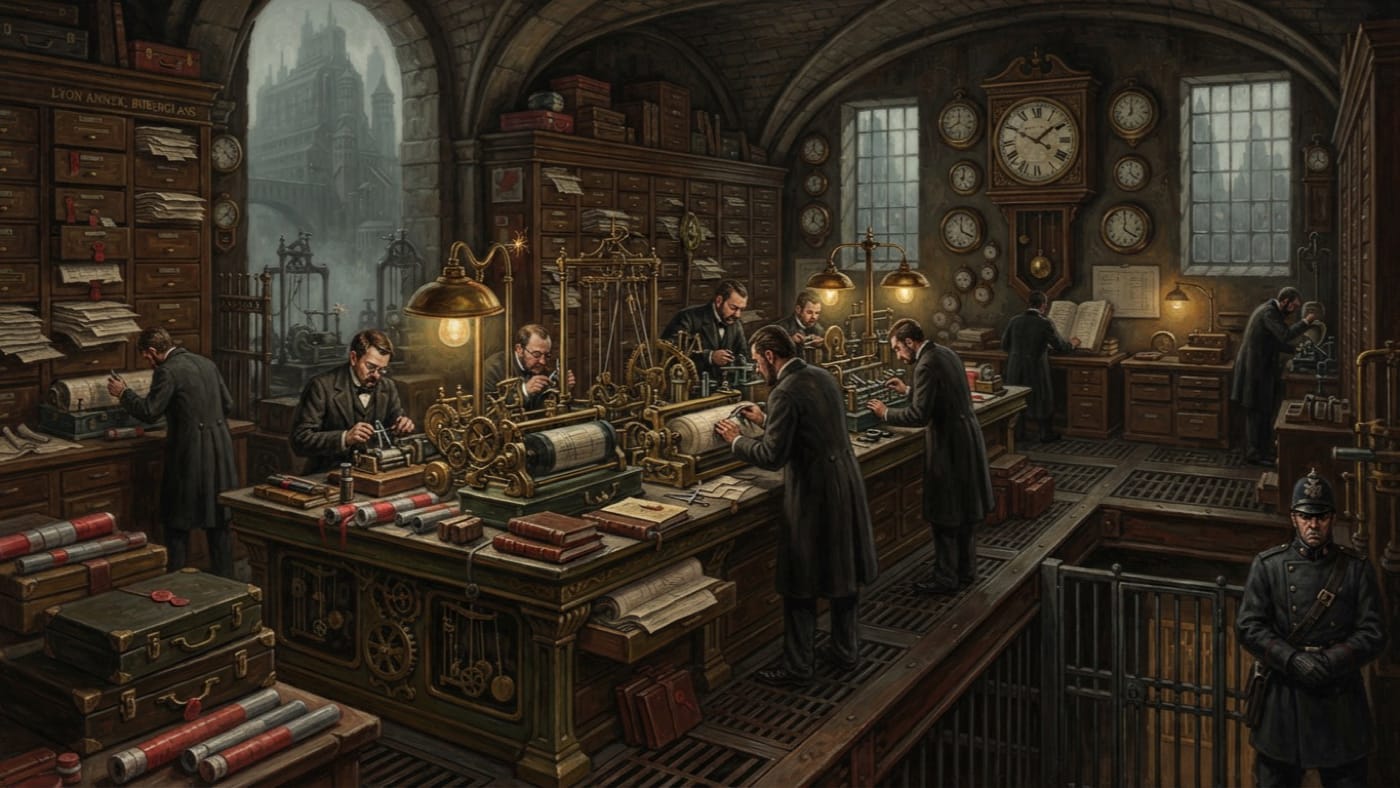
Codex readers know the hall from the plate of A.S. 195: analysts in frock coats bent over brass, fog against tall windows, the master pendulum at its post, and on the far wall a great clock that has disagreed with that pendulum since A.S. 187. The Bureau has not corrected the clock or taken it down. It records the clock's disagreement every working day, in the same ink it uses for the frontier.
The institution can be dated. Its walls cannot. The Bureau of War constituted the Hourglass by Standing Order in A.S. 134 (1844 CE), after the Drava complaints, and the founding survey ran from A.S. 134 to 136. No record placed before me says when the Annex was built, acquired, named or first swept out. I will not supply a year the Ledger has not.
#On the Comparison Benches, and What Arrives by Every Post
Readings arrive from all seven bastion sectors and from fourteen lesser posts. They come as telegraph abstracts, bell-resonance tables, locomotive transit sheets and sealed instrument cases. The master clock in the hall is kept in continuous comparison with the frontier relays. Every relay that drifts is entered against it, and every entry becomes a line on a graph that some junior adept will rule, sign and file before supper.
The returned instruments are handled more carefully. A Drag-Gauge sent home from Bastion-Shipka still has the marsh on it. That residue is preserved and recorded before anyone wipes the brass, because a clean instrument tells a shorter story. The gauge is then connected at a witnessed bench. Its filament is released in silence. The silence is procedure, and a clerk who coughs starts the procedure over. The correction is entered in the bench book.
If the filament descends too early, the room is sealed and a senior adept is summoned. If two witnesses remember two different descents, the Annex keeps the slower record. I know of no other rule in the Synod's apparatus that prefers delay. It was written by people who measure delay for a living, and I have never once seen it waived.
The gauge says how long. It does not say why. Adepts are trained to stop at how long, and the ones who go further are posted somewhere wet.
The Bureau of War tolerates all this because of what depends on it. A battery commander's range tables are set against bell-counts. The bell-counts are set against relay clocks, and the relay clocks against Lyon. The timetable of the train carrying his shells is set the same way, and so is the alarm peal the Bureau of Bells rings when the fog moves. Once a forward sounder drifted seventeen seconds in six hours, and the Synod founded a Bureau over it.
So the work is divided. The clocks keep the count, the gauges keep the drag, and the people keep the ledger. Of the three, the Bureau of Doctrine believes it can discipline only the people, and it has spent sixty-seven years trying.
#On Sublevel Two, and the Standard Beneath the Hall
Below the great clock hall the Annex keeps its arbiter. Access goes by rank, and nobody descends without an escort. When the Academy brings students to the comparison chamber, it brings them in controlled parties with their sight restricted on the way down. I gather they are permitted to know they have been somewhere.
The standard kept there is the Hourglass Monolith. Its work is comparing instruments and discriminating between anomalies, which means telling a fault in the brass from a fault in the hour. The Synod borrowed the Enemy's word for its department, and then, with the thrift of a clerk who will not requisition a second rubber stamp, borrowed it again for the standard. The shared name proves nothing. The Lyon standard sits beneath a hall in Lyon, and instruments are compared against it. The war-engine in Syrion's train has been sighted twice and never measured. Anyone who wishes to argue a kinship between them may take the evidence to the Bureau of Doctrine. Doctrine will receive it with great interest and a brazier.
The master clock upstairs and the standard below do different jobs. The hall compares, constantly and in the open, and its graphs fill the archive. Sublevel Two settles the question when the hall can no longer trust itself. When the pendulum and an instrument disagree, the hall can record that they disagree. Only the standard can be asked which one to believe. The standard is operational. The Bureau of Doctrine's protest about it is on file, as Doctrine's protests generally are.
Corvin Rault is credited with proposing a central comparison standard and with design work on it. The receiving records disagree about when it arrived. The delivery ledger says A.S. 139 (1849 CE). The Bureau's own account says A.S. 142 (1852 CE). The wax on the crate bears a seal that was discontinued in A.S. 136, which shows only that someone had an old seal and used it.
The Hourglass Monolith was fabricated entire in the workshops of the Lyon Academy of Horological Sciences.
The Academy designed the standard's external housing in A.S. 142. The core is older than the housing. Its maker, supplier and origin are not established by any record available to this survey. The delivery ledger (A.S. 139), the Bureau account (A.S. 142) and the crate wax (a seal discontinued A.S. 136) remain in disagreement and are entered as such.
#On the Archive, and the Hours It Keeps for Itself
The archive stores the hall's output: graph sheets in long drawers, bench books bound in calf and numbered by quarter, field abstracts tied with the red tape the War clerks favour and the grey thread the Bells clerks insist on. Correspondence comes from every sector and every lesser post. It also comes from the Bureau of War, which wants corrected tables, from the Bureau of Bells, which wants the raw data and suspects it is getting less than all of it, and from Doctrine, which wants an interpretation and is sent a graph.
Inconvenient findings get the same handling as convenient ones, which is the most damning thing I can say about the place. They are entered, graphed, sealed where required and forwarded to Strasbourg. In Strasbourg they join a queue, and the queue does not move.
I visited the archive in A.S. 197. A walk among the cabinets that should have taken an afternoon took longer than the light allowed. I do not offer that as a finding. I offer it as the same complaint the archivists make. They go in at what they would swear is noon and come out blinking at a sunset. The Bureau does not say why this happens. It times the delay, with the instruments it points at the front, and enters the result. The compliance reports that come of this self-examination are classified, and so I cannot tell the reader whether the Annex has ever found itself late. The Annex knows.
#On the Present Condition, and the Blank Line
In A.S. 199 (1909 CE), Senior Adept Meryth Vesk filed the first formal abstract on what the Codex now records as the A.S. 199 Skip: a daily ninety-second absence in measured duration at Station Two, Bastion-Shipka. The abstract came to Lyon the way every abstract does, by post and under seal, and it went to the benches. The Annex compared it against the catalogue and against the standard. The comparison line for Lyon is blank.
The blank does not mean the anomaly is unreal, and it does not mean Lyon has missed something. It is a comparison that returned nothing, and it has been entered, graphed and forwarded like everything else. Vesk's abstract is in the Strasbourg queue at position four. Nobody has assigned the absence a class. Nobody has proposed a cause. Lyon, which corrects the clocks of the whole Sagittal Line, has nothing to correct this one against.
That is the Annex in A.S. 201 (1911 CE). Every bastion clock on the Line is checked against it. On its own premises the far wall has disagreed for fourteen years, the archive keeps afternoons nobody can account for, three records give the standard's arrival three different dates, and the Bureau's compliance reports on its own delays are sealed. The guns are laid by it regardless, because there is nothing else to lay them by.