
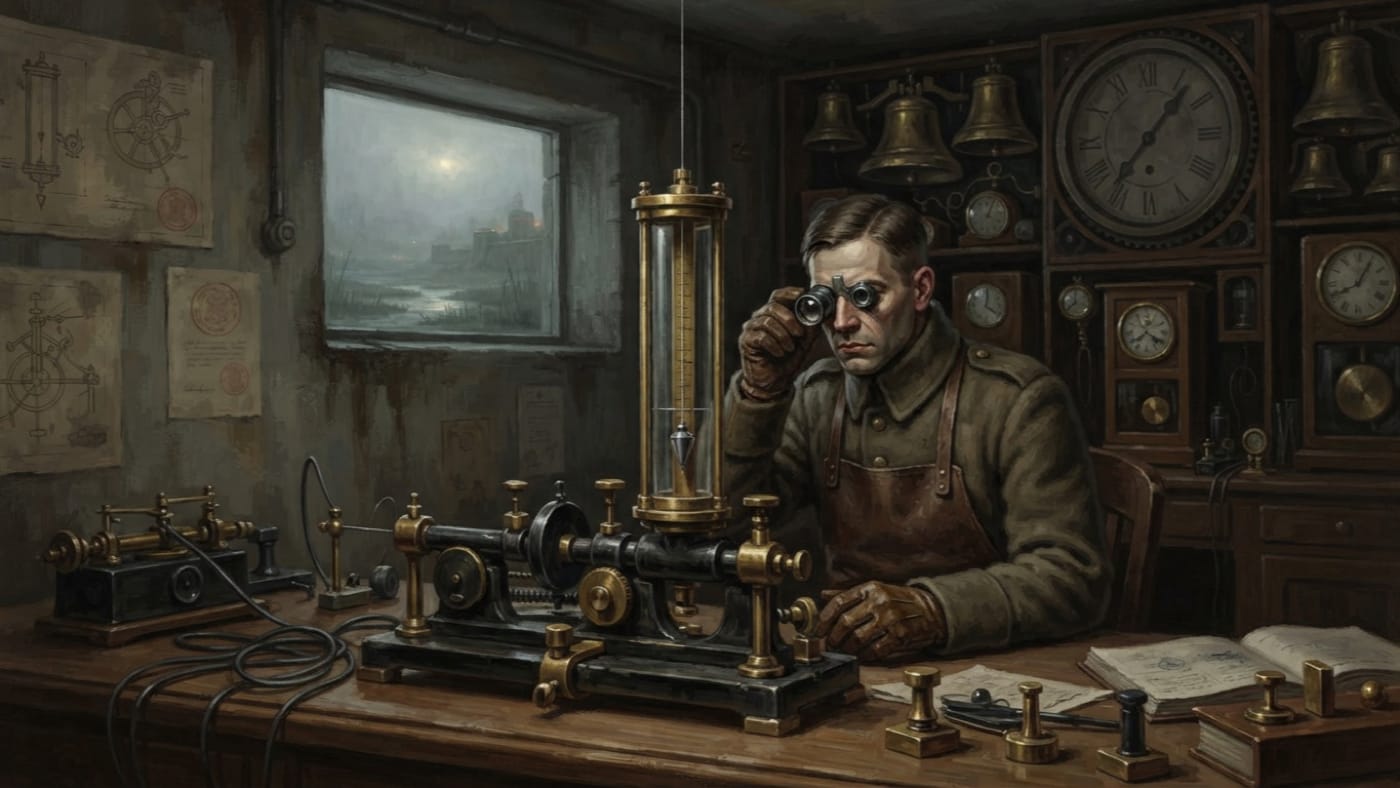
#On the Instrument
A drag-gauge measures what the adepts of the Bureau of the Hourglass call the thickness of passing time. The word is theirs. Asked whether time is literally thick, as gravy is thick or a provincial magistrate is thick, the adepts produce answers so technical that the Ledger records them as one long shrug, initialled three times.
The apparatus is humble enough to embarrass its own reputation. A filament is suspended. A weight hangs from it. The weight descends against a calibrated resistance, and the adept enters the mark where the descent has come to rest. Filament, weight, descent, mark. A war is administered on four nouns.
Where the territory is ordinary, the descent keeps pace with its calibrated reference, as a novice keeps pace with the procession. Under ordinary Syrionic interference it lags. Why a disorder of time should change the resistance felt by a falling weight, no adept has explained to the satisfaction of this office. The Bureau has sensibly stopped trying. A gauge that works does not need a theology of working.
The clock is a different creature. A chronometer counts elapsed time and announces its total with the confidence of a tax-farmer, and it can be stopped, hurried or sent home wrong with no idea that anything has happened to it. A drag-gauge counts nothing. It compares. It asks whether the hour now passing feels, against its filament, like the hour in Lyon. The resonance-bells hung beside it at the front test for other disturbances of time and causality, and they belong to a separate catechism.
The Codex files the instrument among relics because Lyon files its standard there. No saint is in it. Several adepts have tried.
#On the Standard
Every serious field drag-gauge receives its final correction against the Hourglass Monolith, the restricted standard beneath the clock hall of the Lyon Annex. The Monolith's descent is the descent. Every other descent is judged as a deviation from it, and adepts call its reading zero with a reverence they withhold from every altar in the Church.
In public, the Bureau calibrates against master clocks, bell tables, candle registers and water measures. This is true in the way a bishop's sermon on thrift is true. The clocks exist and the bell tables exist, but the gauge that goes back to Shipka has been corrected against black stone.
The Lyon record gives the procedure. The returned instrument is cleaned without disturbing its residue, because the dirt is evidence. Any visible drift stain is entered. The gauge is connected to a brass socket on the comparison bench, under witness. The filament is released, and nobody speaks while it falls. A resistance adjustment follows, written as a number or a notch and never as prose, because prose invites thought and thought invites Doctrine.
If a filament starts to fall before anyone has let it go, the instrument is reporting on the room. The Bureau's answer is a locked door and a superior, which is the correct answer to most things. The seventh line is the wisest instruction ever issued by an office this Ledger otherwise regards as a nest of clock-sniffing schismatics in training.
Part of the Monolith's authority comes from its tables. The rest comes from the fact that nobody can reproduce it. Even its arrival in Lyon is entered three different ways in the Bureau's own receiving books. The gauge inherits that authority whole: a contested pedigree with excellent tables.
#On Field Readings
Station Two sits two kilometres east of the bastion on the reed road. It is a forward observation and temporal monitoring relay facing the marsh corridor that runs toward the Vales of Stagnance and the fog of Syrion. Its Instrument Vault holds drag-gauges, resonance-bells and seismographs, and it smells of oil, old parchment and men who have counted their own heartbeats too often.
At Station Two no reading is taken on its own. The adept sets the gauge's mark beside the station clocks, the bell timings, the telegraph prints and the testimony of whoever stood the causeway watch. A slow descent with the clocks in agreement is one matter. A slow descent while the horn-codes arrive out of order is another, and it travels faster up the chain. The gauge detects a difference. It does not name an enemy, explain a cause or tell a battery to fire.
Commanders find that limit the hardest to tolerate. Syrion's territory does not keep to tidy slowing. His Fog Kingdoms hold fields where a week passes in an hour, and corridors where columns march in and come out years later, aged decades or not at all. A lagging filament is the commonest report from the Sloth front. It is not the whole catalogue. An officer who wants a single figure for how bad things are will get one from some sergeant with a pencil and a hangover, whatever the gauge said.
#On the Eleven Minutes
During the A.S. 194 approach of the Slumber-Hulk, Adept Meryth Vesk of Lyon, senior Hourglass observer at Station Two, watched her drag-gauge flatline for eleven minutes.
The engagement belongs to another folio. The reading belongs here.
A lagging filament says that time is passing thickly. A filament that registers no descent at all says something worse. Vesk's interpretation, adopted into the Hourglass record, is that time at the Hulk's centre was not slow. It was absent. A gauge corrected against Lyon found no duration there to resist, and for eleven minutes the instrument had no office.
Note exactly what the record claims. It claims that this flatline, read by this observer during this approach, marks an absence and not an extreme of slowing. It does not claim that every flatline is an excision. Filaments snap and weights foul. Adepts at Shipka fall asleep with damnable regularity, the marsh being what it is. A dead reading proves only that something stopped. The inquiry into what stopped goes in the proper order: the instrument, the man, the room, and only then time itself.
War Directorate abstracts formerly stated that Syrion's Hourglass Monolith "reduces local time to one-seventh normal speed."
Withdrawn. The ratio belongs to the stillness envelope surrounding the Slumber-Hulk, as measured at Station Two in A.S. 194. Syrion's war-engine shares a name with the Lyon standard and nothing else the Bureau will admit to. No drag-gauge has ever measured it. A figure taken from one horror was pinned to another because both were large and the abstract wanted a number.
The embarrassment is plain to anyone who can read a calibration table. The Hulk's signature lies beyond anything the Lyon standard produces. A gauge trained on Lyon was sent to measure something Lyon cannot imitate, and it reported, with perfect obedience, that it had nothing to report. The Bureau has not forgiven the Hulk. It has also not forgiven Vesk for writing the result down without first asking permission to be humiliated.
#On Missing Intervals
Two other absences sit in the files beside the eleven minutes. Clerks keep trying to bind all three into one folio, and the folio keeps being refused.
At the Queue Road, Minute Drift stutters through the Barricade Maze. Bell-marks ring twice. Ink dries too fast. Waiters swear they have stood a week where the sun allows a day. Near it, a drag-gauge filament may shudder, slip from its own mark, or finish its descent before it has properly begun. The Hourglass classifies the Drift as Class II-Extractive and links it to the Apparatus beneath Gate Nine. Who operates that Apparatus, who pays for it and what it does with what it takes are matters for restricted analysis. This Warden does not mean to lose his seat for the pleasure of telling you.
Vesk's Skip is a third case and a stranger one. At Station Two, always at the same hour, local duration goes missing for exactly ninety seconds. Her A.S. 199 abstract records no match with catalogued Syrionic deceleration, stillness field, drag corridor or bell-lag event. Her comparison note to Lyon states that the Monolith offers no analogue. In sympathy with the Skip the standard does not slow, quicken, reverse or thicken. It stays blank.
Nothing in the record ties the Skip to Syrion. Nothing ties it to Gate Nine. A clerk who draws lines between the three absences is drawing them in his own ink, and the Ledger will charge him for it.
#On Present Service
As of A.S. 201 the drag-gauge remains in service at Station Two and wherever else the Bureau can spare a filament and a sober adept. Shipka's patrol rotations shorten when the comparison reports thicken. Fog that looks no different to the naked eye can bring the relay to full alert if the descent comes up short.
The instrument does one thing honestly. Corrected against Lyon and checked against clocks, bells and frightened men, it can tell a lagging hour from a true one. It cannot tell the Bureau what took eleven minutes from a field on the reed road, or where ninety seconds go every day at the same hour. Those results are written down as they fell, and nobody fills the gap with a ratio borrowed from a different horror. That one discipline is worth more than every committee the Synod has convened on the subject of time.